Wójcik-Gront Elżbieta, Gozdowski Dariusz, Derejko Adriana, Pudełko Rafał
Department of Biometry, Institute of Agriculture, Warsaw University of Life Sciences, Nowoursynowska 159, 02-776 Warsaw, Poland.
Departmentof Bioeconomy and Systems Analysis, Institute of Soil Science and Plant Cultivation-State Research Institute (IUNG-PIB), Czartoryskich 8, 24-100 Pulawy, Poland.
Plants (Basel). 2022 Oct 30;11(21):2922. doi: 10.3390/plants11212922.
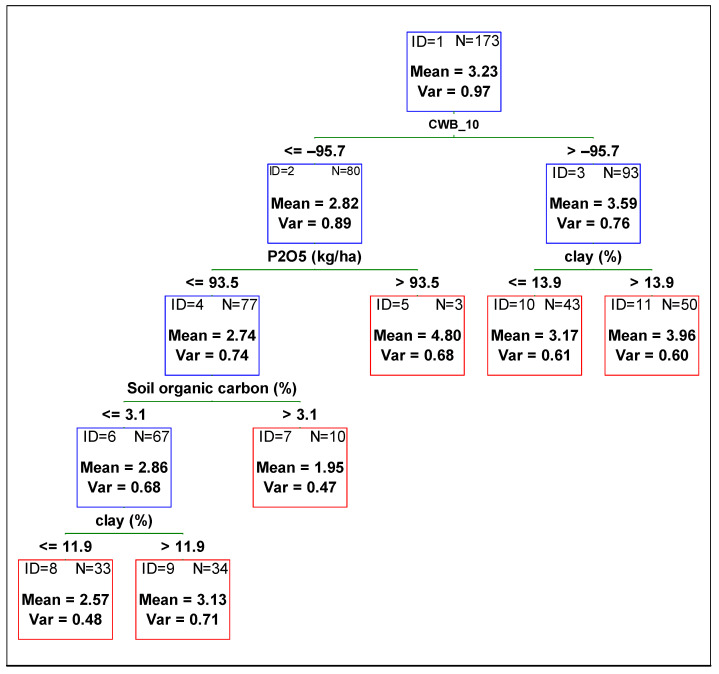
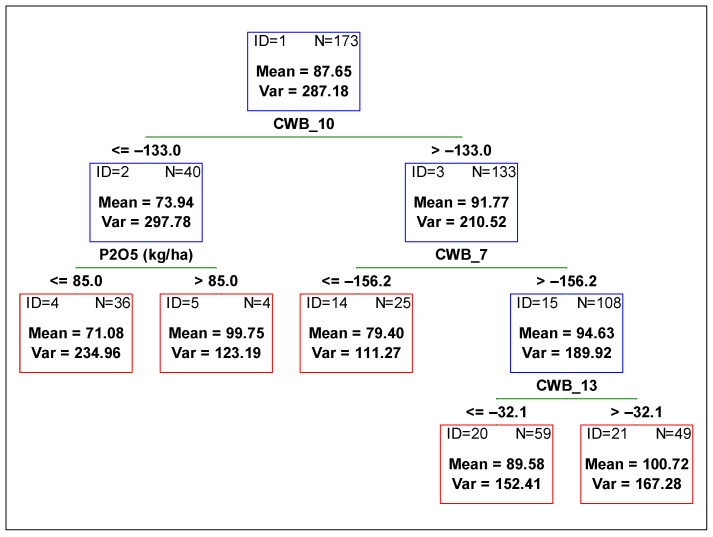
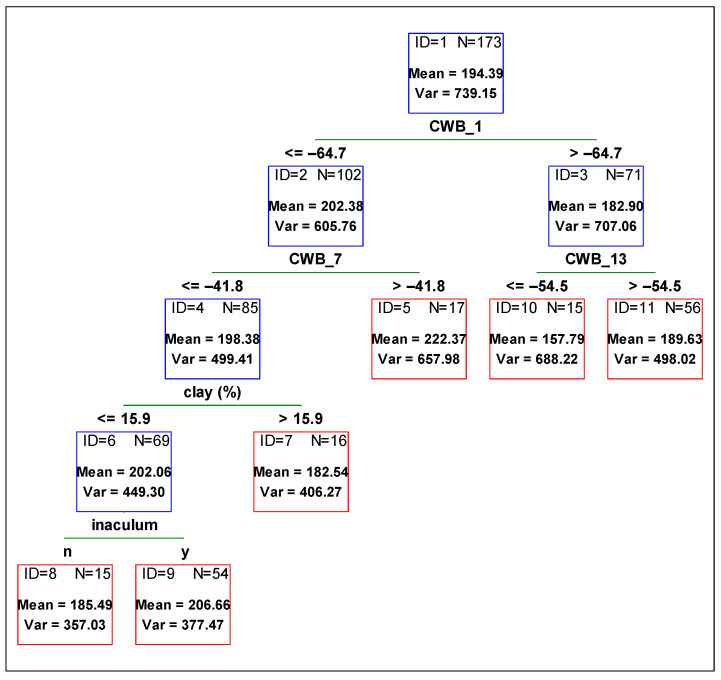
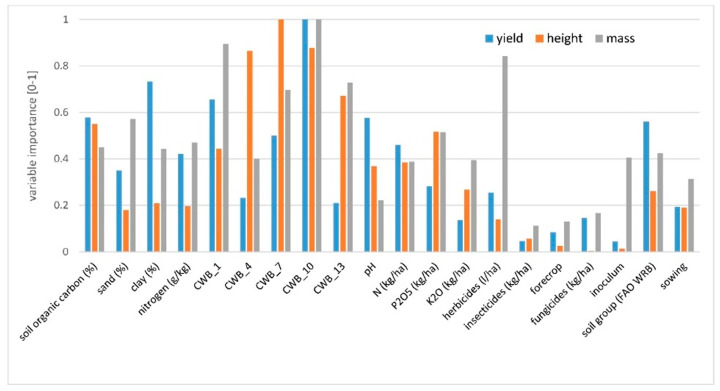
Soybean ( (L.) Merr.) is a species of relatively little economic importance in Central and Eastern Europe, including Poland. Due to its popularity for the production of soybean oil, livestock feed, and human food, soybeans are a widely cultivated agricultural crop in the world. The aim of the presented research is to determine the most important agronomic and environmental variables in soybean production in Central and Eastern Europe. This work used a dataset from the Polish Post-Registration Variety Testing System in multi-environmental trials from the years 2012-2021. Variables classified for crop management included doses of mineral fertilizers (N, P, and K) and herbicides, sowing, and the type of previous crops. The environment was also included in the analysis through soil and weather characteristics using climatic water balance (CWB). The analysis was performed using multiple linear regression models and regression trees. It found that the variability of the soybean yield depended mainly on water available to plants and physical soil properties. This means that environmental variables have a stronger effect in comparison to crop management variables. The effect of the nutrients applied in the fields was relatively weak and only important in the case of phosphorus. Other variables which characterize crop management (including sowing date, previous crop, and plant protection using pesticides) have a weak effect on grain yield and yield-related traits variability. As there are not many studies on soybean cultivation in Poland, this work might be used as an introduction to research on soybean management in a hemiboreal climate.
大豆((L.) Merr.)在中欧和东欧,包括波兰,是一种经济重要性相对较低的作物。由于大豆在生产大豆油、牲畜饲料和人类食品方面很受欢迎,它是世界上广泛种植的农作物。本研究的目的是确定中欧和东欧大豆生产中最重要的农艺和环境变量。这项工作使用了来自波兰注册后品种测试系统2012 - 2021年多环境试验的数据集。归类于作物管理的变量包括矿物肥料(氮、磷和钾)和除草剂的用量、播种以及前茬作物的类型。通过使用气候水分平衡(CWB)的土壤和天气特征,环境也被纳入分析。分析使用了多元线性回归模型和回归树。研究发现,大豆产量的变异性主要取决于植物可利用的水分和土壤物理性质。这意味着与作物管理变量相比,环境变量的影响更强。田间施用养分的影响相对较弱,仅在磷的情况下较为重要。其他表征作物管理的变量(包括播种日期、前茬作物和使用农药进行植物保护)对籽粒产量和产量相关性状变异性的影响较弱。由于波兰关于大豆种植的研究不多,这项工作可作为半寒温带气候下大豆管理研究的引言。