Center for Infectious Disease Modeling and Analysis (CIDMA), Yale School of Public Health, New Haven, Connecticut, USA.
Department of Social and Behavioral Sciences, Yale School of Public Health, New Haven, Connecticut, USA.
J Glob Health. 2022 Nov 12;12:04091. doi: 10.7189/jogh.12.04091.
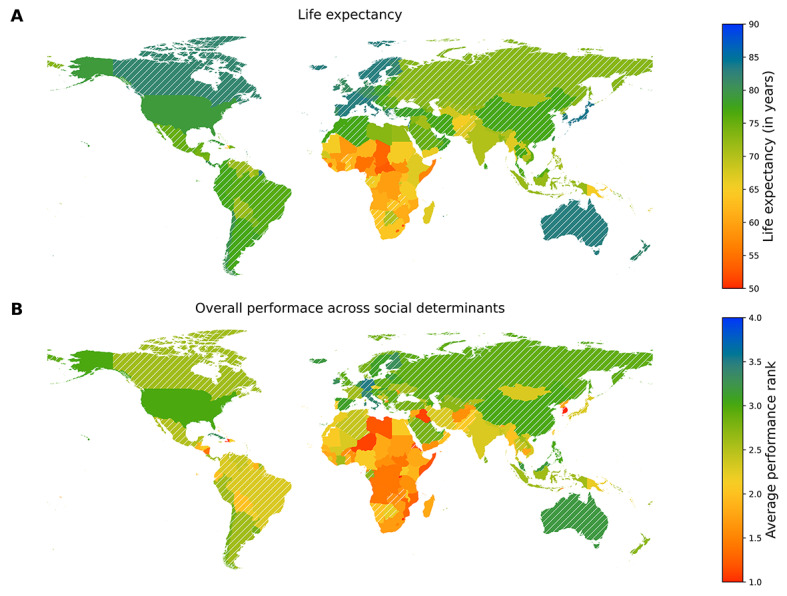
To better understand factors influencing life expectancy, this paper examines how the availability of publicly funded health care in a country and multiple social determinants of health impact longevity of life.
In this descriptive statistical analysis, data regarding publicly funded health care, life expectancy, and social determinants of health were obtained for 196 countries and 4 territories. Social determinants included 10 indicators detailing country-level information to represent 5 key categories: economic stability, education, health & health care, neighbourhood & built environment, and social & community context. Analyses consisted of: 1) comparison of mean life expectancy among countries and territories with- and without- publicly funded health care; 2) correlations in life expectancy across social determinants by health care access and level of burden; and 3) correlations in life expectancy within social determinants for health care access by level of burden.
Overall, life expectancy in countries and territories with- publicly funded health care (Mean (m) = 76.7 years) was significantly longer compared to countries and territories without- publicly funded health care (m = 66.8 years, P < 0.0001). For each social determinant, we observed longer life expectancy continued to be associated with publicly funded health care access across stratum (P < 0.0001), but difference in years of life expectancy existed both by burden of social determinant, as well as access to health care within quartiles of burden (Publicly funded care (yes): 68.12-80.88 years, (no): 62.39-77.33 years, all P < 0.05). Both social determinants as well as the availability of publicly funded health care were individually and simultaneously associated with mean longevity of life between countries and territories worldwide.
These findings demonstrate how, if made widely available, publicly funded health care could extend longevity of life. If combined with programs to reduce the burden of social determinants, a substantial impact can be made to promote more equitable distribution of life expectancies across the world. Ultimately, both access to publicly funded care and reducing inequalities in social determinants are needed in order to promote longer and healthier aging in populations worldwide.
为了更好地了解影响预期寿命的因素,本文研究了一个国家提供公共资助的医疗保健的可用性以及多个健康社会决定因素如何影响寿命。
在这项描述性统计分析中,为 196 个国家和 4 个地区获取了有关公共资助的医疗保健、预期寿命和健康社会决定因素的数据。社会决定因素包括 10 个指标,详细说明了代表 5 个关键类别的国家级信息:经济稳定性、教育、健康和医疗保健、社区和建筑环境以及社会和社区环境。分析包括:1)比较有和没有公共资助的医疗保健的国家和地区的平均预期寿命;2)根据医疗保健的可及性和负担水平,对预期寿命在社会决定因素之间的相关性进行分析;3)根据负担水平,对医疗保健可及性的社会决定因素内的预期寿命进行相关性分析。
总体而言,有公共资助的医疗保健的国家和地区的预期寿命(平均(m)=76.7 岁)明显长于没有公共资助的医疗保健的国家和地区(m=66.8 岁,P<0.0001)。对于每个社会决定因素,我们观察到随着社会决定因素的分层,与公共资助的医疗保健可及性相关的预期寿命更长(P<0.0001),但社会决定因素的负担以及在负担的四分位数内医疗保健的可及性都会导致预期寿命的差异(公共资助的医疗保健(是):68.12-80.88 岁,(否):62.39-77.33 岁,均 P<0.05)。社会决定因素以及公共资助的医疗保健的可用性都单独且同时与全球国家和地区之间的平均寿命有关。
这些发现表明,如果广泛提供公共资助的医疗保健,可以延长寿命。如果与减少社会决定因素负担的计划相结合,可以对促进全球更公平地分配预期寿命产生重大影响。最终,需要获得公共资助的医疗保健和减少社会决定因素的不平等,以促进全球人口的更长和更健康的老龄化。