Department of Medical and Clinical Psychology, Tilburg University, Tilburg, the Netherlands.
Department of Medical and Clinical Psychology, Tilburg University, Tilburg, the Netherlands; Department of Methodology and Statistics, Tilburg University, Tilburg, the Netherlands.
J Affect Disord. 2023 Feb 1;322:15-23. doi: 10.1016/j.jad.2022.11.008. Epub 2022 Nov 11.
Fear is an evolutionary adaptive emotion that serves to protect the organism from harm. Once a threat diminishes, fear should also dissipate as otherwise fear may become chronic and pathological. While actual threat of the COVID-19 pandemic (i.e., number of infections, hospitalizations, and deaths) has substantially varied over the course of the pandemic, it remains unclear whether (subjective) fear has followed a similar pattern.
To examine the development of fear of COVID-19 during the pandemic and investigate potential predictors of chronic fear, we conducted a large online longitudinal study (N = 2000) using the Prolific platform between April 2020 and June 2021. Participants were voluntary response samples and consisted of residents of 34 different countries. The Fear of the Coronavirus Questionnaire (FCQ) and several other demographic and psychological measures were completed monthly.
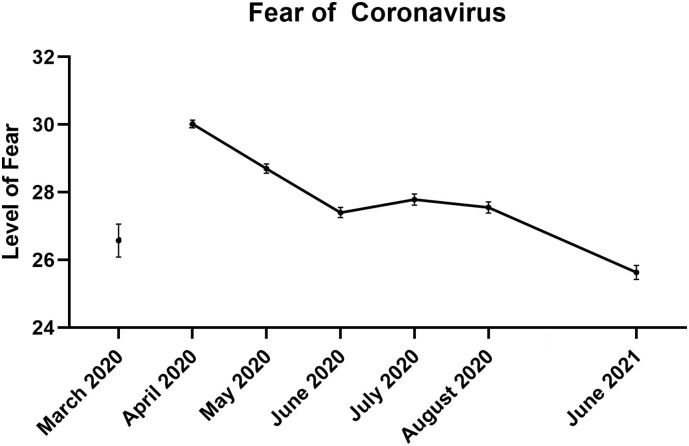
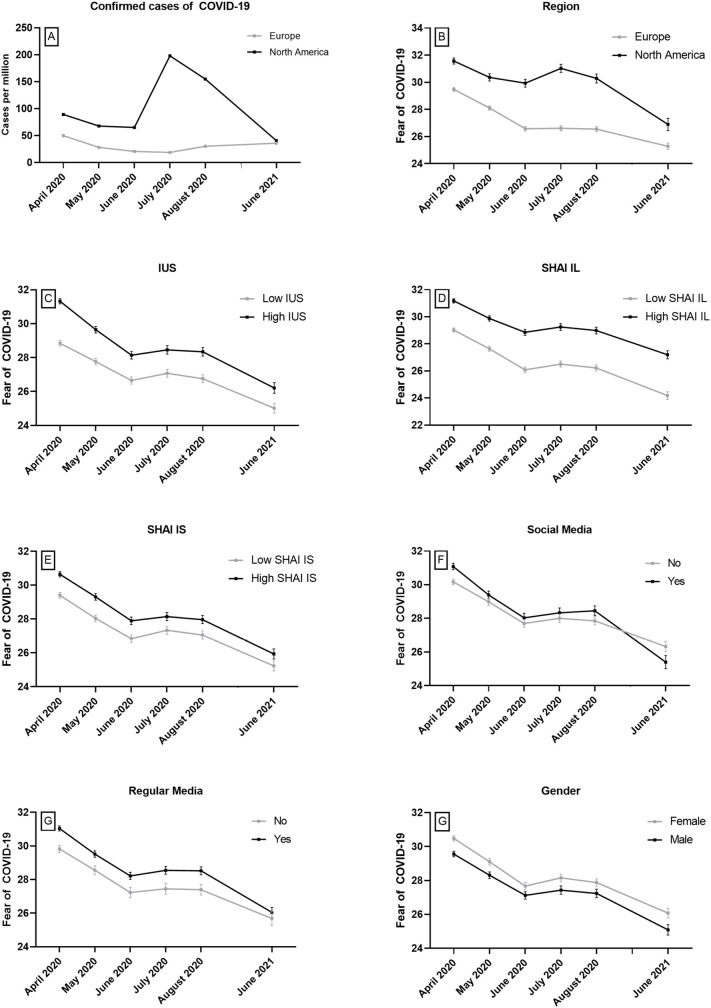
Overall, we find that fear steadily decreased since April 2020. Additional analyses showed that elevated fear was predicted by region (i.e., North America > Europe), anxious traits, gender, risks for loved ones, general health, and media use.
The interpretation of the results of this study is limited by the non-representativeness of the sample and the lack of data points between August 2020 and June 2021.
This study helps to characterize the trajectory of fear levels throughout the COVID-19 pandemic and establish several relevant predictors of increased fear.
恐惧是一种进化适应的情绪,有助于保护生物体免受伤害。一旦威胁减弱,恐惧也应该消散,否则恐惧可能会变得慢性和病态。虽然 COVID-19 大流行期间(即感染、住院和死亡人数)的实际威胁在大流行过程中发生了很大变化,但尚不清楚(主观)恐惧是否遵循类似的模式。
为了研究大流行期间对 COVID-19 的恐惧发展,并调查慢性恐惧的潜在预测因素,我们使用 Prolific 平台在 2020 年 4 月至 2021 年 6 月期间进行了一项大型在线纵向研究(N=2000)。参与者是自愿响应样本,由来自 34 个不同国家的居民组成。使用冠状病毒恐惧问卷(FCQ)和其他一些人口统计学和心理学措施每月完成一次。
总体而言,我们发现自 2020 年 4 月以来,恐惧稳步下降。进一步的分析表明,较高的恐惧程度与地区(即北美>欧洲)、焦虑特质、性别、亲人风险、一般健康状况和媒体使用有关。
由于样本的非代表性以及 2020 年 8 月至 2021 年 6 月之间缺乏数据点,限制了对本研究结果的解释。
这项研究有助于描述 COVID-19 大流行期间恐惧水平的轨迹,并确定几个增加恐惧的相关预测因素。