
P2X7 受体和嘌呤能信号:在神经退行性疾病中协调线粒体功能障碍。
P2X7 Receptor and Purinergic Signaling: Orchestrating Mitochondrial Dysfunction in Neurodegenerative Diseases.
机构信息
Belgorod State University, Belgorod 308015, Russia
Belgorod State University, Belgorod 308015, Russia.
出版信息
eNeuro. 2022 Nov 14;9(6). doi: 10.1523/ENEURO.0092-22.2022. Print 2022 Nov-Dec.
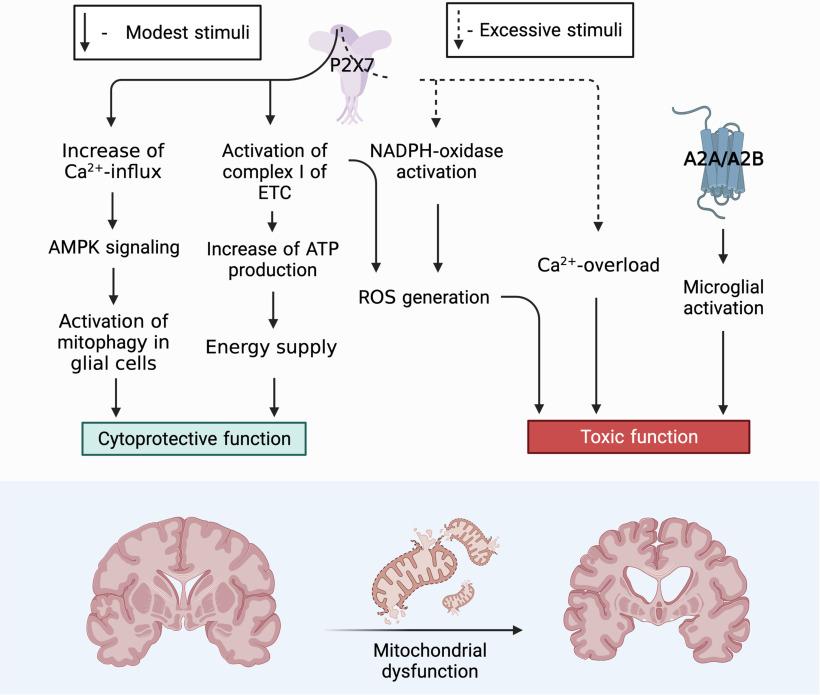
Mitochondrial dysfunction is one of the basic hallmarks of cellular pathology in neurodegenerative diseases. Since the metabolic activity of neurons is highly dependent on energy supply, nerve cells are especially vulnerable to impaired mitochondrial function. Besides providing oxidative phosphorylation, mitochondria are also involved in controlling levels of second messengers such as Ca ions and reactive oxygen species (ROS). Interestingly, the critical role of mitochondria as producers of ROS is closely related to P2XR purinergic receptors, the activity of which is modulated by free radicals. Here, we review the relationships between the purinergic signaling system and affected mitochondrial function. Purinergic signaling regulates numerous vital biological processes in the CNS. The two main purines, ATP and adenosine, act as excitatory and inhibitory neurotransmitters, respectively. Current evidence suggests that purinergic signaling best explains how neuronal activity is related to neuronal electrical activity and energy homeostasis, especially in the development of Alzheimer's and Parkinson's diseases. In this review, we focus on the mechanisms underlying the involvement of the P2RX7 purinoreceptor in triggering mitochondrial dysfunction during the development of neurodegenerative disorders. We also summarize various avenues by which the purine signaling pathway may trigger metabolic dysfunction contributing to neuronal death and the inflammatory activation of glial cells. Finally, we discuss the potential role of the purinergic system in the search for new therapeutic approaches to treat neurodegenerative diseases.
线粒体功能障碍是神经退行性疾病中细胞病理学的基本特征之一。由于神经元的代谢活动高度依赖于能量供应,因此神经细胞特别容易受到线粒体功能障碍的影响。除了提供氧化磷酸化外,线粒体还参与控制第二信使(如 Ca 离子和活性氧(ROS))的水平。有趣的是,线粒体作为 ROS 产生者的关键作用与 P2XR 嘌呤能受体密切相关,其活性受自由基调节。在这里,我们回顾了嘌呤能信号系统与受影响的线粒体功能之间的关系。嘌呤能信号系统调节中枢神经系统中的许多重要的生物学过程。两种主要的嘌呤核苷酸,ATP 和腺苷,分别作为兴奋性和抑制性神经递质发挥作用。目前的证据表明,嘌呤能信号系统最好地解释了神经元活动如何与神经元电活动和能量稳态相关,特别是在阿尔茨海默病和帕金森病的发展中。在这篇综述中,我们重点讨论了 P2RX7 嘌呤能受体在触发神经退行性疾病发展过程中线粒体功能障碍的机制。我们还总结了嘌呤信号通路可能引发代谢功能障碍的各种途径,这些途径导致神经元死亡和神经胶质细胞的炎症激活。最后,我们讨论了嘌呤能系统在寻找治疗神经退行性疾病的新治疗方法中的潜在作用。



 Zotero 插件