Materials Science Division, Lawrence Berkeley National Laboratory, Berkeley, California94720, United States.
Department of Materials Science and Engineering, University of California, Berkeley, California94720, United States.
ACS Nano. 2022 Dec 27;16(12):19873-19891. doi: 10.1021/acsnano.2c08411. Epub 2022 Nov 15.
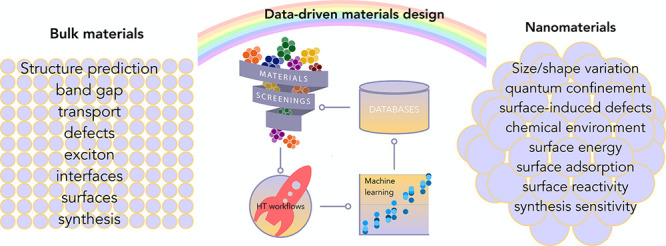
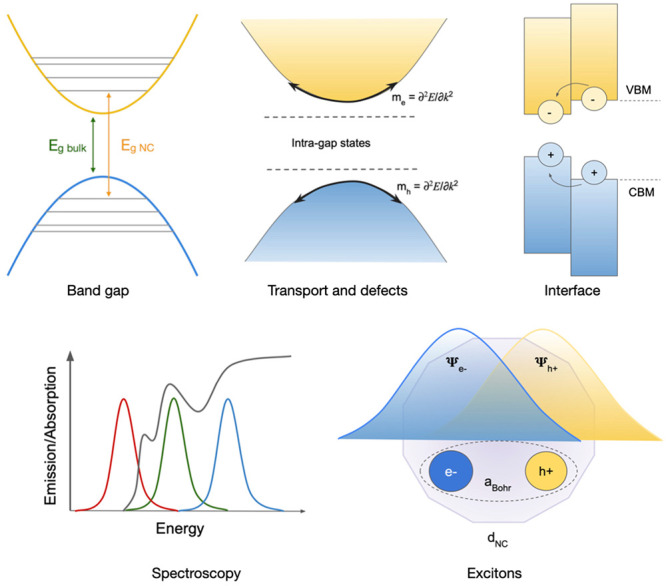
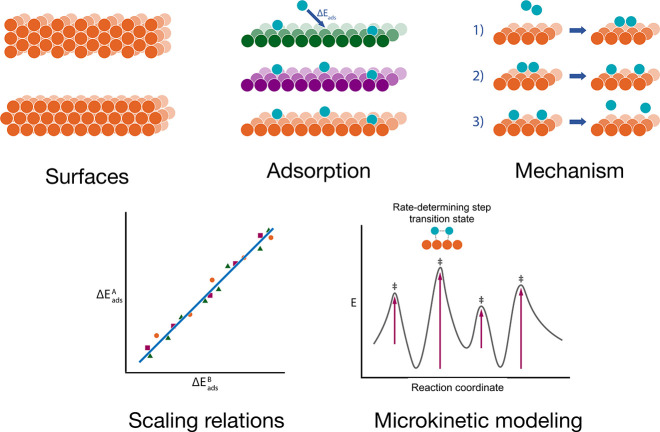
The recent rise of computational, data-driven research has significant potential to accelerate materials discovery. Automated workflows and materials databases are being rapidly developed, contributing to high-throughput data of bulk materials that are growing in quantity and complexity, allowing for correlation between structural-chemical features and functional properties. In contrast, computational data-driven approaches are still relatively rare for nanomaterials discovery due to the rapid scaling of computational cost for finite systems. However, the distinct behaviors at the nanoscale as compared to the parent bulk materials and the vast tunability space with respect to dimensionality and morphology motivate the development of data sets for nanometric materials. In this review, we discuss the recent progress in data-driven research in two aspects: functional materials design and guided synthesis, including commonly used metrics and approaches for designing materials properties and predicting synthesis routes. More importantly, we discuss the distinct behaviors of materials as a result of nanosizing and the implications for data-driven research. Finally, we share our perspectives on future directions for extending the current data-driven research into the nano realm.
近年来,计算驱动的研究有很大的潜力来加速材料的发现。自动化的工作流程和材料数据库正在迅速发展,为大量且复杂的体材料高通量数据做出了贡献,使得结构-化学特征和功能特性之间能够建立关联。相比之下,由于有限系统的计算成本快速增加,计算驱动的方法在纳米材料发现方面仍然相对较少。然而,与母体体材料相比,纳米尺度的独特行为以及在维度和形态方面的巨大可调谐空间,促使人们开发了纳米材料的数据集。在这篇综述中,我们从两个方面讨论了数据驱动研究的最新进展:功能材料设计和指导合成,包括常用的度量标准和设计材料性能以及预测合成路线的方法。更重要的是,我们讨论了材料由于纳米化而产生的独特行为以及对数据驱动研究的影响。最后,我们分享了我们对将当前的数据驱动研究扩展到纳米领域的未来方向的看法。