Department of Pediatrics and Child Health Nursing, School of Nursing and Midwifery, College of Medicine and Health Sciences, Wollo University, Dessie, Ethiopia.
Dream Science and Technology College, Dessie, Ethiopia.
Malar J. 2022 Nov 16;21(1):338. doi: 10.1186/s12936-022-04370-9.
Globally, malaria is among the leading cause of under-five mortality and morbidity. Despite various malaria elimination strategies being implemented in the last decades, malaria remains a major public health concern, particularly in tropical and sub-tropical regions. Furthermore, there have been limited and inconclusive studies in Ethiopia to generate information for action towards malaria in under-five children. Additionally, there is a considerable disparity between the results of the existing studies. Therefore, the pooled estimate from this study will provide a more conclusive result to take evidence-based interventional measures against under-five malaria.
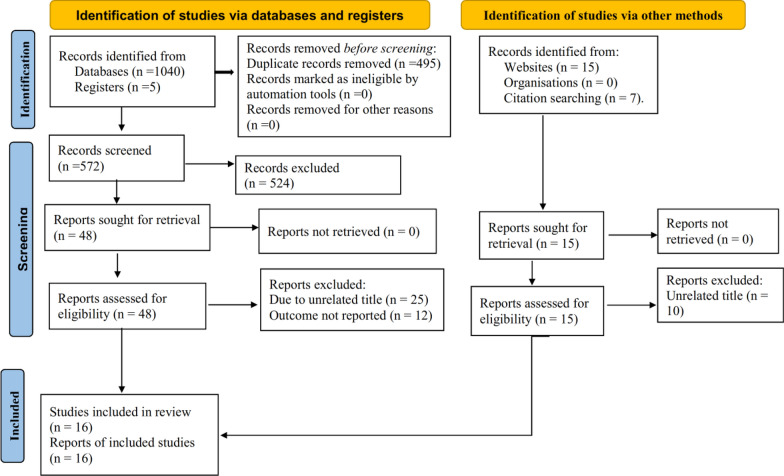
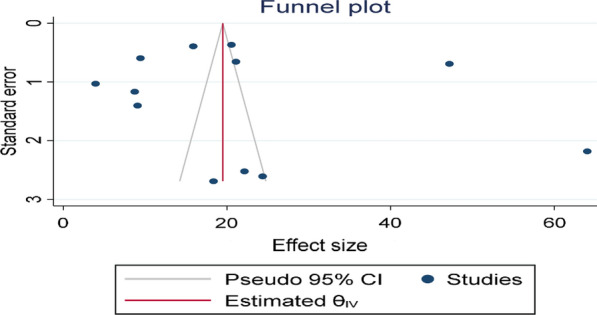
The protocol of this review is registered at PROSPERO with registration number CRD42020157886. All appropriate databases and grey literature were searched to find relevant articles. Studies reporting the prevalence or risk factors of malaria among under-five children were included. The quality of each study was assessed using the Newcastle-Ottawa Quality Assessment Scale (NOS). Data was extracted using Microsoft Excel 2016 and analysis was done using STATA 16.0 statistical software. The pooled prevalence and its associated factors of malaria were determined using a random effect model. Heterogeneity between studies was assessed using the Cochrane Q-test statistics and I test. Furthermore, publication bias was checked by the visual inspection of the funnel plot and using Egger's and Begg's statistical tests.
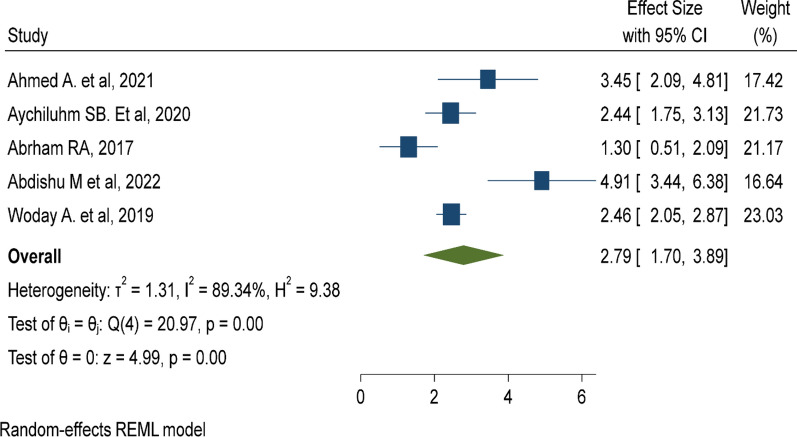
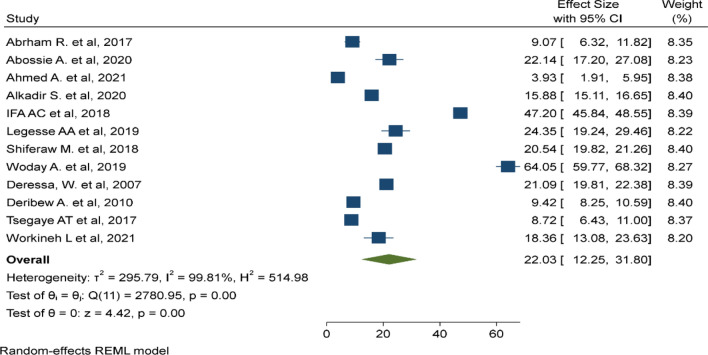
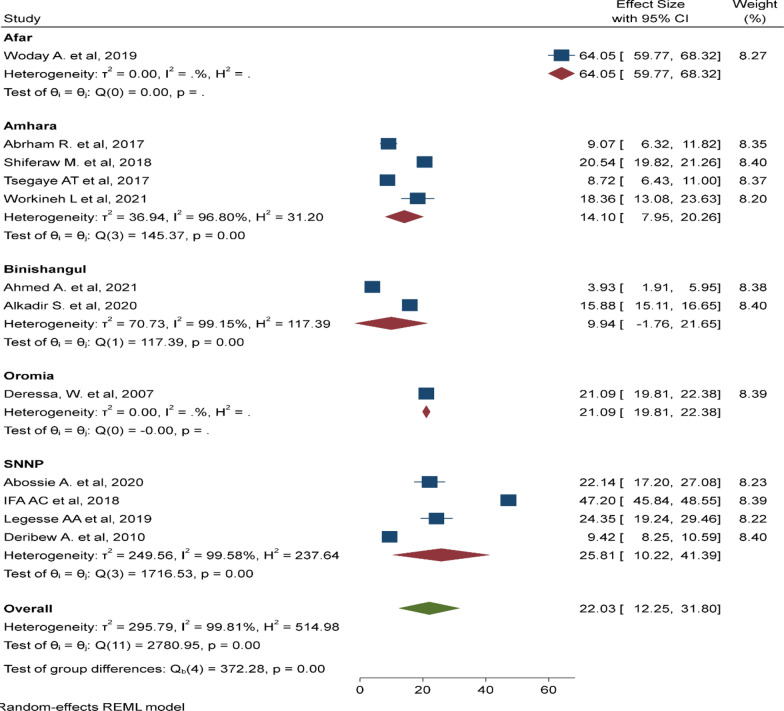
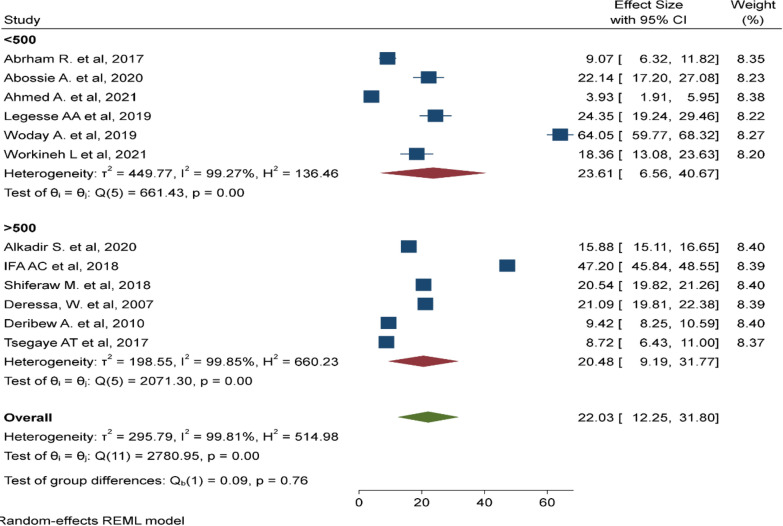
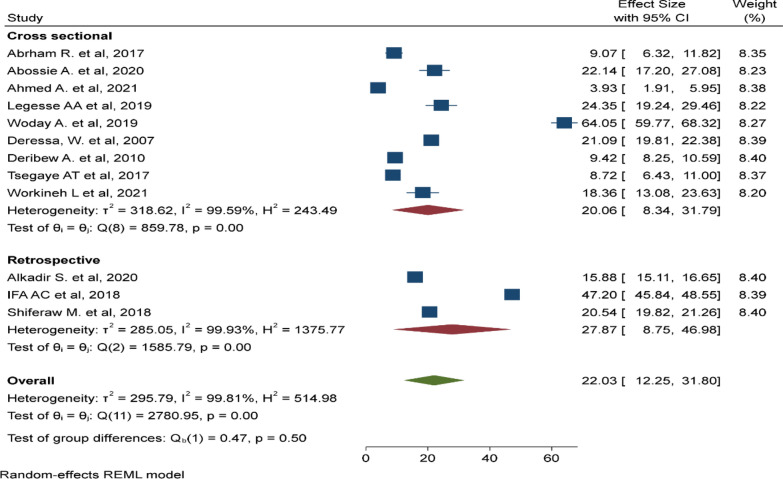
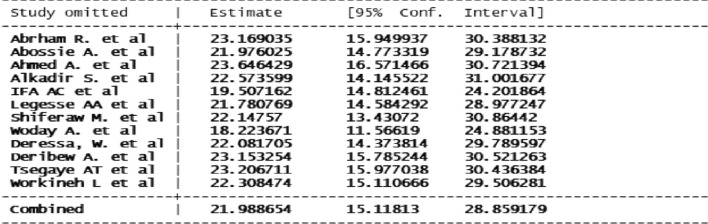
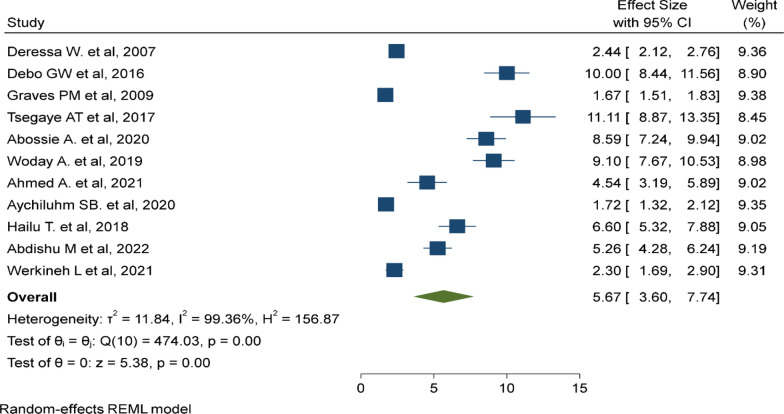
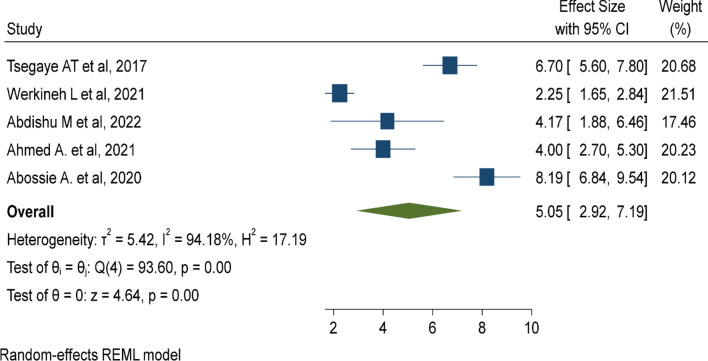
Twelve studies with 34,842 under-five children were included. The pooled prevalence of under-five malaria was 22.03% (95% CI 12.25%, 31.80%). Lack of insecticide-treated mosquito net utilization (AOR: 5.67, 95% CI 3.6, 7.74), poor knowledge of child caretakers towards malaria transmission (AOR: 2.79, 95% CI 1.70, 3.89), and living near mosquito breeding sites (AOR: 5.05, 95% CI 2.92, 7.19) were risk factors of under-five malaria.
More than one in five children aged under five years were infected with malaria. This suggests the rate of under-five malaria is far off the 2030 national malaria elimination programme of Ethiopia. The Government should strengthen malaria control strategies such as disseminating insecticide-treated mosquito nets (ITNs), advocating the utilization of ITNs, and raising community awareness regarding malaria transmission.
在全球范围内,疟疾是导致五岁以下儿童死亡和发病的主要原因之一。尽管过去几十年实施了各种疟疾消除战略,但疟疾仍然是一个主要的公共卫生关注点,特别是在热带和亚热带地区。此外,埃塞俄比亚开展的关于五岁以下儿童疟疾的研究数量有限且结果不一致。因此,本研究的汇总估计将提供更具结论性的结果,以便针对五岁以下儿童疟疾采取基于证据的干预措施。
本综述的方案已在 PROSPERO 注册,注册号为 CRD42020157886。检索了所有适当的数据库和灰色文献,以查找相关文章。纳入报告五岁以下儿童疟疾患病率或危险因素的研究。使用纽卡斯尔-渥太华质量评估量表(NOS)评估每项研究的质量。使用 Microsoft Excel 2016 提取数据,并使用 STATA 16.0 统计软件进行分析。使用随机效应模型确定疟疾的汇总患病率及其相关因素。使用 Cochrane Q 检验统计量和 I 检验评估研究之间的异质性。此外,通过漏斗图的视觉检查以及使用 Egger 和 Begg 统计检验检查发表偏倚。
纳入了 12 项研究,涉及 34842 名五岁以下儿童。五岁以下儿童疟疾的汇总患病率为 22.03%(95%CI 12.25%,31.80%)。未使用经杀虫剂处理的蚊帐(AOR:5.67,95%CI 3.6,7.74)、儿童照顾者对疟疾传播知识不足(AOR:2.79,95%CI 1.70,3.89)和居住在蚊子滋生地附近(AOR:5.05,95%CI 2.92,7.19)是五岁以下儿童疟疾的危险因素。
超过五分之一的五岁以下儿童感染了疟疾。这表明五岁以下儿童疟疾的发病率远低于埃塞俄比亚 2030 年国家疟疾消除计划。政府应加强疟疾控制策略,如分发经杀虫剂处理的蚊帐、倡导使用经杀虫剂处理的蚊帐以及提高社区对疟疾传播的认识。