German Research Center for Artificial Intelligence (DFKI), Berlin, Germany.
Department of Nephrology and Medical Intensive Care, Charité-Universitätsmedizin Berlin, Corporate Member of Freie Universität Berlin, Berlin Institute of Health, Humboldt-Universität zu Berlin, Berlin, Germany.
Front Public Health. 2022 Oct 25;10:979448. doi: 10.3389/fpubh.2022.979448. eCollection 2022.
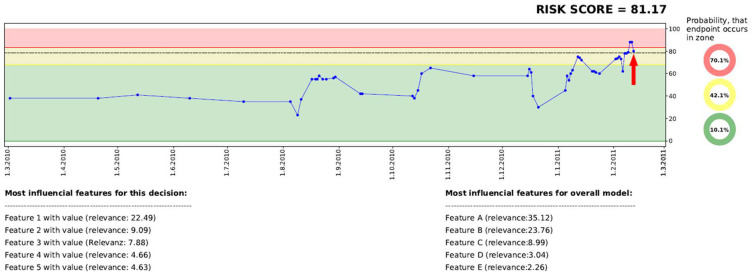
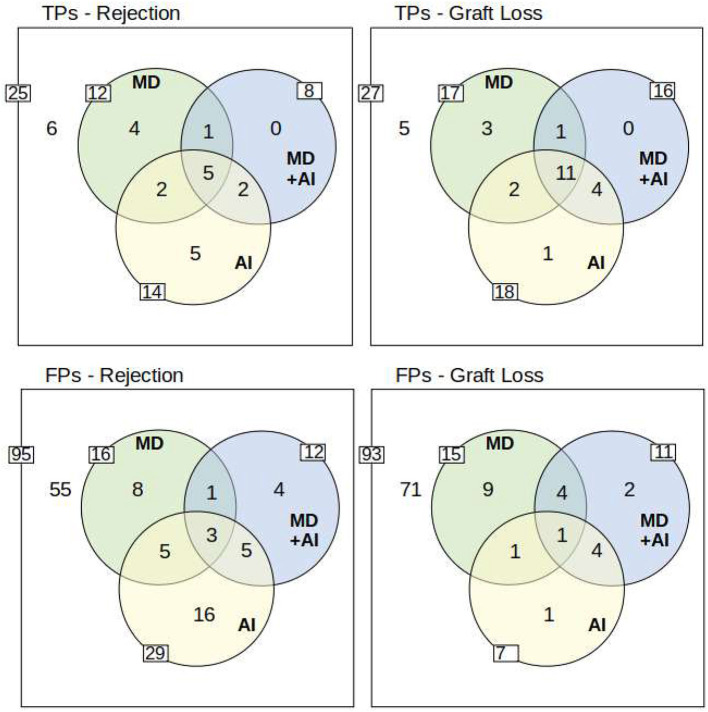
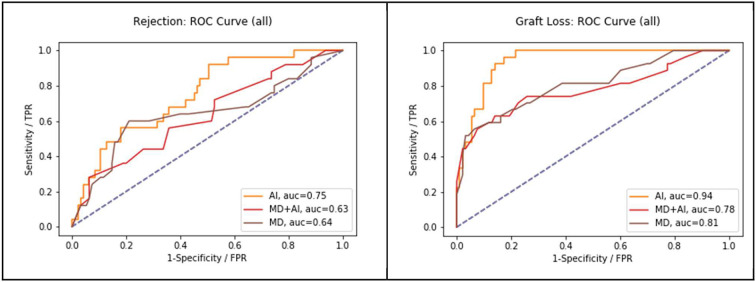
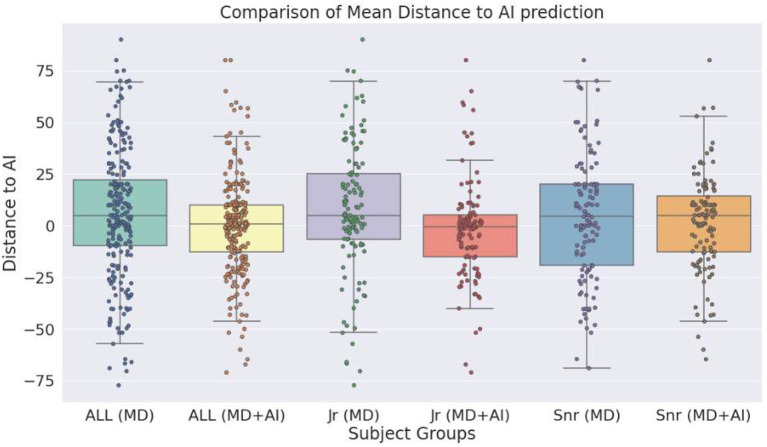
Patient care after kidney transplantation requires integration of complex information to make informed decisions on risk constellations. Many machine learning models have been developed for detecting patient outcomes in the past years. However, performance metrics alone do not determine practical utility. We present a newly developed clinical decision support system (CDSS) for detection of patients at risk for rejection and death-censored graft failure. The CDSS is based on clinical routine data including 1,516 kidney transplant recipients and more than 100,000 data points. In a reader study we compare the performance of physicians at a nephrology department with and without the CDSS. Internal validation shows AUC-ROC scores of 0.83 for rejection, and 0.95 for graft failure. The reader study shows that predictions by physicians converge toward the CDSS. However, performance does not improve (AUC-ROC; 0.6413 vs. 0.6314 for rejection; 0.8072 vs. 0.7778 for graft failure). Finally, the study shows that the CDSS detects partially different patients at risk compared to physicians. This indicates that the combination of both, medical professionals and a CDSS might help detect more patients at risk for graft failure. However, the question of how to integrate such a system efficiently into clinical practice remains open.
肾移植后的患者护理需要整合复杂的信息,以便就风险组合做出明智的决策。过去几年来,已经开发出许多用于检测患者结局的机器学习模型。然而,仅性能指标并不能决定实际效用。我们提出了一种新开发的临床决策支持系统(CDSS),用于检测发生排斥反应和死亡相关移植物衰竭风险的患者。该 CDSS 基于包括 1516 名肾移植受者和超过 100,000 个数据点的临床常规数据。在一项读者研究中,我们比较了肾脏病学部门的医生在使用和不使用 CDSS 时的表现。内部验证显示,排斥反应的 AUC-ROC 评分为 0.83,移植物衰竭的 AUC-ROC 评分为 0.95。读者研究表明,医生的预测结果与 CDSS 趋同。然而,性能并未提高(排斥反应的 AUC-ROC 评分分别为 0.6413 与 0.6314;移植物衰竭的 AUC-ROC 评分分别为 0.8072 与 0.7778)。最后,该研究表明,与医生相比,CDSS 检测到的部分风险患者不同。这表明,将医学专业人员和 CDSS 结合起来,可能有助于检测更多发生移植物衰竭风险的患者。然而,如何将这样的系统有效地整合到临床实践中仍然是一个悬而未决的问题。