School of Public Health, Faculty of Health Sciences, Ben-Gurion University of the Negev, Beer Sheva, Israel.
Magic Lab, Department of Industrial Engineering and Management, Faculty of Engineering, Ben-Gurion University of the Negev, Beer Sheva, Israel.
Front Public Health. 2022 Oct 28;10:1019626. doi: 10.3389/fpubh.2022.1019626. eCollection 2022.
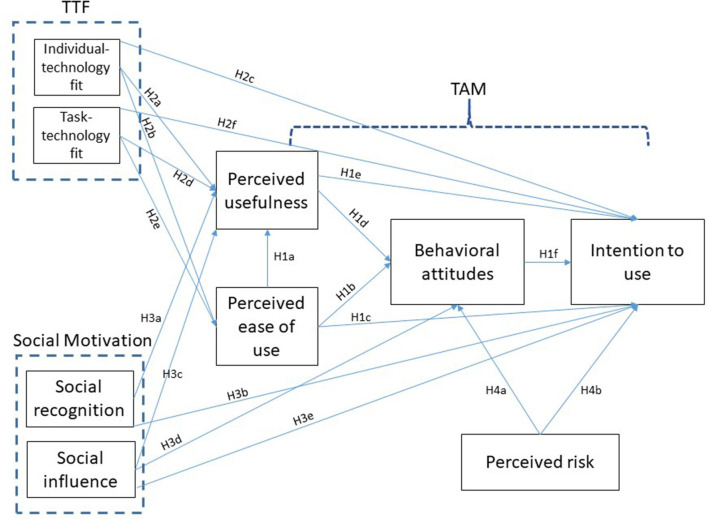
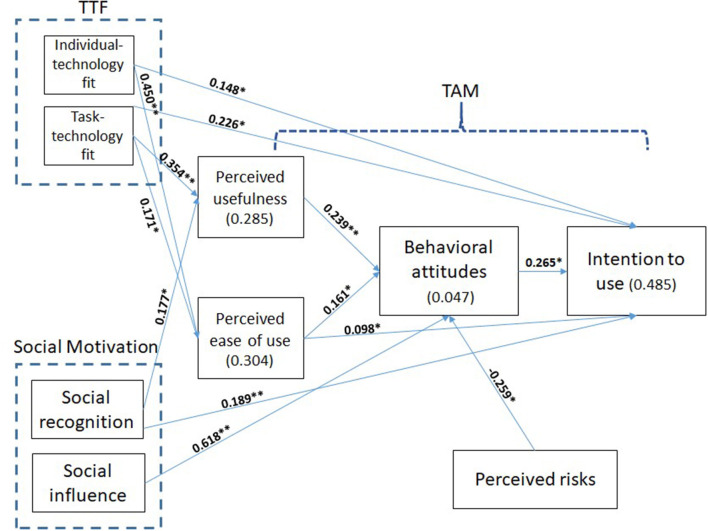
The aim of the study was to propose and test an integrated model combining the technology acceptance model (TAM), task-technology fit (TTF), social motivation, and drone-related perceived risks to explore the intention to use drones in public health emergencies (PHEs). We conducted a survey among the Israeli population, yielding a sample of 568 participants. Structural equation modeling was implemented to test the research hypotheses. The results showed that our integrated model provided a robust and comprehensive framework to perform an in-depth investigation of the factors and mechanisms affecting drone acceptance in PHEs. First, ease of use, attitudes, individual-technology fit, task-technology fit, and social influence significantly and directly influenced users' behavioral intention to utilize drone technology. Second, attitudes were significant mediators of the effects of social influence and perceived risks on the intention to use drones. Finally, significant relationships between TAM, TTF, social motivation, and perceived risks were also observed. Theoretical aspects and practical implications-which can serve as the basis for shaping a positive development in drone public acceptance in PHEs and in general-are discussed.
本研究旨在提出并检验一个整合模型,该模型结合了技术接受模型(TAM)、任务技术适配(TTF)、社会动机以及与无人机相关的感知风险,以探讨在公共卫生突发事件(PHEs)中使用无人机的意愿。我们对以色列人口进行了一项调查,共收集了 568 名参与者的样本。采用结构方程模型来检验研究假设。结果表明,我们的整合模型为深入研究影响 PHEs 中无人机接受度的因素和机制提供了一个强大而全面的框架。首先,易用性、态度、个体-技术适配、任务-技术适配和社会影响显著且直接影响用户使用无人机技术的行为意愿。其次,态度是社会影响和感知风险对使用无人机意愿的影响的重要中介。最后,还观察到 TAM、TTF、社会动机和感知风险之间存在显著关系。讨论了理论方面和实际意义——这可以为塑造 PHEs 中以及一般情况下无人机公众接受度的积极发展提供依据。