Graduate School of Medicine, Human Health Sciences, Kyoto University, 53-Kawahara-Cho, Shogoin, Sakyo-Ku, Kyoto, 606-8507, Japan.
Faculty of Rehabilitation, Kansai Medical University, Hirakata, Japan.
Rheumatol Int. 2023 May;43(5):953-960. doi: 10.1007/s00296-022-05246-6. Epub 2022 Nov 17.
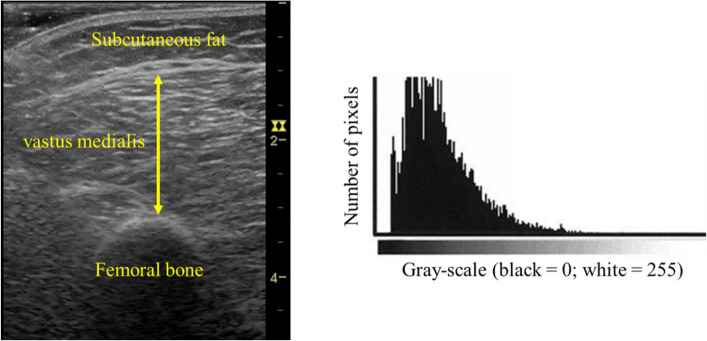
Patients with knee osteoarthritis (OA) experience muscle quality loss, and is characterized by the enhanced echo intensity (EI) of the vastus medialis (VM) muscles and a high extracellular water-to-intracellular water (ECW/ICW) ratio of the thigh. This study aimed to elucidate the association between muscle degeneration and the worsening of functional disabilities and symptoms in patients with KOA over 3 years duration. Thirty-three patients with KOA who completed follow-up over 3 years were included in the analysis. The knee scoring system (KSS) was used to evaluate the functional abilities and symptoms. Based on the 3 years change in KSS scores, patients were classified into progressive or non-progressive groups. Muscle thickness (MT) and EI of the VM were determined using ultrasonography. The ECW/ICW ratio was measured using segmental-bioelectrical impedance spectroscopy. Multivariable logistic regression analyses were conducted with the groups as the dependent variables and VM-MT, VM-EI, and ECW/ICW ratio at baseline as independent variables, including potential confounders. Thirteen (39.4%) patients showed progressive features. VM-EI at baseline was significantly associated with the progression of functional disabilities (adjusted odds ratio [OR] 1.24; 95% confidence interval [CI] 1.03 - 1.50) and symptoms (adjusted OR 1.13; 95% CI 1.01 - 1.25). Enhanced VM-EI was associated with the worsening of functional disabilities and symptoms in patients with KOA over a period of 3 years. Therefore, the assessment of VM-EI using ultrasonography is a useful indicator for predicting the future worsening of KOA.
患有膝骨关节炎 (OA) 的患者会出现肌肉质量下降的情况,其特征是股四头肌的超声回声强度 (EI) 增强,以及大腿细胞外水与细胞内水 (ECW/ICW) 的比值较高。本研究旨在阐明肌肉退化与 KOA 患者功能障碍和症状恶化之间的关系,这些患者的病程超过 3 年。在分析中纳入了 33 名完成 3 年以上随访的 KOA 患者。使用膝关节评分系统 (KSS) 评估功能能力和症状。根据 KSS 评分 3 年的变化,患者被分为进展组或非进展组。使用超声检查测量股四头肌的肌肉厚度 (MT) 和 EI。使用节段生物电阻抗光谱法测量 ECW/ICW 比值。将组作为因变量,将 VM-MT、VM-EI 和基线时的 ECW/ICW 比值作为自变量,进行多变量逻辑回归分析,包括潜在的混杂因素。13 名(39.4%)患者表现出进展性特征。基线时的 VM-EI 与功能障碍的进展显著相关(调整后的优势比 [OR] 1.24;95%置信区间 [CI] 1.03-1.50)和症状(调整后的 OR 1.13;95% CI 1.01-1.25)。增强的 VM-EI 与 KOA 患者在 3 年内功能障碍和症状的恶化有关。因此,使用超声评估 VM-EI 是预测 KOA 未来恶化的有用指标。