PhysioLab, University of Florence, Florence, Italy.
Department of Biology, University of Florence, Florence, Italy.
Commun Biol. 2022 Nov 18;5(1):1266. doi: 10.1038/s42003-022-04184-0.
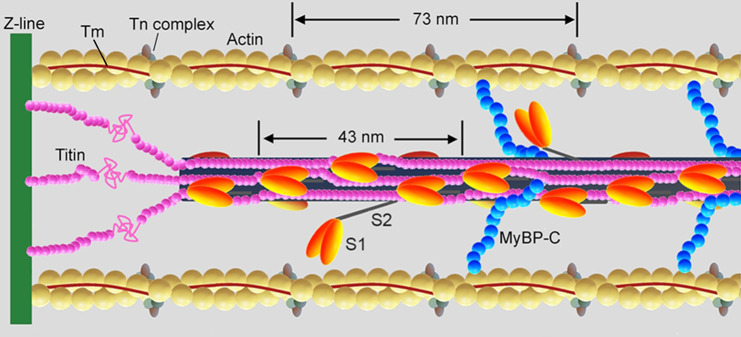
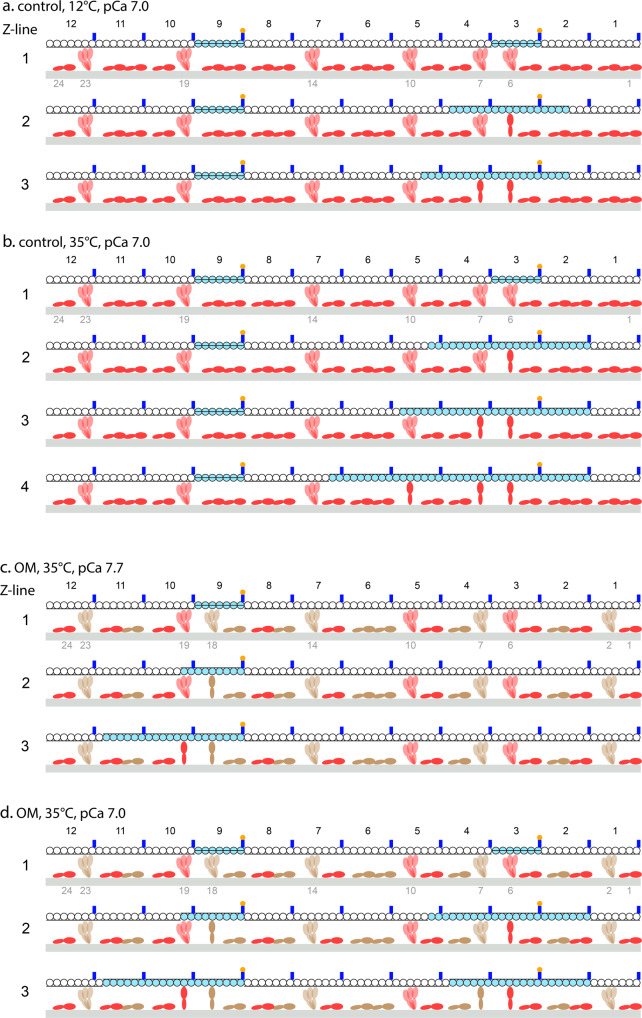
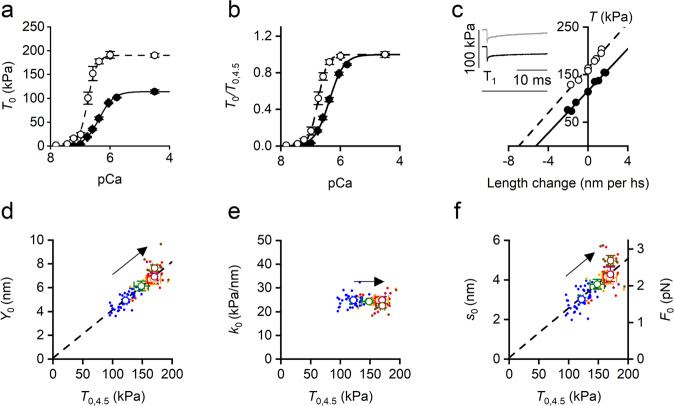
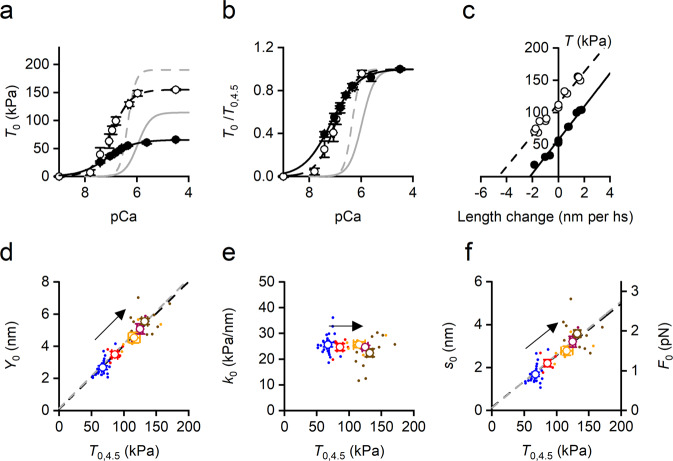
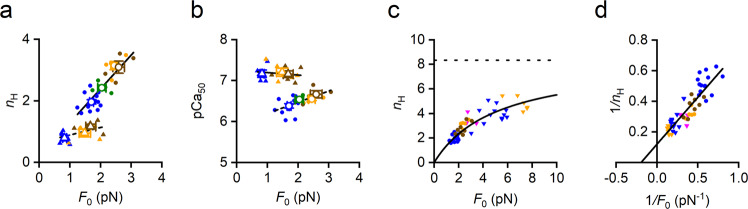
Contraction of striated muscle is regulated by a dual mechanism involving both thin, actin-containing filament and thick, myosin-containing filament. Thin filament is activated by Ca binding to troponin, leading to tropomyosin displacement that exposes actin sites for interaction with myosin motors, extending from the neighbouring stress-activated thick filaments. Motor attachment to actin contributes to spreading activation along the thin filament, through a cooperative mechanism, still unclear, that determines the slope of the sigmoidal relation between isometric force and pCa (-log[Ca]), estimated by Hill coefficient n. We use sarcomere-level mechanics in demembranated fibres of rabbit skeletal muscle activated by Ca at different temperatures (12-35 °C) to show that n depends on the motor force at constant number of attached motors. The definition of the role of motor force provides fundamental constraints for modelling the dynamics of thin filament activation and defining the action of small molecules as possible therapeutic tools.
横纹肌的收缩受双重机制调节,涉及细肌丝和粗肌丝。细肌丝通过与肌钙蛋白结合的 Ca2+ 激活,导致肌动蛋白位移,暴露出肌动蛋白与肌球蛋白马达相互作用的位点,从相邻的应激激活的粗肌丝延伸出来。马达与肌动蛋白的结合有助于通过一个尚不清楚的协同机制沿细肌丝扩散激活,该机制决定了等长力与 pCa(-log[Ca])之间的关系的斜率,通过 Hill 系数 n 来估计。我们使用不同温度(12-35°C)下 Ca 激活的兔骨骼肌去膜纤维的肌节水平力学来证明 n 取决于在恒定数量附着的马达的马达力。马达力的作用定义为模型化细肌丝激活动力学和定义小分子作用的基本限制,小分子作为可能的治疗工具。