Department of Health Management and Policy, University of Michigan, School of Public Health, 1415 Washington Heights, Ann Arbor, MI, USA.
Cancer Prevention and Control Program, Georgetown University-Lombardi Comprehensive Cancer Center, 3300 Whitehaven St, Washington, DC, USA.
BMC Public Health. 2022 Nov 19;22(1):2128. doi: 10.1186/s12889-022-14440-x.
To synthesize the outcomes of policy evaluations of flavoured electronic nicotine delivery systems (ENDS) restrictions.
PubMed, Scopus, Embase and Web of Science before May 3, 2022.
Studies that report sales, behaviour, or compliance outcomes related to implemented or hypothetical ENDS flavour restrictions.
Restriction details, whether implemented or hypothetical, whether additional products were restricted, jurisdictional level, study locations, and outcomes classified by sales, behaviour, and compliance.
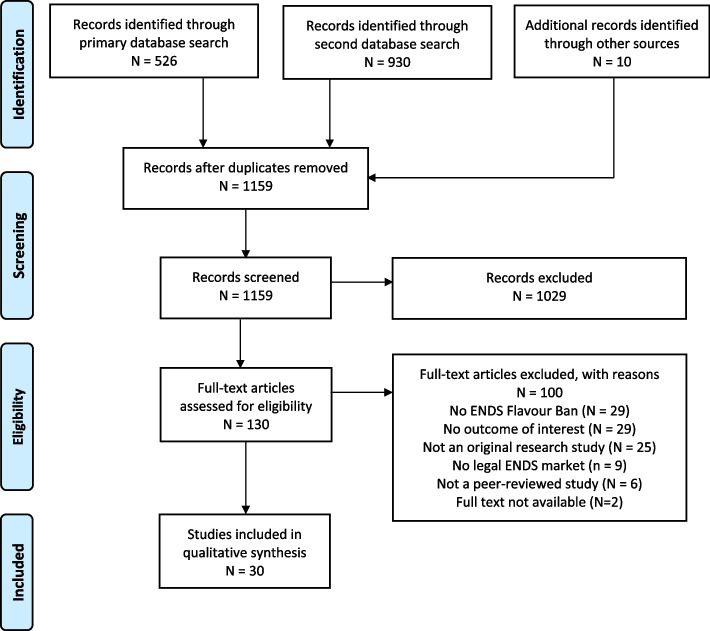
We included 30 studies. Of those, 26 were conducted exclusively in the US, two in India, and two surveyed respondents in multiple countries, including the US. Twenty-one evaluated implemented restrictions, while nine considered hypothetical restrictions. Five studies evaluated product sales, 17 evaluated behaviour, and 10 evaluated compliance, with two studies reporting multiple outcomes. Two studies reported an increase and one a reduction in cigarette sales following restrictions, while three reported reductions in ENDS sales. Behavioural studies presented a mixed view of the impacts of regulations on ENDS and cigarette use. However, the use of disparate outcomes limits the comparability of studies. Studies of hypothetical restrictions suggest decreased ENDS use, increased cigarette use, and increased use of illicit markets. Studies of compliance with flavoured product restrictions that included ENDS found that 6-39% of stores sold restricted flavoured products post-restrictions. Online stores remain a potential source of restricted products.
Our findings highlight the need for additional research on the impacts of ENDS restrictions. Research should further evaluate the impact of restrictions on youth and adult use of nicotine and tobacco products in addition to the effects of restrictions in countries beyond the US to enable a robust consideration of the harm-benefit trade-off of restrictions.
综合评估调味电子烟限制政策的效果。
截至 2022 年 5 月 3 日,在 PubMed、Scopus、Embase 和 Web of Science 上进行了检索。
报告与实施或假设的电子烟口味限制相关的销售、行为或合规结果的研究。
限制的详细信息,无论是实施的还是假设的,是否限制了其他产品,管辖范围,研究地点,以及根据销售、行为和合规进行分类的结果。
我们纳入了 30 项研究。其中,26 项研究仅在美国进行,2 项在印度进行,2 项调查了包括美国在内的多个国家的受访者。21 项评估了已实施的限制,9 项考虑了假设的限制。五项研究评估了产品销售,17 项评估了行为,10 项评估了合规性,其中两项研究报告了多个结果。两项研究报告称,限制后香烟销售量增加,一项研究报告电子烟销售量减少,而三项研究报告电子烟销售量减少。行为研究对法规对电子烟和香烟使用的影响提出了混合观点。然而,使用不同的结果限制了研究的可比性。关于假设限制的研究表明,电子烟使用减少,香烟使用增加,非法市场使用增加。对调味产品限制合规性的研究发现,限制后有 6%-39%的商店销售受限的调味产品。在线商店仍然是受限产品的潜在来源。
我们的研究结果强调了需要进一步研究电子烟限制的影响。研究应进一步评估限制对青少年和成年人使用尼古丁和烟草产品的影响,以及在美国以外国家实施限制的影响,以便对限制的危害-效益权衡进行全面考虑。