Ma Shaoying, Shang Ce, Do Vuong V, Huang Jidong, Pechacek Terry F, Weaver Scott R
Center for Tobacco Research, The Ohio State University Comprehensive Cancer Center, Columbus, Ohio, United States of America.
Department of Internal Medicine, The Ohio State University Wexner Medical Center, Columbus, Ohio, United States of America.
PLoS One. 2025 Mar 12;20(3):e0320023. doi: 10.1371/journal.pone.0320023. eCollection 2025.
Concurrent use of alcohol and cigarettes is well-documented in the literature. However, it is unclear how e-cigarette regulations in a growing number of localities impact the use of tobacco and alcohol in the US. This study aims to evaluate the impacts of excise taxes, tobacco use restrictions in restaurants/bars, and availability of alcohol flavor in e-cigarettes on tobacco consumption, and their cross impacts on alcohol consumption.
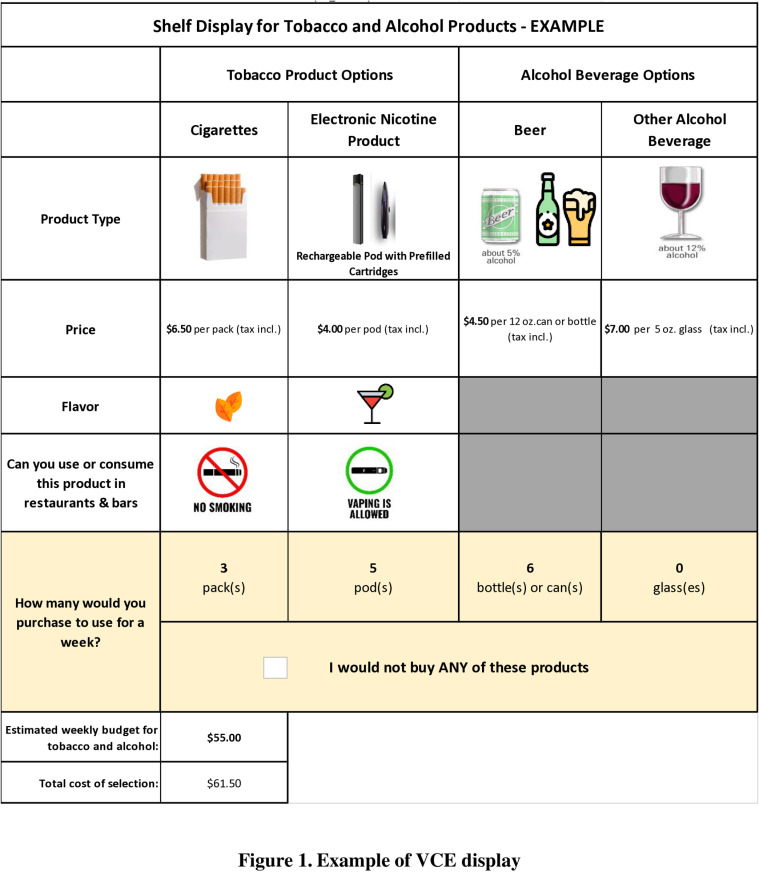
A total of 181 US adult smokers who were using e-cigarettes and consuming alcohol participated in online volumetric choice experiments and reported on the quantity they would purchase among cigarettes, closed-system e-cigarettes, beer, and one other alcohol product (wine/liquor) under varying policy scenarios.
Estimated own-price elasticities of demand for beer, liquor/wine, and cigarettes were -0.10, -0.11, and -0.16, respectively (p < 0.001). Higher beer (cross-price elasticity = 0.13) and liquor/wine prices (cross-price elasticity = 0.05) increased e-cigarette consumption (p < 0.05). If e-cigarettes were allowed in bars/restaurants, their consumption increased by 2.4 units (p < 0.001), and if cigarettes were allowed in bars/restaurants, e-cigarette consumption increased by 1.9 units (p < 0.01), relative to the mean consumption level. Greater reported weekly spending on alcohol and/or tobacco was associated with higher consumption of all products (p < 0.001).
Higher taxes or prices may reduce the consumption of beer, liquor/wine, and cigarettes. E-cigarettes are economic substitutes for alcohol among smokers who are currently drinking and using e-cigarettes. Regulating tobacco indoor use will have an impact on e-cigarette consumption.
文献中充分记载了酒精与香烟的同时使用情况。然而,越来越多地区的电子烟法规如何影响美国烟草和酒精的使用尚不清楚。本研究旨在评估消费税、餐厅/酒吧内的烟草使用限制以及电子烟中酒精口味的可获得性对烟草消费的影响,以及它们对酒精消费的交叉影响。
共有181名使用电子烟且饮酒的美国成年吸烟者参与了在线容量选择实验,并报告了在不同政策情景下他们会在香烟、封闭式电子烟、啤酒和另一种酒精产品(葡萄酒/烈酒)中购买的数量。
啤酒、烈酒/葡萄酒和香烟的估计自身价格需求弹性分别为-0.10、-0.11和-0.16(p < 0.001)。啤酒价格上涨(交叉价格弹性 = 0.13)和烈酒/葡萄酒价格上涨(交叉价格弹性 = 0.05)会增加电子烟消费(p < 0.05)。相对于平均消费水平,如果酒吧/餐厅允许使用电子烟,其消费量会增加2.4个单位(p < 0.001),如果酒吧/餐厅允许吸烟,电子烟消费量会增加1.9个单位(p < 0.01)。报告的每周在酒精和/或烟草上的支出越高,所有产品的消费量就越高(p < 0.001)。
提高税收或价格可能会减少啤酒、烈酒/葡萄酒和香烟的消费。对于目前既饮酒又使用电子烟的吸烟者来说,电子烟是酒精的经济替代品。规范室内烟草使用将对电子烟消费产生影响。