Zadeh Mahmoud Asle Mohammadi, Afrasyabi Saleh, Mohamadi Zaynab Asle
Department of Exercise Physiology, Faculty of Sport Sciences, University of Isfahan, Hezar Jerib Street, P.O. Box 81746-7344, Isfahan, Iran.
Department of Sports Science, Farhangian University, Bushehr, Iran.
J Diabetes Metab Disord. 2022 Sep 3;21(2):1219-1231. doi: 10.1007/s40200-021-00808-0. eCollection 2022 Dec.
Recently, many studies have examined the effects of various training on pro-inflammatory and anti-inflammatory adipocytes. The results of these studies are contradictory. Some have reported positive effects and others have reported negative effects. However, there is no research to study the effect of exercise on similar energy expenditures on adipocytes. Hence the purpose of this study was the effects exercise training induced calories expenditure on type 2 diabetes related cardio metabolic physiological parameters and adipocytokines.
Sixty-eight men patients with type 2 diabetes [12 weeks] were randomized to 4 groups according to training regimens. the groups are [1] HIIT [n = 17], [2] RT[n = 17], [3] AT[n = 18], and [4] AT + RT n = 16]. For 12 weeks [4 days/week, 20-30 min/season], participants performed training sessions with 300 kcal energy expenditure. Before and after 12 weeks interventions, Anthropometric and physiological variables and Glucose, insulin, FFA, LDL, HDL, TG, TC collected and analyses. Leptin, SFRP5, LGR4 and Irisin levels in Serum were assessment by ELISA.
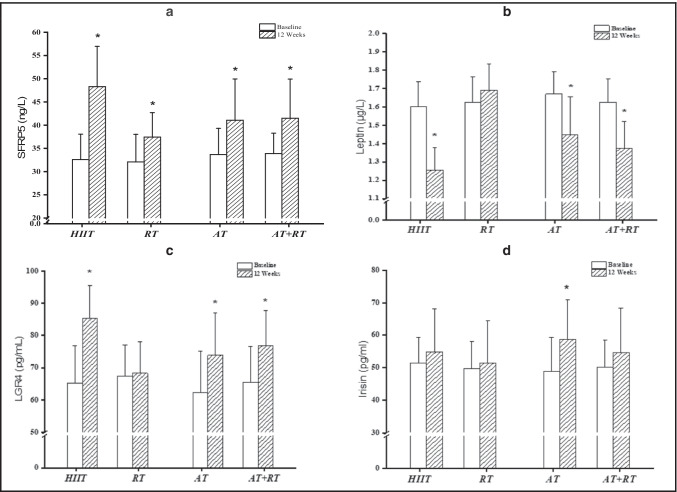
Serum irisin concentrations were significantly higher in AT [%20.4] compared to other groups. Leptin, SFRP5 and LGR4 were significantly higher in HIIT [%-21.7, %48.1 and %30.9 respectively] compared to other groups. Serum SFRP5 concentrations were significantly increased in 4 groups[P > 0.05]. However, leptin and LGR4 were significantly decreased and increased in 3 groups expect in RT group[P > 0.05]. And irisin concentrations were significantly increased in AT group only[P > 0.05]. And many variables indicated positive and negative relationship between together [P > 0.05].
The findings of the present study showed that if exercised with energy expenditure equal to HIIT training, it has the greatest effect on improving inflammatory and anti-inflammatory indicators in type 2 diabetic patients, as well as glycemic and lipid-chemical variables.
最近,许多研究探讨了各种训练对促炎和抗炎脂肪细胞的影响。这些研究结果相互矛盾。一些报告了积极影响,另一些则报告了消极影响。然而,尚无研究探讨运动对脂肪细胞类似能量消耗的影响。因此,本研究的目的是探讨运动训练引起的热量消耗对2型糖尿病相关心脏代谢生理参数和脂肪细胞因子的影响。
68名2型糖尿病男性患者[12周]根据训练方案随机分为4组。分组如下:[1]高强度间歇训练组[HIIT,n = 17],[2]抗阻训练组[RT,n = 17],[3]有氧运动组[AT,n = 18],以及[4]有氧运动+抗阻训练组[AT + RT,n = 16]。在12周内[每周4天,每次20 - 30分钟],参与者进行能量消耗为300千卡的训练课程。在12周干预前后,收集并分析人体测量和生理变量以及血糖、胰岛素、游离脂肪酸、低密度脂蛋白、高密度脂蛋白、甘油三酯、总胆固醇。通过酶联免疫吸附测定法评估血清中瘦素、分泌型卷曲相关蛋白5(SFRP5)、富含亮氨酸重复序列4(LGR4)和鸢尾素的水平。
与其他组相比,有氧运动组(AT)的血清鸢尾素浓度显著更高[20.4%]。与其他组相比,高强度间歇训练组(HIIT)的瘦素、SFRP5和LGR4显著更高[分别为 - 21.7%、48.1%和30.9%]。4组的血清SFRP5浓度均显著升高[P > 0.05]。然而,除抗阻训练组外,3组的瘦素和LGR4分别显著降低和升高[P > 0.05]。且仅有氧运动组的鸢尾素浓度显著升高[P > 0.05]。许多变量之间呈现出正负相关关系[P > 0.05]。
本研究结果表明,对于2型糖尿病患者,若进行与高强度间歇训练能量消耗相当的运动,对改善炎症和抗炎指标以及血糖和血脂化学变量具有最大效果。