Arhire Lidia I, Mihalache Laura, Covasa Mihai
Department of Internal Medicine, "Grigore T. Popa" University of Medicine and Pharmacy, Iaşi, Romania.
Clinical Hospital "Sf. Spiridon", Iaşi, Romania.
Front Endocrinol (Lausanne). 2019 Aug 2;10:524. doi: 10.3389/fendo.2019.00524. eCollection 2019.
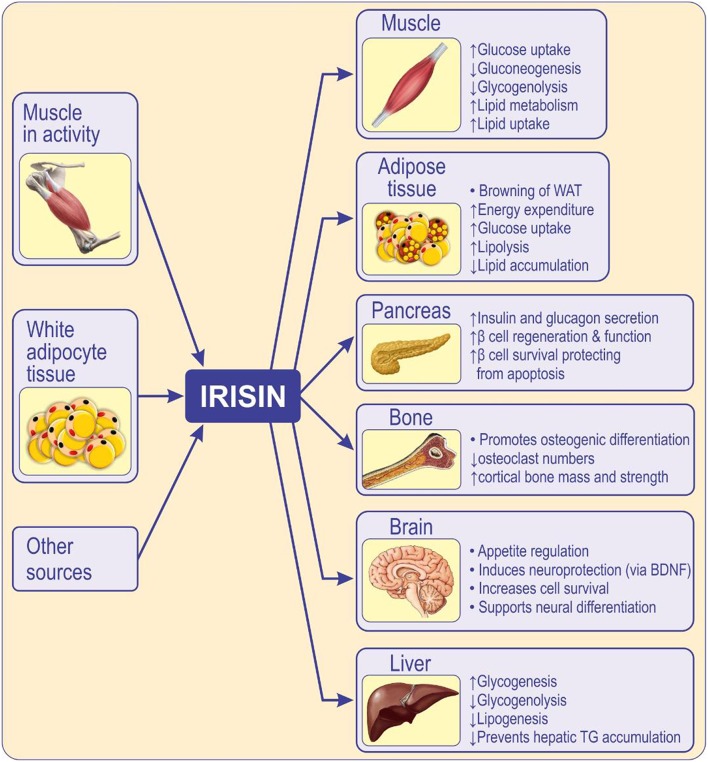
White adipose tissue (WAT) is an endocrine organ highly integrated in homeostasis and capable of establishing ways of communicating and influencing multiple metabolic processes. Brown adipose tissue promotes energy expenditure by incorporating the uncoupling protein 1 (UCP1), also known as thermogenin, which decouples cellular respiration and heat production, in the mitochondrial membranes. Recent data suggest the presence of a thermogenic cell formation from white adipocytes (beige or brite cells) with a potential role in preventing obesity and metabolic syndrome. The formation of these cells is influenced by physical exertion that induces expression of PPARγ coactivator-1 (PGC1) and downstream membrane protein, fibronectin type III domain-containing protein 5 (FNDC5) in skeletal muscle. Irisin, a thermogenic adipomyokine produced by FNDC5 cleavage is involved in the browning of adipose tissue. While animal studies are congruent with regard to the relationship between physical exertion and irisin release, the results from human studies are less than clear. Therefore, this review focuses on recent advances in our understanding of muscle and adipose tissue thermogenesis. Further, it describes the molecular mechanisms by which irisin impacts exercise, glucose homeostasis and obesity. Finally, the review discusses current gaps and controversies related to irisin release, its mode of action and its future potential as a therapeutic tool in managing obesity and metabolic syndrome.
白色脂肪组织(WAT)是一个高度整合于体内稳态的内分泌器官,能够建立与多种代谢过程进行沟通并施加影响的方式。棕色脂肪组织通过在线粒体膜中整合解偶联蛋白1(UCP1,也称为产热素)来促进能量消耗,该蛋白可使细胞呼吸与产热解偶联。最近的数据表明,白色脂肪细胞可形成产热细胞(米色或亮细胞),这在预防肥胖和代谢综合征中可能发挥作用。这些细胞的形成受体育锻炼的影响,体育锻炼可诱导骨骼肌中PPARγ共激活因子-1(PGC1)和下游膜蛋白含纤连蛋白III型结构域蛋白5(FNDC5)的表达。鸢尾素是一种由FNDC5裂解产生的产热脂肪肌因子,参与脂肪组织的褐变。虽然动物研究在体育锻炼与鸢尾素释放之间的关系方面是一致的,但人体研究的结果尚不清楚。因此,本综述重点关注我们对肌肉和脂肪组织产热的最新认识进展。此外,它还描述了鸢尾素影响运动、葡萄糖稳态和肥胖的分子机制。最后,本综述讨论了与鸢尾素释放、其作用方式及其作为治疗肥胖和代谢综合征的治疗工具的未来潜力相关的当前差距和争议。