Bowe Ross, Irwin Ruairí, Browne Gerard, Harbison Meghan, Gallen Shauna, Yore Patrick J, MacGearailt Eanna, Popivanov Petar, Tan Terry
Department of Anaesthesia, The Coombe Women and Infants University Hospital, Dublin, Ireland.
SN Compr Clin Med. 2022;4(1):257. doi: 10.1007/s42399-022-01332-9. Epub 2022 Nov 14.
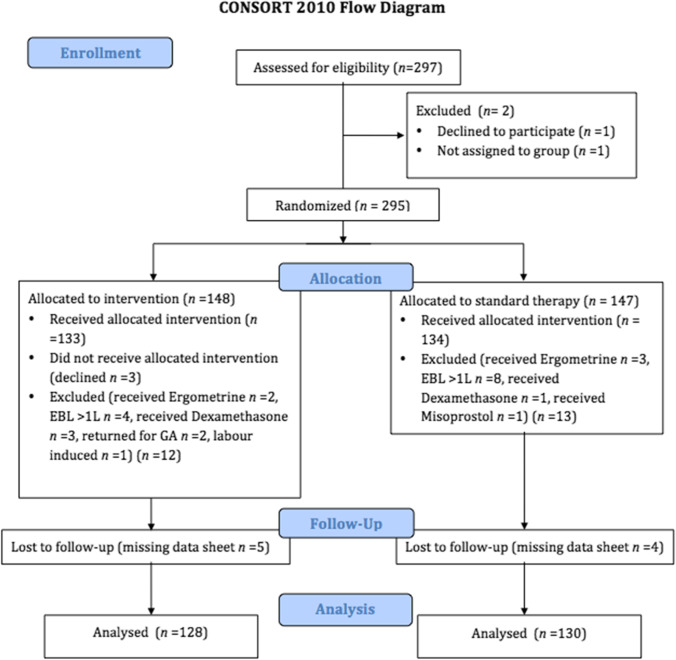
Nausea and vomiting are common complications in patients undergoing caesarean delivery under regional anaesthesia. When experienced after surgery, they may delay recovery, reduce patient satisfaction and affect the bonding between mother and baby. Various pharmacological and non-pharmacological approaches for prophylaxis and treatment of postoperative nausea and vomiting (PONV) have been employed with different degree of efficacy. In this pilot randomised controlled trial, we aimed to determine the possible preventative effects of chewing gum on the rate of PONV in expectant mothers undergoing neuraxial anaesthesia for elective lower segment caesarean section. All participants underwent spinal anaesthesia with administration of 10-11.5 mg of intrathecal heavy Bupivicaine 0.5% according to anaesthetists' preference, Morphine 100 μg and Fentanyl 25 μg. Postoperative analgesia regimen was also standardised. Two hundred ninety-six patients were randomised to an intervention arm to receive chewing gum in addition to standard therapy and to a non-intervention arm to receive standard therapy. After exclusions, 258 patients were followed up 24 h postoperatively. Standard therapy is defined as Ondansetron 4 mg IV intra-operatively. The primary outcomes were the incidences of nausea and vomiting in the first 24 h postoperatively. Secondary outcomes were the number of episodes of nausea or vomiting in the recovery room and on the ward 24 h postoperatively, use of anti-emetics postoperatively, severity of nausea and patient satisfaction with the intervention. Our study revealed no significant differences in rates of postoperative nausea and vomiting between the intervention and standard therapy groups (41.4% v 36.9% = 0.461). There were no significant differences in secondary outcomes between groups. Chewing gum does not reduce the incidence of PONV after elective LSCS under spinal anaesthesia. Our trial was registered with clinicaltrials.org (NCT04191694).
恶心和呕吐是接受区域麻醉剖宫产患者常见的并发症。术后出现恶心和呕吐时,可能会延迟恢复、降低患者满意度并影响母婴关系。已采用各种药物和非药物方法预防和治疗术后恶心和呕吐(PONV),但疗效程度不同。在这项初步随机对照试验中,我们旨在确定咀嚼口香糖对接受择期下段剖宫产术的产妇在接受神经轴麻醉后PONV发生率的可能预防作用。所有参与者均根据麻醉师的偏好接受脊髓麻醉,鞘内注射10 - 11.5毫克0.5%重比重布比卡因、100微克吗啡和25微克芬太尼。术后镇痛方案也进行了标准化。296例患者被随机分为干预组,除接受标准治疗外还接受口香糖,以及非干预组,仅接受标准治疗。排除部分患者后,258例患者术后24小时接受随访。标准治疗定义为术中静脉注射4毫克昂丹司琼。主要结局是术后24小时内恶心和呕吐的发生率。次要结局包括术后恢复室和术后24小时病房内恶心或呕吐发作的次数、术后使用止吐药的情况、恶心的严重程度以及患者对干预措施的满意度。我们的研究显示,干预组和标准治疗组术后恶心和呕吐的发生率无显著差异(41.4%对36.9%,P = 0.461)。两组间次要结局也无显著差异。咀嚼口香糖并不能降低脊髓麻醉下择期下段剖宫产术后PONV的发生率。我们的试验已在clinicaltrials.org注册(NCT04191694)。