Peña Javier, Sampedro Agurne, Balboa-Bandeira Yolanda, Ibarretxe-Bilbao Naroa, Zubiaurre-Elorza Leire, García-Guerrero M Acebo, Ojeda Natalia
Department of Psychology, Faculty of Health Sciences, University of Deusto, Bilbao, Spain.
Front Hum Neurosci. 2022 Nov 3;16:997445. doi: 10.3389/fnhum.2022.997445. eCollection 2022.
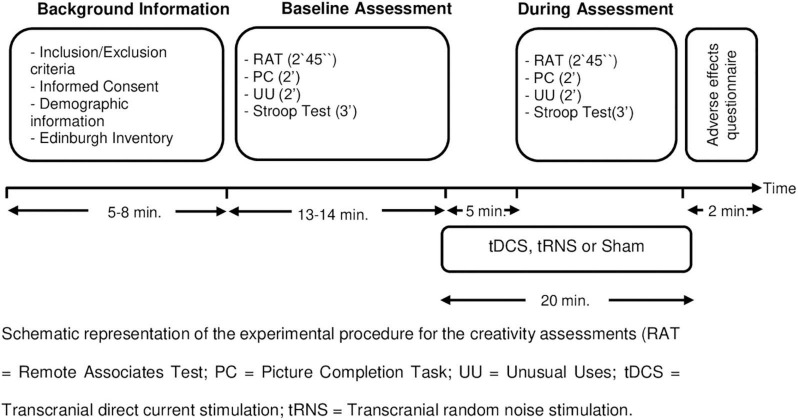
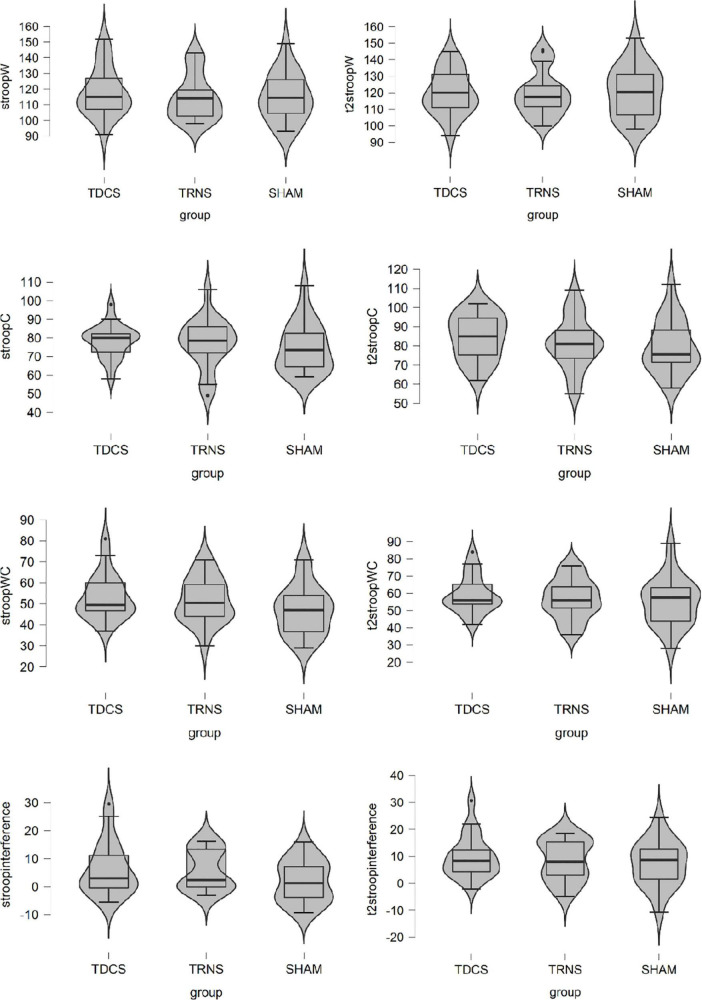
The essential role of creativity has been highlighted in several human knowledge areas. Regarding the neural underpinnings of creativity, there is evidence about the role of left dorsolateral prefrontal cortex (DLPFC) and left inferior frontal gyrus (IFG) on divergent thinking (DT) and convergent thinking (CT). Transcranial stimulation studies suggest that the left DLPFC is associated with both DT and CT, whereas left IFG is more related to DT. However, none of the previous studies have targeted both hubs simultaneously and compared transcranial direct current stimulation (tDCS) and random noise stimulation (tRNS). Additionally, given the relationship between cognitive flexibility and creativity, we included it in order to check if the improvement in creativity may be mediated by cognitive flexibility. In this double-blind, between-subjects study, 66 healthy participants were randomly assigned to one of three groups ( = 22) that received a transcranial direct current stimulation (tDCS), transcranial random noise stimulation (tRNS), or sham for 20 min. The tDCS group received 1.5 mA with the anode over the left DLPFC and cathode over the left IFG. Locations in tRNS group were the same and they received 1.5 mA of high frequency tRNS (100-500 Hz). Divergent thinking was assessed before (baseline) and during stimulation with unusual uses (UU) and picture completion (PC) subtests from Torrance Creative thinking Test, whereas convergent thinking was evaluated with the remote association test (RAT). Stroop test was included to assess cognitive flexibility. ANCOVA results of performance under stimulation (controlling for baseline performance) showed that there were significant differences in PC ( = 3.35, = 0.042, = 0.10) but not in UU ( = 0.61, = 0.546) and RAT ( = 2.65, = 0.079) scores. analyses showed that tRNS group had significantly higher scores compared to sham ( = 0.004) in PC. More specifically, tRNS showed higher performance in fluency ( = 0.012) and originality ( = 0.021) dimensions of PC compared to sham. Regarding cognitive flexibility, we did not find any significant effect of any of the stimulation groups ( = 0.34, = 0.711). Therefore, no further mediation analyses were performed. Finally, the group that received tDCS reported more adverse effects than sham group ( = 3.46, = 0.035). Altogether, these results suggest that tRNS may have some advantages over tDCS in DT.
创造力的重要作用在多个人类知识领域中得到了凸显。关于创造力的神经基础,有证据表明左背外侧前额叶皮层(DLPFC)和左下额回(IFG)在发散性思维(DT)和聚合性思维(CT)中发挥的作用。经颅刺激研究表明,左DLPFC与DT和CT均相关,而左IFG与DT的关系更为密切。然而,之前的研究均未同时针对这两个中枢,也未比较经颅直流电刺激(tDCS)和随机噪声刺激(tRNS)。此外,鉴于认知灵活性与创造力之间的关系,我们将其纳入研究,以检验创造力的提升是否可能由认知灵活性介导。在这项双盲、被试间研究中,66名健康参与者被随机分配到三个组之一(每组n = 22),分别接受20分钟的经颅直流电刺激(tDCS)、经颅随机噪声刺激(tRNS)或假刺激。tDCS组将阳极置于左DLPFC上方,阴极置于左IFG上方,电流为1.5 mA。tRNS组的电极位置相同,接受1.5 mA的高频tRNS(100 - 500 Hz)。在刺激前(基线)以及刺激期间,使用托兰斯创造性思维测验中的非常规用途(UU)和图片完成(PC)子测验评估发散性思维,同时使用远距离联想测验(RAT)评估聚合性思维。纳入斯特鲁普测验以评估认知灵活性。刺激期间表现的协方差分析结果(控制基线表现)显示,PC子测验存在显著差异(F = 3.35,p = 0.042,η² = 0.10),但UU子测验(F = 0.61,p = 0.546)和RAT测验(F = 2.65,p = 0.079)得分无显著差异。事后检验表明,与假刺激组相比,tRNS组在PC子测验中的得分显著更高(p = 0.004)。更具体地说,与假刺激组相比,tRNS在PC子测验的流畅性(p = 0.012)和独创性(p = 0.021)维度上表现更高。关于认知灵活性,我们未发现任何一个刺激组有显著影响(F = 0.34,p = 0.711)。因此,未进行进一步的中介分析。最后,接受tDCS的组报告的不良反应比假刺激组更多(χ² = 3.46,p = 0.035)。总之,这些结果表明,在发散性思维方面,tRNS可能比tDCS具有一些优势。