Department of Psychology and Methods, Jacobs University Bremen, Bremen, Germany.
Department of Health Psychology and Neurorehabilitation, SRH Mobile University, Riedlingen, Germany.
Brain Struct Funct. 2020 Jul;225(6):1691-1704. doi: 10.1007/s00429-020-02081-y. Epub 2020 Jun 17.
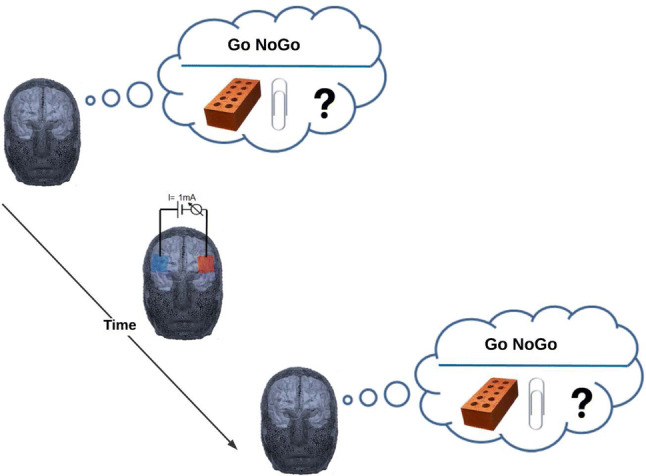
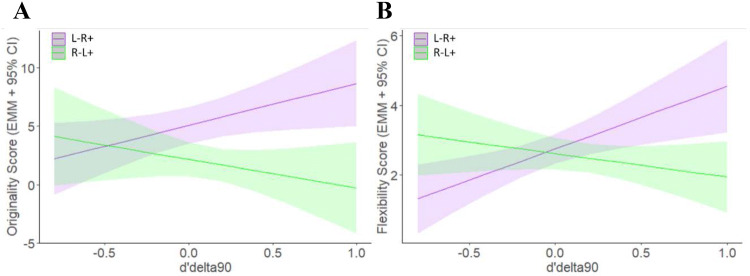
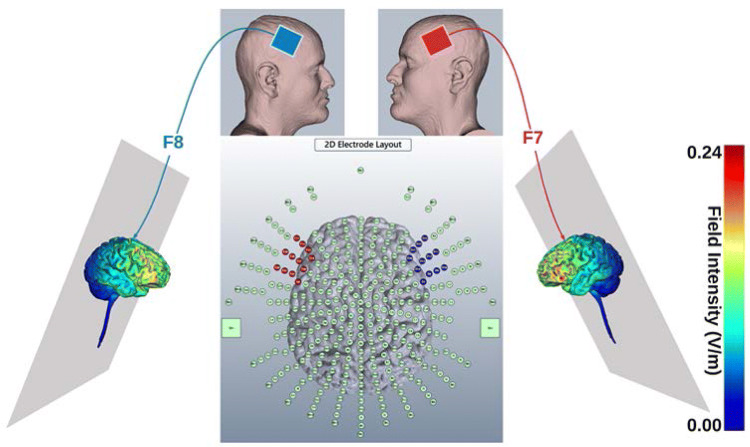
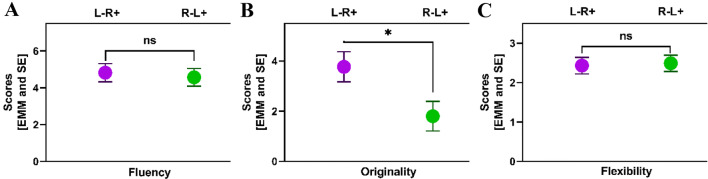
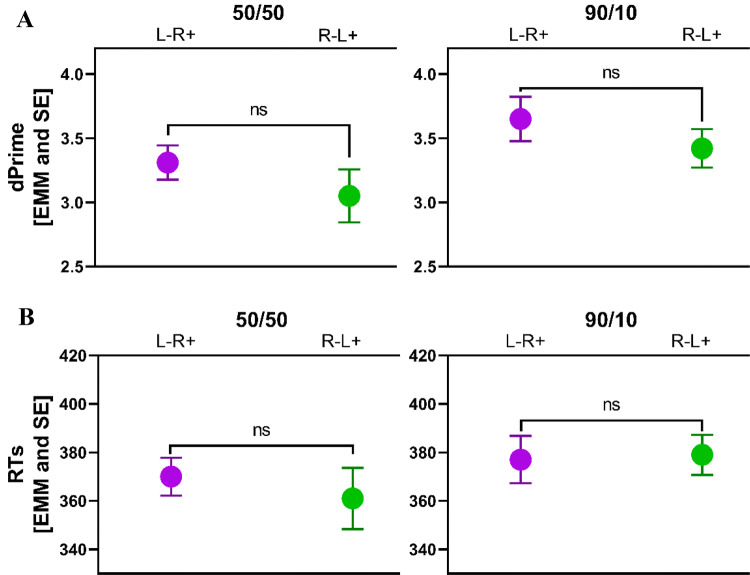
Divergent thinking (DT) as one component of creativity is the ability to search for multiple solutions to a single problem and is reliably tested with the Alternative Uses Task (AUT). DT depends on activity in the inferior frontal gyrus (IFG), a prefrontal region that has also been associated with inhibitory control (IC). Experimentally manipulating IC through transcranial direct current stimulation (tDCS) led to alterations in DT. Here, we aimed at further examining such potential mediating effects of IC on DT (measured as flexibility, fluency, and originality in the AUT) by modulating IC tDCS. Participants received either cathodal tDCS (c-tDCS) of the left IFG coupled with anodal tDCS (a-tDCS) of the right IFG (L-R + ; N = 19), or the opposite treatment (L + R-; N = 21). We hypothesized that L + R- stimulation would enhance IC assessed with the Go NoGo task (GNGT), and that facilitated IC would result in lower creativity scores. The reversed stimulation arrangement (i.e., L- R +) should result in higher creativity scores. We found that tDCS only affected the originality component of the AUT but not flexibility or fluency. We also found no effects on IC, and thus, the mediation effect of IC could not be confirmed. However, we observed a moderation effect: inhibition of left and facilitation of right IFG (L-R +) resulted in enhanced flexibility and originality scores, only when IC performance was also improved. We conclude that inducing a right-to-left gradient in IFG activity by tDCS is efficient in enhancing DT, but only under conditions where tDCS is sufficient to alter IC performance as well.
发散思维(DT)是创造力的一个组成部分,它是指能够搜索一个问题的多种解决方案的能力,并且可以通过替代用途任务(AUT)可靠地进行测试。DT 依赖于下额叶(IFG)的活动,这是一个与抑制控制(IC)相关的前额区域。通过经颅直流电刺激(tDCS)实验性地操纵 IC 会导致 DT 的改变。在这里,我们旨在通过调制 IC tDCS 进一步研究 IC 对 DT(在 AUT 中测量为灵活性、流畅性和新颖性)的潜在介导作用。参与者接受左侧 IFG 的阴极 tDCS(c-tDCS)与右侧 IFG 的阳极 tDCS(L-R+;N=19)联合治疗,或接受相反的治疗(L+R-;N=21)。我们假设 L+R-刺激会增强 Go NoGo 任务(GNGT)评估的 IC,并且促进的 IC 会导致创造力得分降低。相反的刺激安排(即 L-R+)应该会导致更高的创造力得分。我们发现 tDCS 仅影响 AUT 的原创性成分,而不影响灵活性或流畅性。我们也没有发现 IC 的影响,因此,不能确认 IC 的介导作用。然而,我们观察到了一种调节效应:当 IC 表现也得到改善时,抑制左侧和促进右侧 IFG(L-R+)会导致灵活性和原创性得分提高。我们的结论是,通过 tDCS 诱导 IFG 活动的从右到左梯度有效地增强了 DT,但仅在 tDCS 足以改变 IC 表现的情况下。