Kitagawa Daisuke, Suzuki Yuki, Abe Noriyuki, Ui Koji, Suzuki Keitaro, Yamashita Takaya, Sakaguchi Atsuko, Suzuki Soma, Masuo Kazue, Nakano Akiyo, Nakano Ryuichi, Sato Masatoshi, Maeda Koichi, Nakamura Fumihiko, Yano Hisakazu
Department of Microbiology and Infectious Diseases, Nara Medical University, Japan.
Department of Laboratory Medicine, Nara Prefecture General Medical Center, Japan.
Heliyon. 2022 Nov 13;8(11):e11585. doi: 10.1016/j.heliyon.2022.e11585. eCollection 2022 Nov.
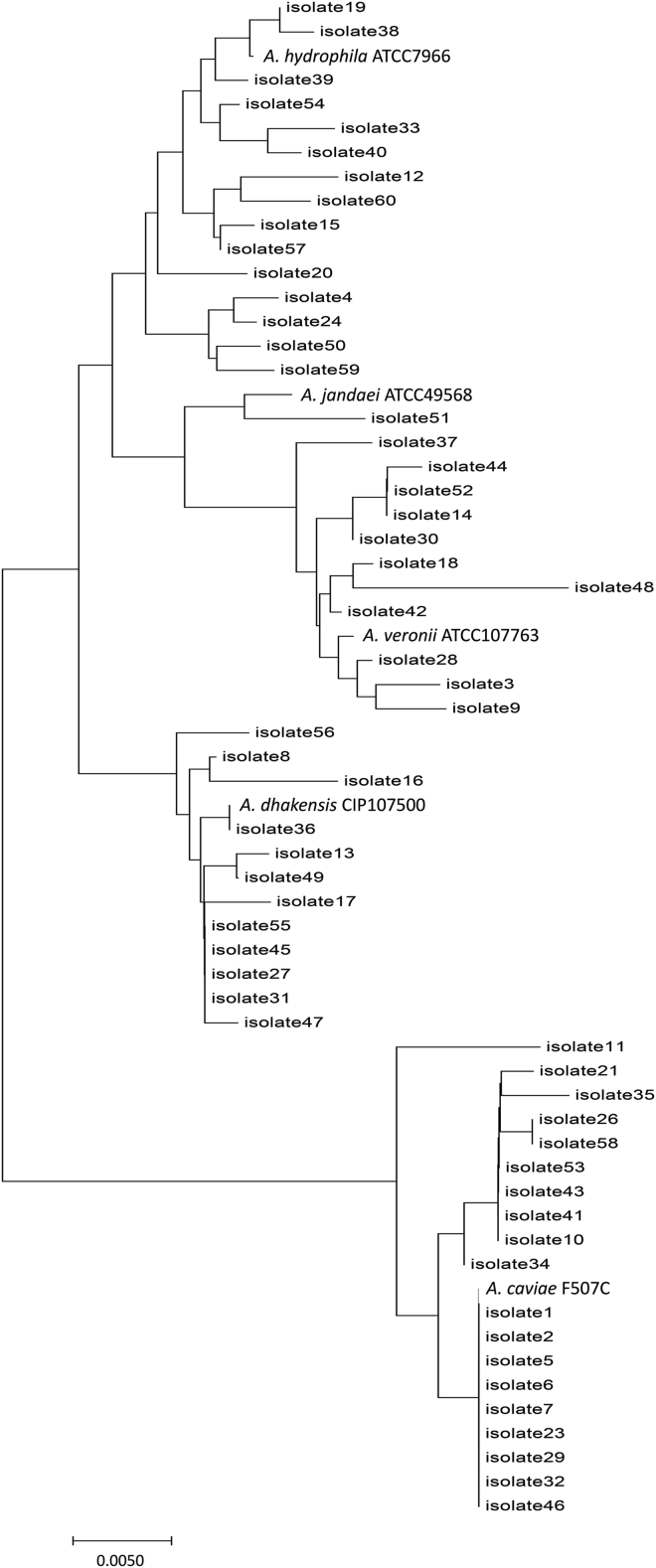
spp., widely present in rivers and soil, cause mild gastroenteritis, severe septicemia, and soft tissue infections in humans. Treatment of these infections require accurate identification of pathogenic spp. However, identification at the species level using conventional methods is highly challenging. In this study, we aimed to compare the accuracy of two different approaches developed for bacterial identification: (i) housekeeping gene sequencing () in conjunction with phylogenetic analysis and (ii) matrix-assisted laser desorption ionization mass spectrometry-time of flight (MALDI-TOF MS) (MALDI Biotyper and VITEK MS), for differentiating spp. We analyzed 58 isolates recovered from patients at different medical institutions in Japan using both identification methods. The B sequencing method was the most accurate, identifying all isolates at the species level. Meanwhile, the MALDI Biotyper system correctly identified 53 (91.4%) isolates at the genus level and an additional 30 (51.7%) at the species level. The VITEK MS system correctly identified 58 (100%) isolates at the genus level and an additional 34 (58.6%) at the species level. Thus, MALDI Biotyper and VITEK MS accurately identified isolates at the genus level, but differences were found in the accuracy of identification of species. However, the low cost and ease of analysis make MALDI-TOF MS-based methods strong candidates for use in clinical laboratories that require easy-to-use identification methods.
[具体物种名]广泛存在于河流和土壤中,可导致人类轻度肠胃炎、严重败血症和软组织感染。治疗这些感染需要准确鉴定致病的[具体物种名]。然而,使用传统方法在物种水平进行鉴定极具挑战性。在本研究中,我们旨在比较为细菌鉴定开发的两种不同方法的准确性:(i)管家基因测序([具体方法])结合系统发育分析,以及(ii)基质辅助激光解吸电离飞行时间质谱(MALDI-TOF MS)(MALDI Biotyper和VITEK MS),用于区分[具体物种名]。我们使用这两种鉴定方法分析了从日本不同医疗机构的患者中分离出的58株[具体物种名]菌株。B测序方法最为准确,在物种水平鉴定出了所有58株菌株。同时,MALDI Biotyper系统在属水平正确鉴定出53株(91.4%)菌株,在物种水平又额外鉴定出30株(51.7%)。VITEK MS系统在属水平正确鉴定出58株(100%)菌株,在物种水平又额外鉴定出34株(58.6%)。因此,MALDI Biotyper和VITEK MS在属水平准确鉴定出了菌株,但在物种鉴定准确性上存在差异。然而,低成本和易于分析使得基于MALDI-TOF MS的方法成为临床实验室中需要易于使用的鉴定方法的有力候选者。