Nelson Monica E, Veal Britney M, Andel Ross, Martinkova Julie, Veverova Katerina, Horakova Hana, Nedelska Zuzana, Laczó Jan, Vyhnalek Martin, Hort Jakub
School of Aging Studies, University of South Florida, Tampa, FL, United States.
Edson College of Nursing and Health Innovation, Arizona State University, Phoenix, AZ, United States.
Front Aging Neurosci. 2022 Nov 3;14:1018071. doi: 10.3389/fnagi.2022.1018071. eCollection 2022.
Dementia syndrome is one of the most devastating conditions in older adults. As treatments to stop neurodegeneration become available, accurate and timely diagnosis will increase in importance. One issue is that cognitive performance sometimes does not match the corresponding level of neuropathology, affecting diagnostic accuracy. Cognitive reserve (CR), which can preserve cognitive function despite underlying neuropathology, explains at least some variability in cognitive performance. We examined the influence of CR proxies (education and occupational position) on the relationship between hippocampal or total gray matter volume and cognition.
We used data from the Czech Brain Aging Study. Participants were clinically confirmed to be without dementia ( = 457, including subjective cognitive decline and amnestic mild cognitive impairment) or with dementia syndrome ( = 113).
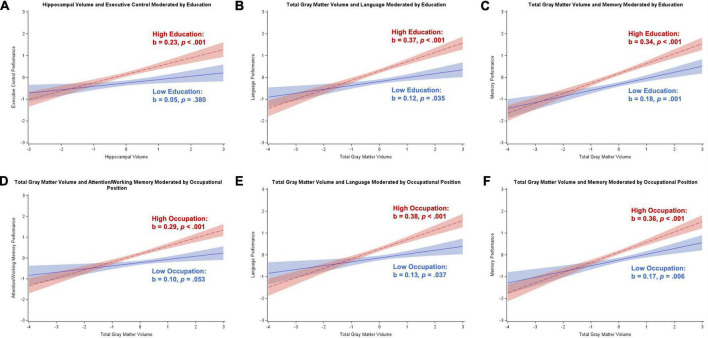
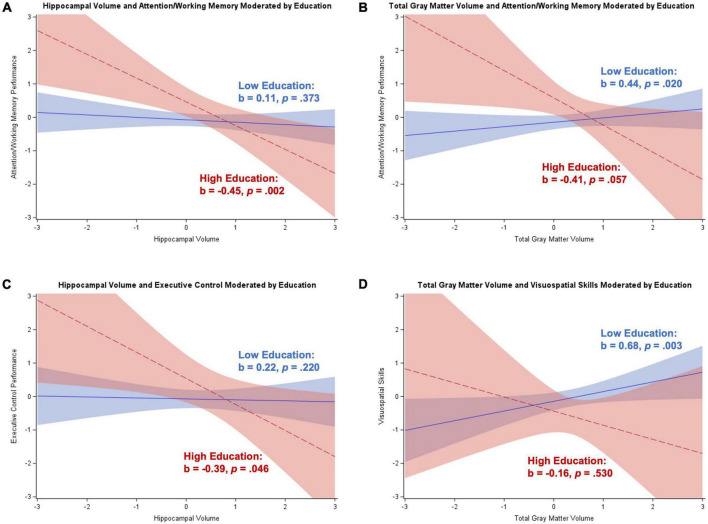
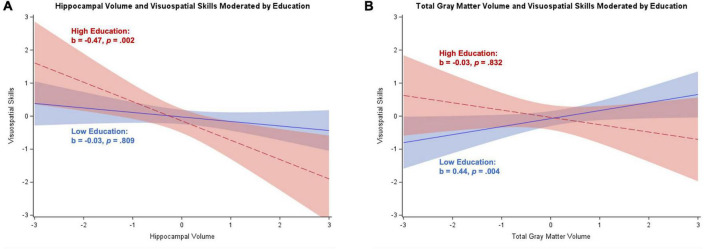
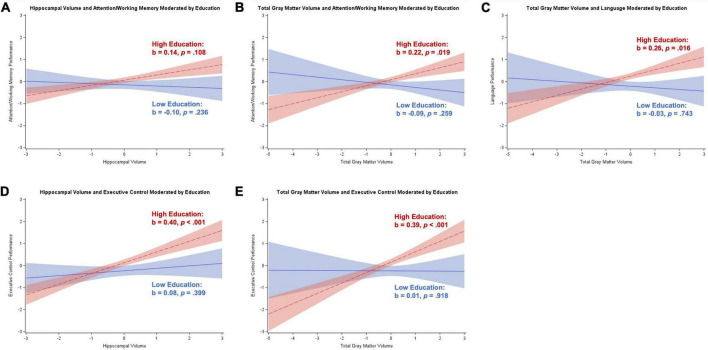
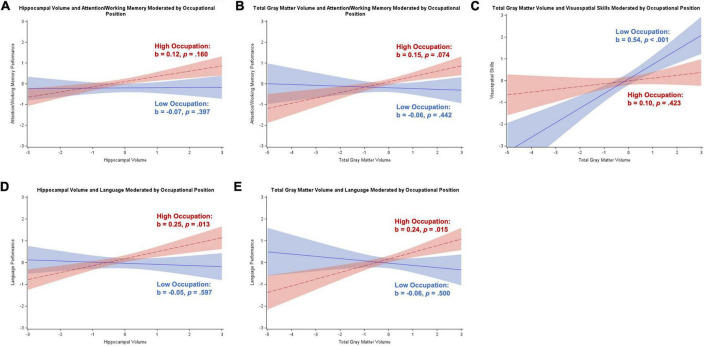
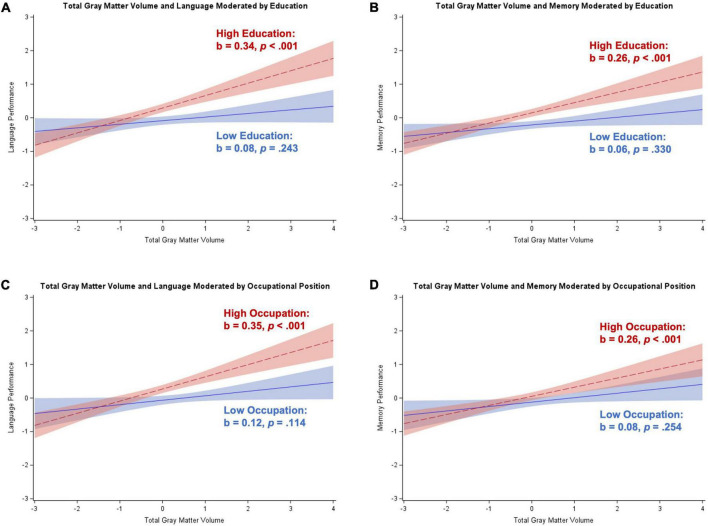
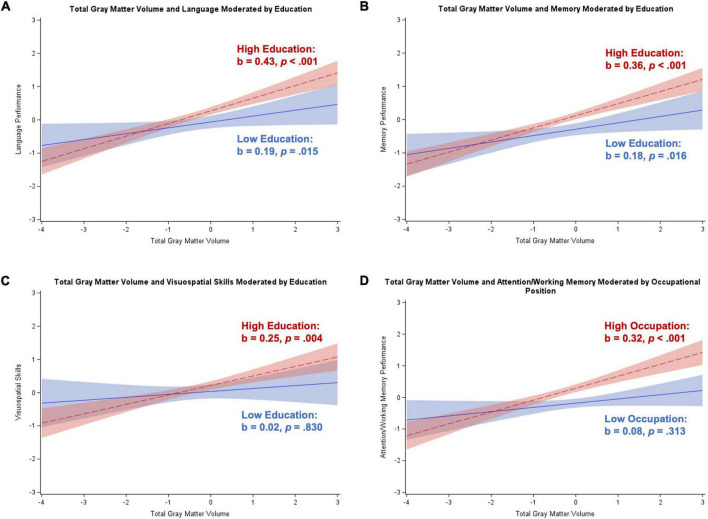
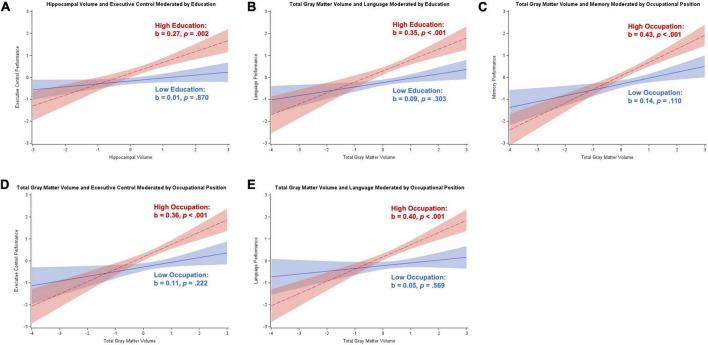
For participants without dementia, higher education magnified the associations between (a) hippocampal volume and executive control ( = 0.09, = 0.033), (b) total gray matter volume and language ( = 0.12, < 0.001), and (c) total gray matter volume and memory ( = 0.08, = 0.018). Similarly, higher occupational position magnified the association between total gray matter volume and (a) attention/working memory ( = 0.09, = 0.009), (b) language ( = 0.13, = 0.002), and (c) memory ( = 0.10, = 0.013). For participants with dementia, the associations between hippocampal ( = -0.26, = 0.024) and total gray matter ( = -0.28, = 0.024) volume and visuospatial skills decreased in magnitude with higher education.
We found that the association between brain volume and cognitive performance varies based on CR, with greater CR related to a stronger link between brain volume and cognition before, and a weaker link after, dementia diagnosis.
痴呆综合征是老年人中最具破坏性的疾病之一。随着阻止神经退行性变的治疗方法的出现,准确及时的诊断将变得更加重要。一个问题是认知表现有时与相应的神经病理学水平不匹配,影响诊断准确性。认知储备(CR),即尽管存在潜在神经病理学仍能保持认知功能,至少可以解释认知表现中的一些变异性。我们研究了CR替代指标(教育程度和职业地位)对海马体或全脑灰质体积与认知之间关系的影响。
我们使用了来自捷克脑老化研究的数据。参与者经临床确认无痴呆(n = 457,包括主观认知下降和遗忘型轻度认知障碍)或患有痴呆综合征(n = 113)。
对于无痴呆的参与者,较高的教育程度放大了以下关联:(a)海马体体积与执行控制之间的关联(β = 0.09,p = 0.033),(b)全脑灰质体积与语言之间的关联(β = 0.12,p < 0.001),以及(c)全脑灰质体积与记忆之间的关联(β = 0.08,p = 0.018)。同样,较高的职业地位放大了全脑灰质体积与以下方面的关联:(a)注意力/工作记忆(β = 0.09,p = 0.009),(b)语言(β = 0.13,p = 0.002),以及(c)记忆(β = 0.10,p = 0.013)。对于患有痴呆的参与者,随着教育程度的提高,海马体(β = -0.26,p = 0.024)和全脑灰质(β = -0.28,p = 0.024)体积与视觉空间技能之间的关联强度降低。
我们发现脑容量与认知表现之间的关联因CR而异,较高的CR与痴呆诊断前脑容量与认知之间更强的联系以及诊断后较弱的联系相关。