
贝叶斯统计模型能够预测人类觅食任务中逐个目标的选择行为。
A Bayesian Statistical Model Is Able to Predict Target-by-Target Selection Behaviour in a Human Foraging Task.
作者信息
Clarke Alasdair D F, Hunt Amelia R, Hughes Anna E
机构信息
Department of Psychology, University of Essex, Wivenhoe Park, Colchester CO4 3SQ, UK.
School of Psychology, University of Aberdeen, King's College, Aberdeen AB24 3FX, UK.
出版信息
Vision (Basel). 2022 Nov 11;6(4):66. doi: 10.3390/vision6040066.
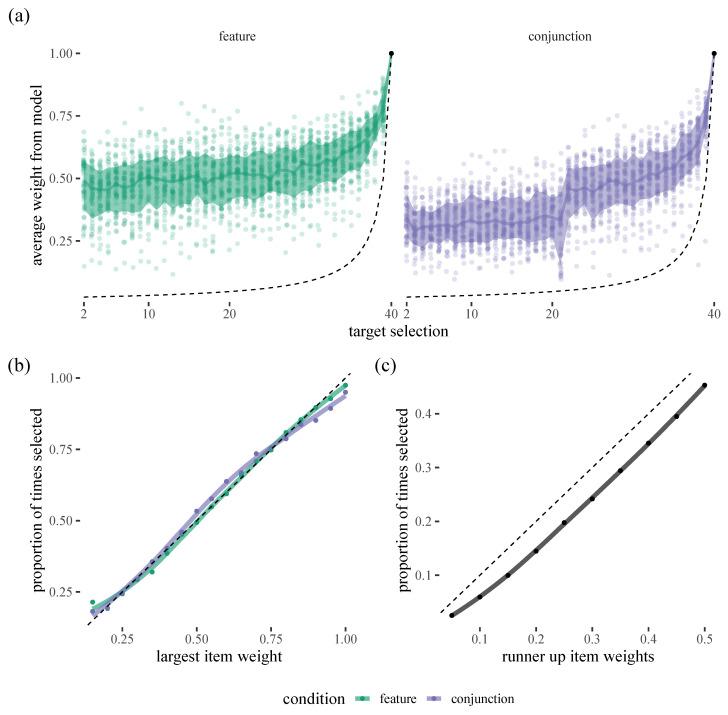
Foraging refers to search involving multiple targets or multiple types of targets, and as a model task has a long history in animal behaviour and human cognition research. Foraging behaviour is usually operationalized using summary statistics, such as average distance covered during target collection (the path length) and the frequency of switching between target types. We recently introduced an alternative approach, which is to model each instance of target selection as random selection without replacement. Our model produces estimates of a set of foraging biases, such as a bias to select closer targets or targets of a particular category. Here we apply this model to predict individual target selection events. We add a new start position bias to the model, and generate foraging paths using the parameters estimated from individual participants' pre-existing data. The model predicts which target the participant will select next with a range of accuracy from 43% to 69% across participants (chance is 11%). The model therefore explains a substantial proportion of foraging behaviour in this paradigm. The situations where the model makes errors reveal useful information to guide future research on those aspects of foraging that we have not yet explained.
觅食是指涉及多个目标或多种类型目标的搜索,作为一种模型任务,在动物行为和人类认知研究中有着悠久的历史。觅食行为通常使用汇总统计数据来操作化,例如在目标收集过程中覆盖的平均距离(路径长度)以及目标类型之间的切换频率。我们最近引入了一种替代方法,即将每个目标选择实例建模为无放回的随机选择。我们的模型产生了一组觅食偏差的估计值,例如选择更近目标或特定类别目标的偏差。在这里,我们应用这个模型来预测个体目标选择事件。我们在模型中添加了一个新的起始位置偏差,并使用从个体参与者的现有数据中估计的参数生成觅食路径。该模型预测参与者接下来会选择哪个目标,在不同参与者中准确率范围为43%至69%(随机概率为11%)。因此,该模型解释了这种范式中很大一部分的觅食行为。模型出现错误的情况揭示了有用的信息,可指导我们对尚未解释的觅食方面进行未来研究。



 Zotero 插件