Elkommos-Zakhary Marina, Rajesh Neeraja, Beljanski Vladimir
Dr. Kiran C. Patel College of Allopathic Medicine, Nova Southeastern University, Davie, FL 33314, USA.
Cell Therapy Institute, Nova Southeastern University, Davie, FL 33314, USA.
Noncoding RNA. 2022 Nov 9;8(6):75. doi: 10.3390/ncrna8060075.
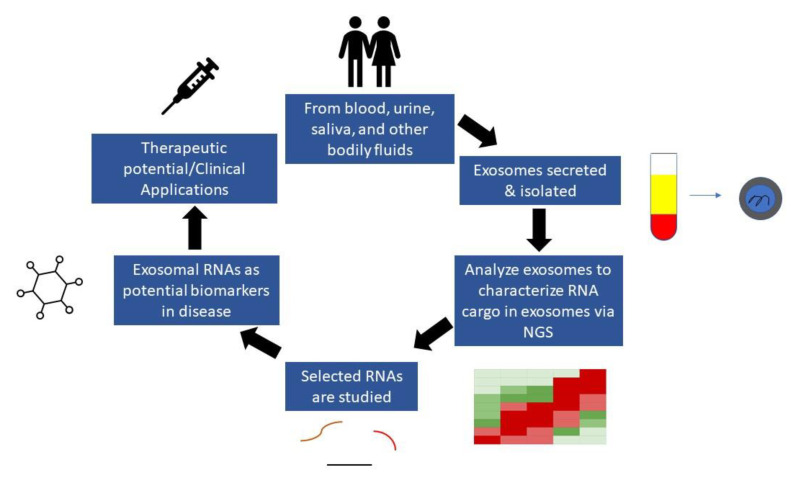
Numerous noninvasive methods are currently being used to determine biomarkers for diseases such as cancer. However, these methods are not always precise and reliable. Thus, there is an unmet need for better diagnostic and prognostic biomarkers that will be used to diagnose cancer in early, more treatable stages of the disease. Exosomes are extracellular vesicles of endocytic origin released by the majority of cells. Exosomes contain and transport nucleic acids, proteins, growth factors, and cytokines from their parent cells to surrounding or even distant cells via circulation in biofluids. Exosomes have attracted the interest of researchers, as recent data indicate that exosome content may be indicative of disease stages and may contribute to disease progression via exosome-mediated extracellular communication. Therefore, the contents of these vesicles are being investigated as possible biomarkers for disease diagnosis and prognosis. The functions of exosomes and their contents in disease development are becoming clearer as isolation and analytical methods, such as RNA sequencing, advance. In this review, we discuss current advances and challenges in exosomal content analyses with emphasis on information that can be generated using RNA sequencing. We also discuss how the RNA sequencing of exosomes may be used to discover novel biomarkers for the detection of different stages for various cancers using specific microRNAs that were found to be differentially expressed between healthy controls and cancer-diagnosed subjects.
目前,许多非侵入性方法被用于确定癌症等疾病的生物标志物。然而,这些方法并不总是精确和可靠的。因此,对于能够在疾病早期更可治疗阶段用于诊断癌症的更好的诊断和预后生物标志物存在未满足的需求。外泌体是大多数细胞释放的内吞起源的细胞外囊泡。外泌体通过生物流体中的循环,将核酸、蛋白质、生长因子和细胞因子从其母细胞携带并运输到周围甚至远处的细胞。外泌体引起了研究人员的兴趣,因为最近的数据表明,外泌体内容物可能指示疾病阶段,并可能通过外泌体介导的细胞外通讯促进疾病进展。因此,这些囊泡的内容物正在作为疾病诊断和预后的潜在生物标志物进行研究。随着诸如RNA测序等分离和分析方法的进步,外泌体及其内容物在疾病发展中的功能越来越清晰。在这篇综述中,我们讨论外泌体内容物分析的当前进展和挑战,重点是使用RNA测序可生成的信息。我们还讨论了如何利用外泌体的RNA测序,通过在健康对照和癌症诊断患者之间差异表达的特定微小RNA,发现用于检测各种癌症不同阶段的新型生物标志物。