Department of Cardiology, University Heart & Vascular Center Hamburg, University Medical Center Hamburg-Eppendorf, Martinistr. 52, 20251 Hamburg, Germany.
German Center for Cardiovascular Research (DZHK), Partner Site Hamburg/Kiel/Luebeck, Martinistr 52, 20251 Hamburg, Germany.
Europace. 2023 Feb 16;25(2):571-577. doi: 10.1093/europace/euac213.
Three Tesla (T) magnetic resonance imaging (MRI) provides critical imaging information for many conditions. Owing to potential interactions of the magnetic field, it is largely withheld from patients with cardiac implantable electronic devices (CIEDs). Therefore, we assessed the safety of 3T MRI in patients with '3T MRI-conditional' and 'non-3T MRI-conditional' CIEDs.
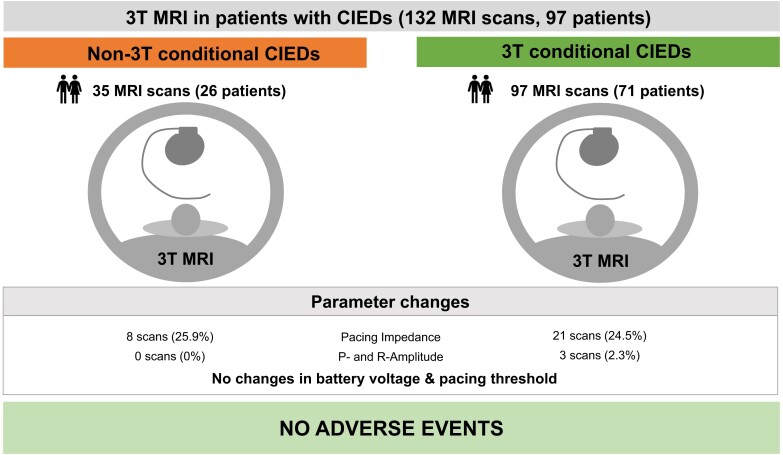
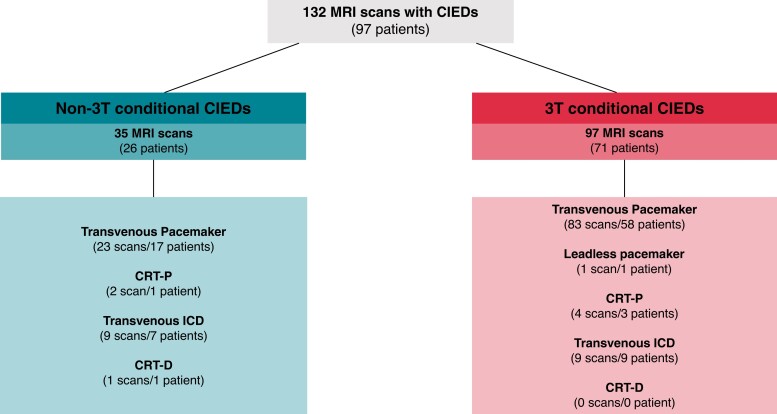
We performed a retrospective single-centre analysis of clinically indicated 3T MRI examinations in patients with conventional pacemakers, cardiac resynchronization devices, and implanted defibrillators from April 2020 to May 2022. All CIEDs were interrogated and programmed before and after scanning. Adverse events included all-cause death, arrhythmias, loss of capture, inappropriate anti-tachycardia therapies, electrical reset, and lead or generator failure during or shortly after MRI. Changes in signal amplitude and lead impedance were systematically assessed. Statistics included median and interquartile range. A total of 132 MRI examinations were performed on a 3T scanner in 97 patients. Thirty-five examinations were performed in patients with 'non-3T MRI-conditional' CIEDs. Twenty-six scans were performed in pacemaker-dependent patients. No adverse events occurred during or shortly after MRI. P-wave or R-wave reductions ≥ 50 and ≥ 25%, respectively, were noted after three (2.3%) scans, all in patients with '3T MRI-conditional' CIEDs. Pacing and shock impedance changed by ± 30% in one case (0.7%). Battery voltage and stimulation thresholds did not relevantly change after MRI.
Pending verification in independent series, our data suggest that clinically indicated MRI scans at 3T field strength should not be withheld from patients with cardiac pacemakers or defibrillators.
3 特斯拉(T)磁共振成像(MRI)为许多疾病提供了关键的成像信息。由于磁场的潜在相互作用,它在很大程度上不被心脏植入式电子设备(CIED)患者使用。因此,我们评估了“3T MRI 有条件”和“非 3T MRI 有条件”CIED 患者进行 3T MRI 的安全性。
我们对 2020 年 4 月至 2022 年 5 月期间因临床需要进行的 3T MRI 检查的常规起搏器、心脏再同步治疗设备和植入式除颤器患者进行了回顾性单中心分析。所有 CIED 在扫描前后均进行了询问和编程。不良事件包括全因死亡、心律失常、捕获丧失、不适当的抗心动过速治疗、电重置以及 MRI 期间或之后不久的导联或发生器故障。系统评估了信号幅度和导联阻抗的变化。统计数据包括中位数和四分位距。97 例患者在 3T 扫描仪上共进行了 132 次 MRI 检查。35 次检查在“非 3T MRI 有条件”CIED 患者中进行。26 次扫描在依赖起搏器的患者中进行。MRI 期间或之后不久没有发生不良事件。在 3 次(2.3%)扫描后,分别记录到 P 波或 R 波降低≥50%和≥25%,均在“3T MRI 有条件”CIED 患者中。起搏和电击阻抗在 1 例(0.7%)中改变了±30%。MRI 后电池电压和刺激阈值没有明显变化。
在独立系列中得到验证之前,我们的数据表明,不应拒绝心脏起搏器或除颤器患者进行临床需要的 3T 场强 MRI 扫描。