Instituto de Ciencia y Tecnología de Polímeros, (ICTP), CSIC, C/ Juan de la Cierva, 3, 28006, Madrid, Spain.
Centro de Investigaciones Biológicas - Margarita Salas (CIB-Margarita Salas), CSIC, C/ Ramiro de Maeztu, 9, 28040, Madrid, Spain.
Sci Rep. 2022 Nov 23;12(1):20177. doi: 10.1038/s41598-022-24300-8.
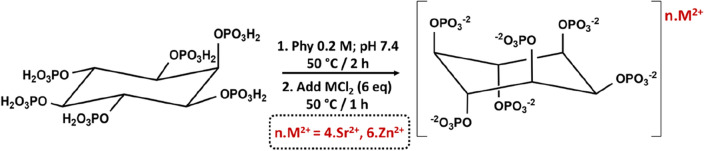
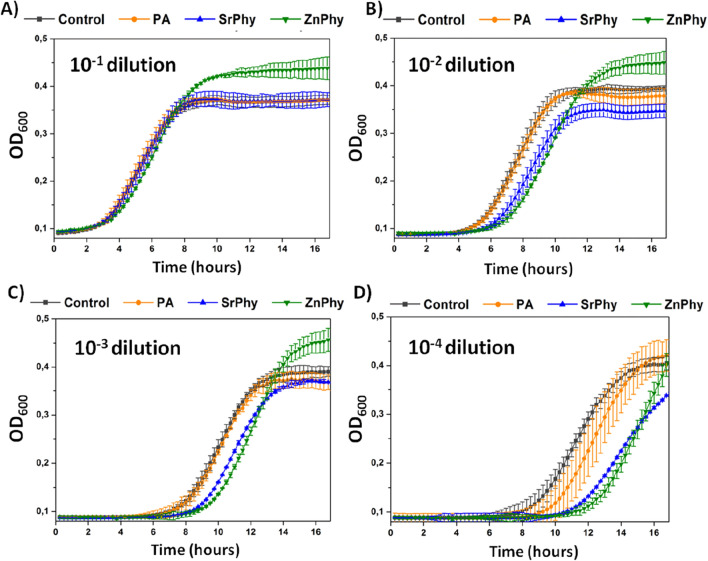
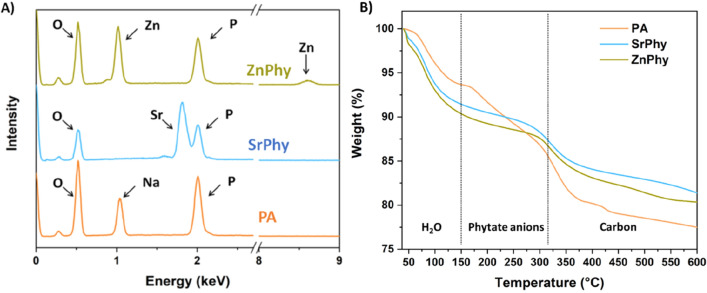
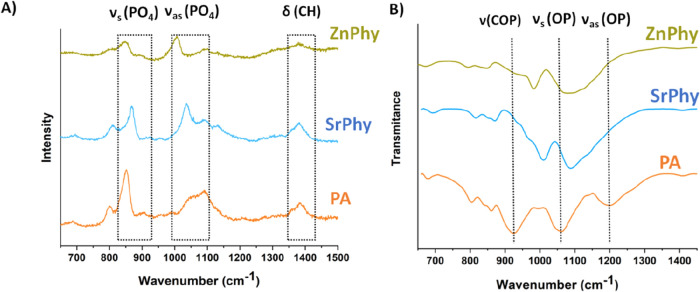
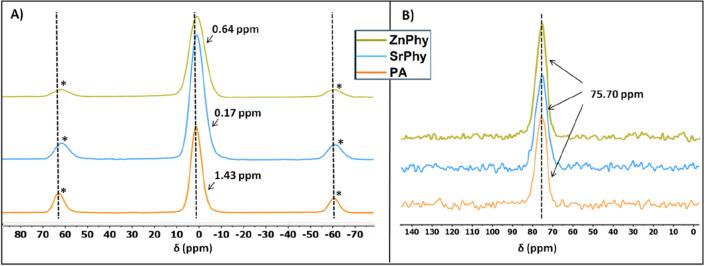
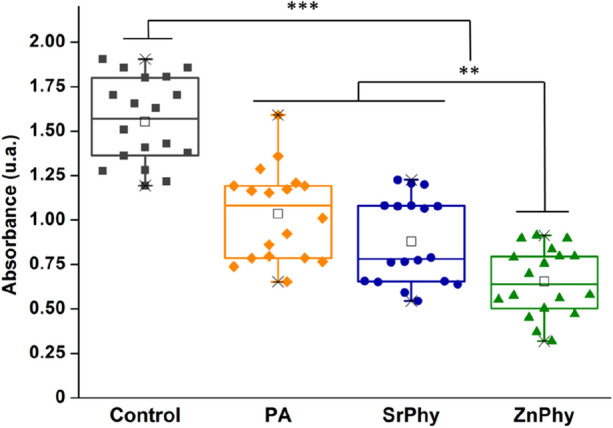
Phytic acid (PA) is an abundant natural plant component that exhibits a versatility of applications benefited from its chemical structure, standing out its use as food, packing and dental additive due to its antimicrobial properties. The capacity of PA to chelate ions is also well-established and the formation and thermodynamic properties of different metallic complexes has been described. However, research studies of these compounds in terms of chemistry and biological features are still demanded in order to extend the application scope of PA complexes. The main goal of this paper is to deepen in the knowledge of the bioactive metal complexes chemistry and their bactericide activity, to extend their application in biomaterial science, specifically in oral implantology. Thus, this work presents the synthesis and structural assessment of two metallic phytate complexes bearing the bioactive cations Zn and Sr (ZnPhy and SrPhy respectively), along with studies on the synergic biological properties between PA and cations. Metallic phytates were synthesized in the solid-state by hydrothermal reaction leading to pure solid compounds in high yields. Their molecular formulas were CH0PSr·5HO and CH0PZn·6HO, as determined by ICP and HRES-TGA. The metal coordination bond of the solid complexes was further analysed by EDS, Raman, ATR-FTIR and solid C and P-NMR spectroscopies. Likewise, we evaluated the in vitro ability of the phytate compounds for inhibiting biofilm production of Streptococcus mutans cultures. Results indicate that all compounds significantly reduced biofilm formation (PA < SrPhy < ZnPhy), and ZnPhy even showed remarkable differences with respect to PA and SrPhy. Analysis of antimicrobial properties shows the first clues of the possible synergic effects created between PA and the corresponding cation in different cell metabolic processes. In overall, findings of this work can contribute to expand the applications of these bioactive metallic complexes in the biotechnological and biomedical fields, and they can be considered for the fabrication of anti-plaque coating systems in the dentistry field.
植酸(PA)是一种丰富的天然植物成分,由于其化学结构,具有多种应用,其抗菌性能使其在食品、包装和牙科添加剂方面具有优势。PA 螯合离子的能力也得到了很好的证实,并且已经描述了不同金属配合物的形成和热力学性质。然而,为了扩展 PA 配合物的应用范围,仍然需要对这些化合物的化学和生物学特性进行研究。本文的主要目的是深入了解生物活性金属配合物的化学和杀菌活性,将其应用扩展到生物材料科学,特别是口腔植入物领域。因此,本工作合成并评估了两种含有生物活性阳离子 Zn 和 Sr 的植酸金属配合物(分别为 ZnPhy 和 SrPhy)的结构,并研究了 PA 和阳离子之间的协同生物学特性。通过水热反应在固态下合成了金属植酸盐,以高产率得到纯固体化合物。它们的分子式分别为 CH0PSr·5HO 和 CH0PZn·6HO,通过 ICP 和 HRES-TGA 确定。通过 EDS、拉曼、ATR-FTIR 和固体 C 和 P-NMR 光谱进一步分析了固体配合物的金属配位键。同样,我们评估了植酸盐化合物抑制变形链球菌培养物生物膜形成的体外能力。结果表明,所有化合物均显著降低了生物膜的形成(PA<SrPhy<ZnPhy),而 ZnPhy 甚至与 PA 和 SrPhy 相比表现出显著差异。抗菌性能分析表明,PA 和相应阳离子在不同细胞代谢过程中可能存在协同作用的第一个线索。总的来说,这项工作的结果可以有助于扩展这些生物活性金属配合物在生物技术和生物医学领域的应用,并可考虑将其用于牙科领域的抗菌斑涂层系统的制备。