Departamento de Microbiología y Ecología, Facultad de Medicina y Odontología, Universitat de Valencia, E-46100 Burjasot, Valencia, Spain.
Departamento de Microbiología y Ecología, Facultad de Ciencias Biológicas, Universitat de Valencia, E-46100 Burjasot, Valencia, Spain.
Toxins (Basel). 2022 Nov 19;14(11):807. doi: 10.3390/toxins14110807.
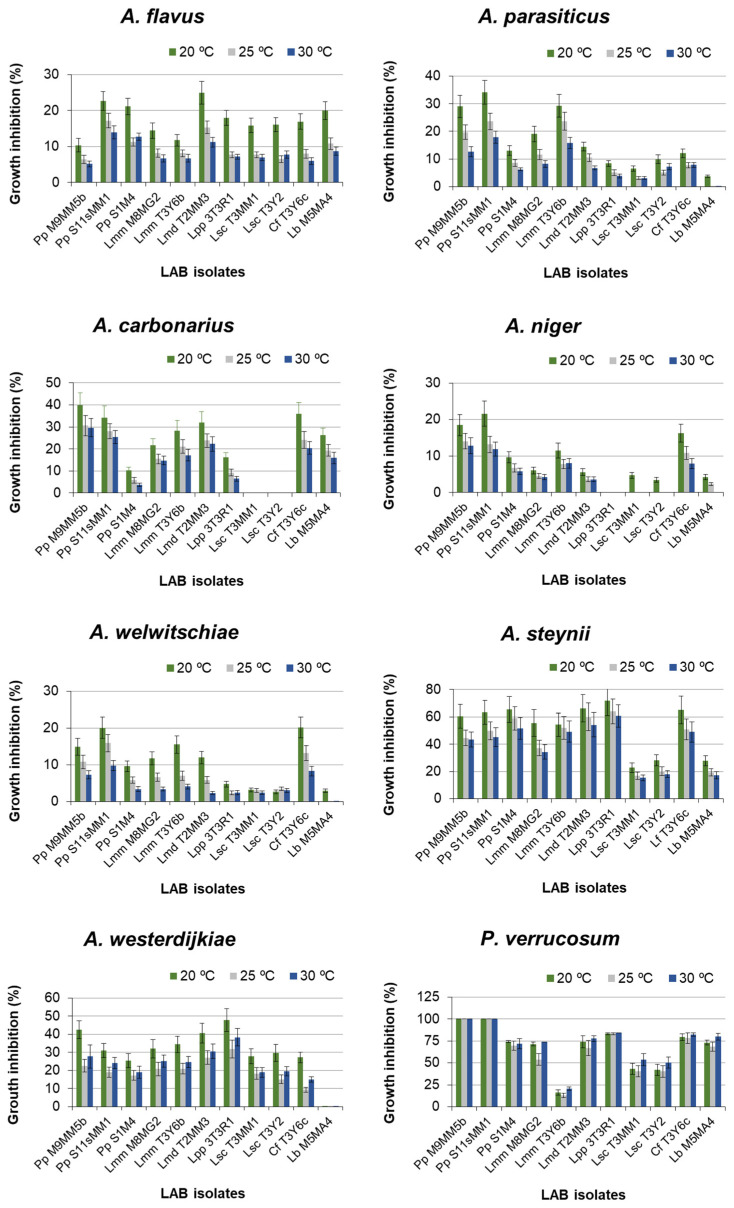
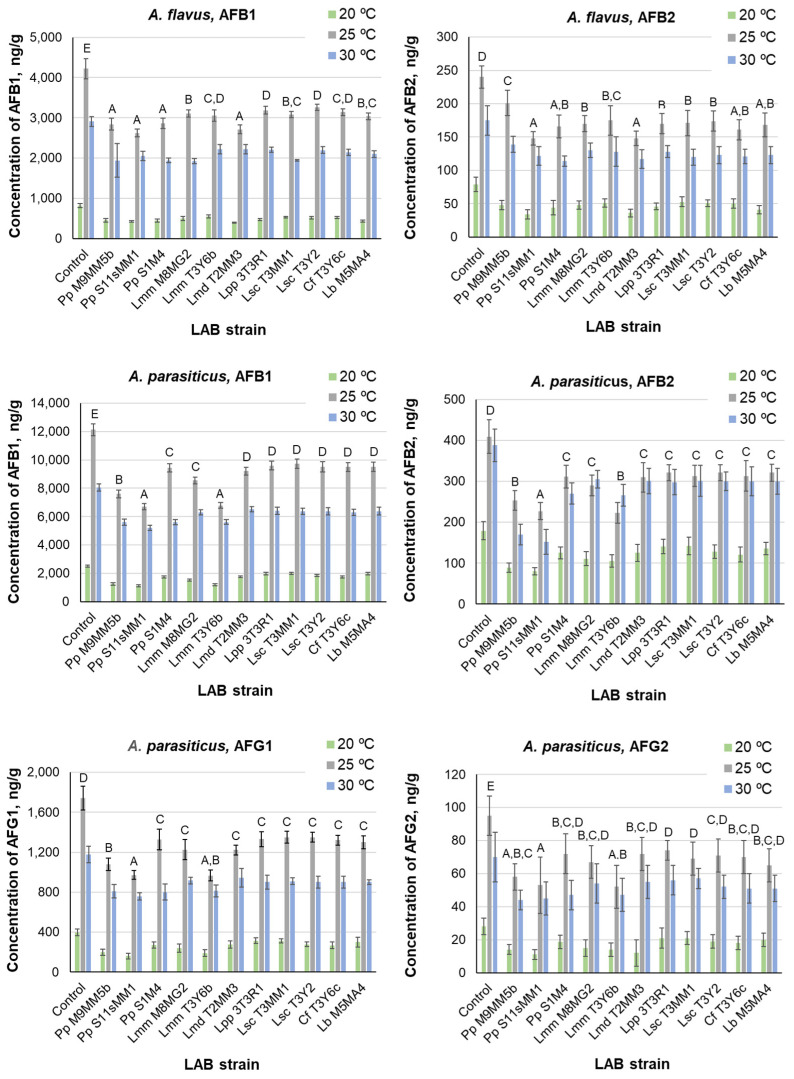
Aflatoxins (AF) and ochratoxin A (OTA) are fungal metabolites that have carcinogenic, teratogenic, embryotoxic, genotoxic, neurotoxic, and immunosuppressive effects in humans and animals. The increased consumption of plant-based foods and environmental conditions associated with climate change have intensified the risk of mycotoxin intoxication. This study aimed to investigate the abilities of eleven selected LAB strains to reduce/inhibit the growth of , , , , , , , and and AF and OTA production under different temperature regiments. Data were treated by ANOVA, and machine learning (ML) models able to predict the growth inhibition percentage were built, and their performance was compared. All factors LAB strain, fungal species, and temperature significantly affected fungal growth and mycotoxin production. The fungal growth inhibition range was 0-100%. Overall, the most sensitive fungi to LAB treatments were and , while the least sensitive were and . The LAB strains with the highest antifungal activity were (strains S11sMM and M9MM5b). The reduction range for AF was 19.0% (aflatoxin B1)-60.8% (aflatoxin B2) and for OTA, 7.3-100%, depending on the bacterial and fungal strains and temperatures. The LAB strains with the highest anti-AF activity were the three strains of and ssp. (T2MM3), and those with the highest anti-OTA activity were ssp. (3T3R1) and ssp. (T2MM3). The best ML methods in predicting fungal growth inhibition were multilayer perceptron neural networks, followed by random forest. Due to anti-fungal and anti-mycotoxin capacity, the LABs strains used in this study could be good candidates as biocontrol agents against aflatoxigenic and ochratoxigenic fungi and AFL and OTA accumulation.
黄曲霉毒素(AF)和赭曲霉毒素 A(OTA)是真菌代谢物,对人类和动物具有致癌、致畸、胚胎毒性、遗传毒性、神经毒性和免疫抑制作用。植物性食品消费的增加以及与气候变化相关的环境条件加剧了真菌毒素中毒的风险。本研究旨在研究 11 株选定的 LAB 菌株在不同温度条件下降低/抑制生长的能力,,,,,,,,和 AF 和 OTA 的产生。数据通过方差分析处理,并建立了能够预测生长抑制率的机器学习(ML)模型,并比较了它们的性能。所有因素 LAB 菌株、真菌种类和温度都显著影响真菌的生长和真菌毒素的产生。真菌生长抑制范围为 0-100%。总体而言,对 LAB 处理最敏感的真菌是 和 ,而最不敏感的是 和 。具有最高抗真菌活性的 LAB 菌株是 (S11sMM 和 M9MM5b 菌株)。AF 的减少范围为 19.0%(黄曲霉毒素 B1)-60.8%(黄曲霉毒素 B2),OTA 为 7.3-100%,这取决于细菌和真菌菌株以及温度。具有最高抗 AF 活性的 LAB 菌株是 3 株 和 亚种(T2MM3),具有最高抗 OTA 活性的是 和 亚种(3T3R1)和 亚种(T2MM3)。预测真菌生长抑制的最佳 ML 方法是多层感知器神经网络,其次是随机森林。由于抗真菌和抗真菌毒素的能力,本研究中使用的 LAB 菌株可以作为生物防治剂,对抗产黄曲霉毒素和产赭曲霉毒素真菌以及 AFL 和 OTA 的积累。