Departamento de Sistemas Informáticos, Universidad de Castilla-La Mancha, 02071 Albacete, Spain.
Neurocognition and Emotion Unit, Instituto de Investigación en Informática, 02071 Albacete, Spain.
Sensors (Basel). 2022 Nov 17;22(22):8886. doi: 10.3390/s22228886.
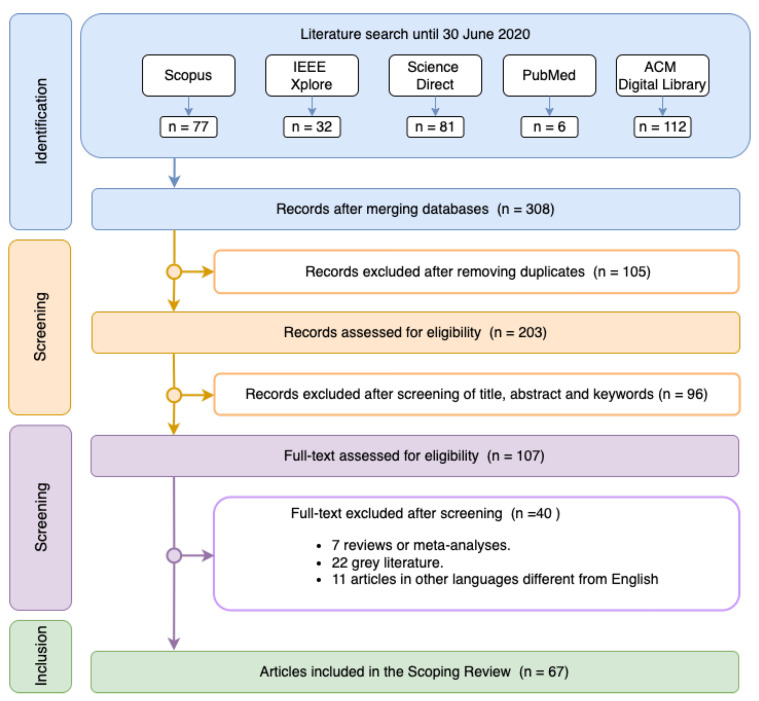
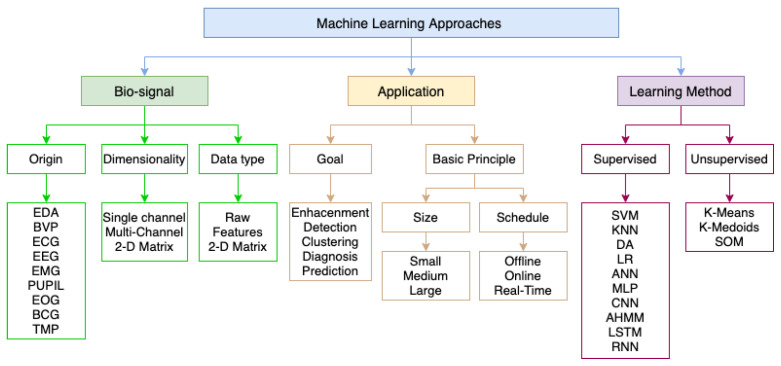
This article introduces a systematic review on arousal classification based on electrodermal activity (EDA) and machine learning (ML). From a first set of 284 articles searched for in six scientific databases, fifty-nine were finally selected according to various criteria established. The systematic review has made it possible to analyse all the steps to which the EDA signals are subjected: acquisition, pre-processing, processing and feature extraction. Finally, all ML techniques applied to the features of these signals for arousal classification have been studied. It has been found that support vector machines and artificial neural networks stand out within the supervised learning methods given their high-performance values. In contrast, it has been shown that unsupervised learning is not present in the detection of arousal through EDA. This systematic review concludes that the use of EDA for the detection of arousal is widely spread, with particularly good results in classification with the ML methods found.
本文介绍了一项基于皮肤电活动(EDA)和机器学习(ML)的觉醒分类的系统评价。从六个科学数据库中搜索到的最初的 284 篇文章中,根据各种既定标准,最终选择了 59 篇文章。该系统评价使我们能够分析 EDA 信号所经历的所有步骤:采集、预处理、处理和特征提取。最后,研究了所有应用于这些信号的特征以进行觉醒分类的 ML 技术。研究发现,支持向量机和人工神经网络在监督学习方法中表现出色,因为它们具有高性能值。相比之下,通过 EDA 检测觉醒时,未发现无监督学习。本系统评价得出结论,使用 EDA 进行觉醒检测已得到广泛应用,在使用所发现的 ML 方法进行分类时,取得了特别好的结果。