Li Chun'e, Chen Yujing, Wen Yan, Jia Yumeng, Cheng Shiqiang, Liu Li, Zhang Huijie, Pan Chuyu, Zhang Jingxi, Zhang Zhen, Yang Xuena, Meng Peilin, Yao Yao, Zhang Feng
Key Laboratory of Trace Elements and Endemic Diseases, School of Public Health, Collaborative Innovation Center of Endemic Disease and Health Promotion for Silk Road Region, Health Science Center, Xi'an Jiaotong University, Xi'an, China.
Front Psychiatry. 2022 Nov 10;13:960756. doi: 10.3389/fpsyt.2022.960756. eCollection 2022.
Growing evidence supports that alterations in the gut microbiota play an essential role in the etiology of anxiety, depression, and other psychiatric disorders. However, the potential effect of oral microbiota on mental health has received little attention.
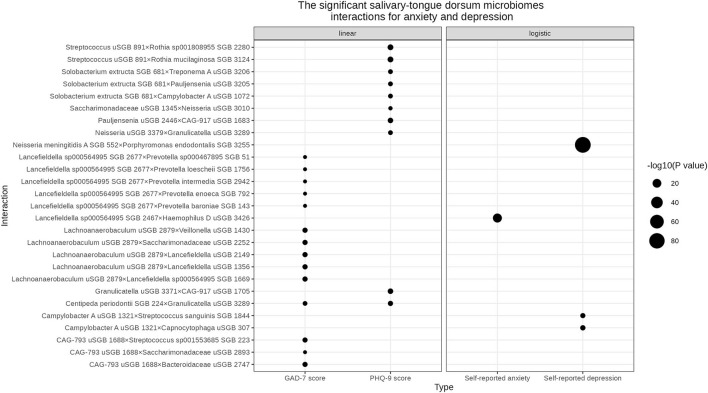
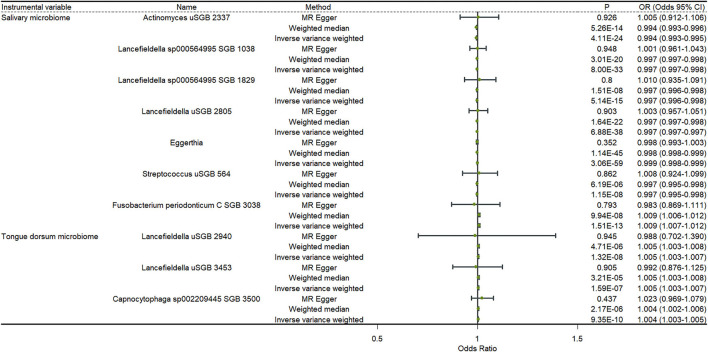
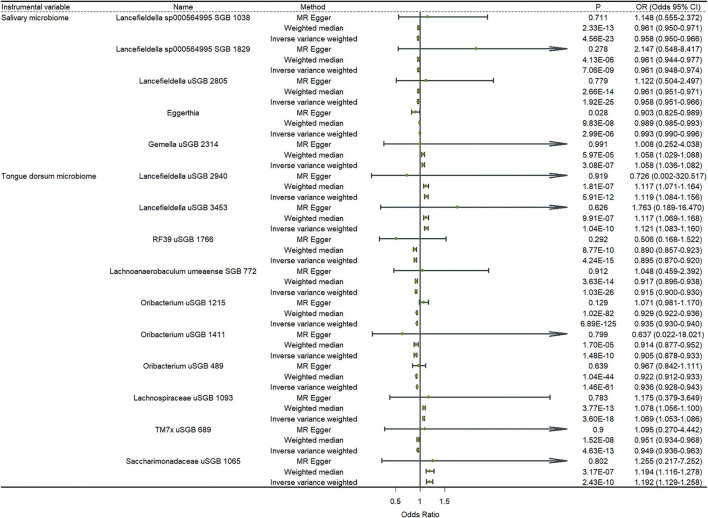
Using the latest genome-wide association study (GWAS) summary data of the oral microbiome, polygenic risk scores (PRSs) of 285 salivary microbiomes and 309 tongue dorsum microbiomes were conducted. Logistic and linear regression models were applied to evaluate the relationship between salivary-tongue dorsum microbiome interactions with anxiety and depression. Two-sample Mendelian randomization (MR) was utilized to compute the causal effects between the oral microbiome, anxiety, and depression.
We observed significant salivary-tongue dorsum microbiome interactions related to anxiety and depression traits. Significantly, one common interaction was observed to be associated with both anxiety score and depression score, × (P = 1.41 × 10, P = 5.10 × 10). Furthermore, we detected causal effects between the oral microbiome and anxiety and depression. Importantly, we identified one salivary microbiome associated with both anxiety and depression in both the UKB database and the Finngen public database, (P = 2.99 × 10, P = 3.06 × 10, P = 3.16 × 10 P = 1.14 × 10).
This study systematically explored the relationship between the oral microbiome and anxiety and depression, which could help improve our understanding of disease pathogenesis and propose new diagnostic targets and early intervention strategies.
越来越多的证据支持肠道微生物群的改变在焦虑、抑郁和其他精神疾病的病因中起重要作用。然而,口腔微生物群对心理健康的潜在影响却很少受到关注。
利用口腔微生物组的最新全基因组关联研究(GWAS)汇总数据,对285个唾液微生物组和309个舌背微生物组进行多基因风险评分(PRSs)。应用逻辑回归和线性回归模型来评估唾液-舌背微生物组相互作用与焦虑和抑郁之间的关系。采用两样本孟德尔随机化(MR)方法计算口腔微生物组、焦虑和抑郁之间的因果效应。
我们观察到与焦虑和抑郁特征相关的唾液-舌背微生物组之间存在显著相互作用。值得注意的是,观察到一种常见的相互作用与焦虑评分和抑郁评分均相关,×(P = 1.41×10,P = 5.10×10)。此外,我们检测到口腔微生物组与焦虑和抑郁之间的因果效应。重要的是,我们在英国生物银行(UKB)数据库和芬兰基因(Finngen)公共数据库中均发现一种与焦虑和抑郁均相关的唾液微生物组,(P = 2.99×10,P = 3.06×10,P = 3.16×10,P = 1.14×10)。
本研究系统地探讨了口腔微生物组与焦虑和抑郁之间的关系,这有助于提高我们对疾病发病机制的理解,并提出新的诊断靶点和早期干预策略。