Bergdolt Juliane, Sellin Pauline, Driessen Martin, Beblo Thomas, Dehn Lorenz B
Department of Psychiatry and Psychotherapy, Evangelisches Klinikum Bethel, Universitätsklinikum OWL of Bielefeld University, Bielefeld, Germany.
Department of Psychology, Bielefeld University, Bielefeld, Germany.
Front Psychiatry. 2022 Nov 9;13:942161. doi: 10.3389/fpsyt.2022.942161. eCollection 2022.
Major depression is one of the leading causes of disability and limited capacity to work. Neuropsychological impairment is a common symptom in acute and remitted major depression and is associated with poor psychosocial functioning. This scoping review aimed to identify research on the role of neuropsychological functioning in outcomes of vocational rehabilitation programs in individuals with depression.
We report on the conduct of this pre-registered (https://osf.io/5yrnf) scoping review in accordance with PRISMA-ScR guidelines. PubMed and PsychInfo were systematically searched for English or German research articles published between 1990 and September 2021 that studied objective neuropsychological tests as predictors of vocational rehabilitation interventions and included participants with depression.
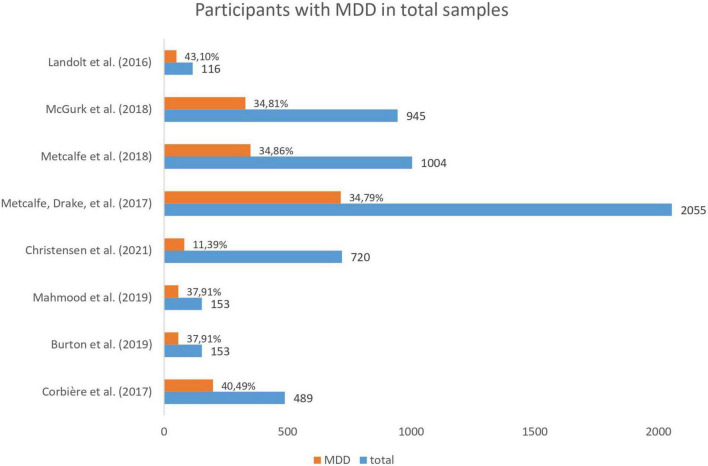
The systematic literature search yielded no studies that specifically targeted subjects with major depression. However, eight articles published since 2016 were included in the review, analyzing data from five trials that evaluated the effectiveness of supported employment in North America and Europe in severe mental illnesses. An estimated 31% of the total number of participants included ( = 3,533) had major depression. Using a variety of cognitive tests and covariates, seven articles found that neuropsychological functioning - especially global cognition scores, verbal and visual learning and memory - significantly predicted vocational outcomes of rehabilitation programs.
Despite a lack of studies specifically targeting major depressive disorder, the identified literature suggests that higher baseline neuropsychological functioning predicts better vocational outcomes of supported employment programs in individuals with depression. In clinical practice, additional neuropsychological modules during return-to-work interventions might be helpful for vocational outcomes of such programs.
重度抑郁症是导致残疾和工作能力受限的主要原因之一。神经心理障碍是急性和缓解期重度抑郁症的常见症状,且与社会心理功能不佳有关。本范围综述旨在确定关于神经心理功能在抑郁症患者职业康复计划结果中的作用的研究。
我们按照PRISMA-ScR指南报告了这项预先注册(https://osf.io/5yrnf)的范围综述的开展情况。我们系统检索了PubMed和PsychInfo,以查找1990年至2021年9月期间发表的英文或德文研究文章,这些文章研究了客观神经心理测试作为职业康复干预预测指标的情况,并纳入了抑郁症患者。
系统文献检索未发现专门针对重度抑郁症患者的研究。然而,2016年以来发表的八篇文章被纳入综述,这些文章分析了五项试验的数据,这些试验评估了北美和欧洲支持性就业对严重精神疾病的有效性。在纳入的参与者总数(n = 3533)中,估计有31%患有重度抑郁症。七篇文章使用了各种认知测试和协变量,发现神经心理功能——尤其是整体认知得分、言语和视觉学习及记忆——显著预测了康复计划的职业结果。
尽管缺乏专门针对重度抑郁症的研究,但已确定的文献表明,较高的基线神经心理功能预示着抑郁症患者支持性就业计划的职业结果更好。在临床实践中,重返工作干预期间增加神经心理模块可能有助于此类计划的职业结果。