Jeong Donghyun Paul, Hall Eva, Neu Erin, Hanjaya-Putra Donny
Department of Aerospace and Mechanical Engineering, Bioengineering Graduate Program, University of Notre Dame, 141 Multidisciplinary Research Building, Notre Dame, IN 46556 USA.
Department of Chemical and Biomolecular Engineering, University of Notre Dame, Notre Dame, IN 46556 USA.
Cell Mol Bioeng. 2022 Aug 6;15(5):467-478. doi: 10.1007/s12195-022-00730-2. eCollection 2022 Oct.
Controlling the formation of blood and lymphatic vasculatures is crucial for engineered tissues. Although the lymphatic vessels originate from embryonic blood vessels, the two retain functional and physiological differences even as they develop in the vicinity of each other. This suggests that there is a previously unknown molecular mechanism by which blood (BECs) and lymphatic endothelial cells (LECs) recognize each other and coordinate to generate distinct capillary networks.
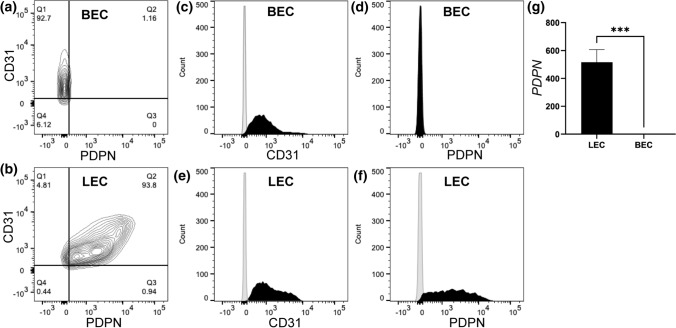
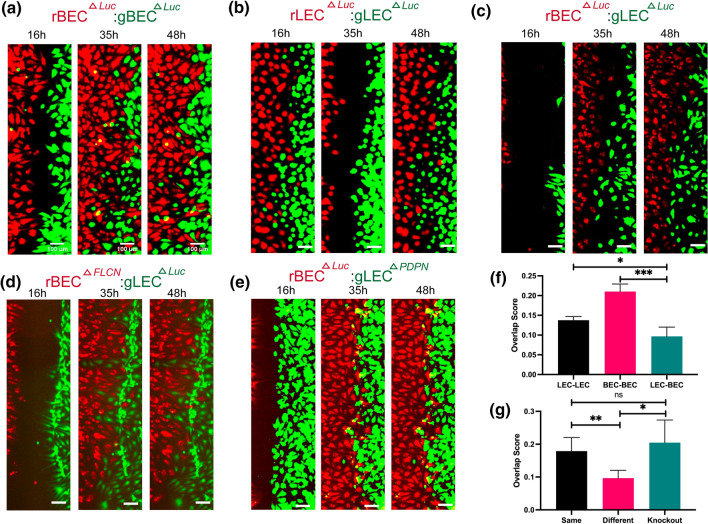
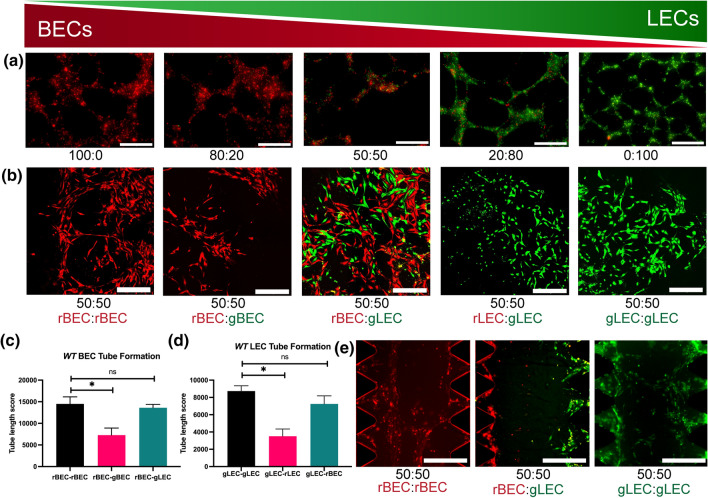
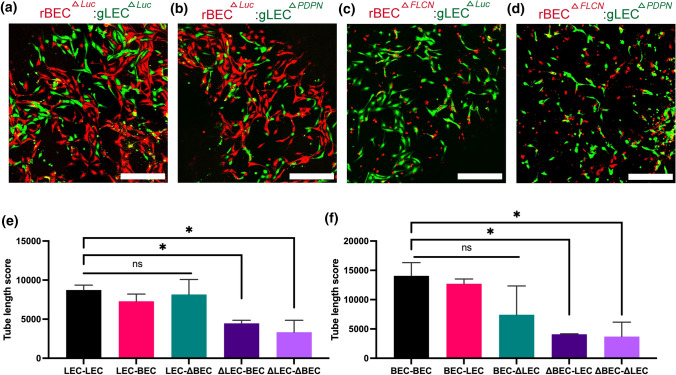
We utilized Matrigel and fibrin assays to determine how cord-like structures (CLS) can be controlled by altering LEC and BEC identity through podoplanin () and folliculin () expressions. We generated BEC and LEC , and observed cell migration to characterize loss lymphatic and blood characteristics due to respective knockouts.
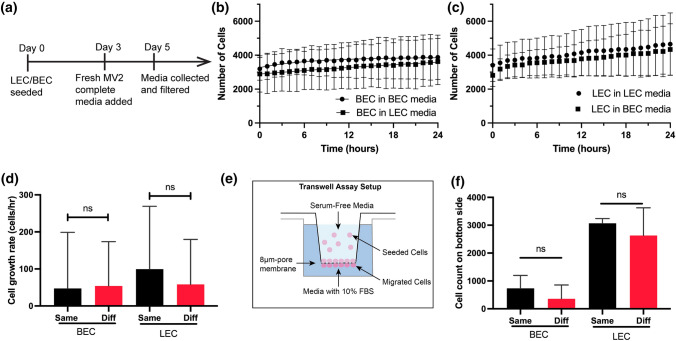
We observed that LECs and BECs form distinct CLS in Matrigel and fibrin gels despite being cultured in close proximity with each other. We confirmed that the LECs and BECs do not recognize each other through paracrine signaling, as proliferation and migration of both cells were unaffected by paracrine signals. On the other hand, we found to be the key surface protein that is responsible for LEC-BEC recognition, and LECs lacking became pseudo-BECs and vice versa. We also found that maintains BEC identity through downregulation of .
Overall, these observations reveal a new molecular pathway through which LECs and BECs form distinct CLS through physical contact by which in turn is regulated by , which has important implications toward designing functional engineered tissues.
The online version contains supplementary material available at 10.1007/s12195-022-00730-2.
控制血液和淋巴管系统的形成对于工程组织至关重要。尽管淋巴管起源于胚胎血管,但即使它们在彼此附近发育,两者仍保持功能和生理差异。这表明存在一种以前未知的分子机制,通过该机制血液内皮细胞(BECs)和淋巴管内皮细胞(LECs)相互识别并协调以生成不同的毛细血管网络。
我们利用基质胶和纤维蛋白测定法来确定如何通过血小板内皮细胞黏附分子()和卵泡抑素()的表达改变LEC和BEC的特性来控制索状结构(CLS)。我们生成了BEC和LEC,并观察细胞迁移以表征由于各自基因敲除导致的淋巴管和血液特性丧失。
我们观察到,尽管LECs和BECs彼此紧密培养,但它们在基质胶和纤维蛋白凝胶中形成了不同的CLS。我们证实,LECs和BECs不会通过旁分泌信号相互识别,因为两种细胞的增殖和迁移均不受旁分泌信号的影响。另一方面,我们发现是负责LEC-BEC识别的关键表面蛋白,缺乏的LECs变成了假BECs,反之亦然。我们还发现通过下调来维持BEC的特性。
总体而言,这些观察结果揭示了一种新的分子途径,通过该途径LECs和BECs通过物理接触形成不同的CLS,而这又受的调节,这对设计功能性工程组织具有重要意义。
在线版本包含可在10.1007/s12195-022-00730-2获取的补充材料。