Damant Ronald W, Rourke Liam, Cui Ying, Lam Grace Y, Smith Maeve P, Fuhr Desi P, Tay Jaqueline K, Varughese Rhea A, Laratta Cheryl R, Lau Angela, Wong Eric Y, Stickland Michael K, Ferrara Giovanni
University of Alberta, Faculty of Medicine and Dentistry, Edmonton, AB, Canada.
University of Alberta, Faculty of Education, Edmonton, AB, Canada.
EClinicalMedicine. 2022 Nov 25;55:101755. doi: 10.1016/j.eclinm.2022.101755. eCollection 2023 Jan.
Many of the 10-20% percent of COVID-19 survivors who develop Post COVID-19 Condition (PCC, or Long COVID) describe experiences suggestive of stigmatization, a known social determinant of health. Our objective was to develop an instrument, the Post COVID-19 Condition Stigma Questionnaire (PCCSQ), with which to quantify and characterise PCC-related stigma.
We conducted a prospective cohort study to assess the reliability and validity of the PCCSQ. Patients referred to our Post COVID-19 Clinic in the Canadian City of Edmonton, Alberta between May 29, 2021 and May 24, 2022 who met inclusion criteria (attending an academic post COVID-19 clinic; age ≥18 years; persistent symptoms and impairment at ≥ 12 weeks since PCR positive acute COVID-19 infection; English-speaking; internet access; consenting) were invited to complete online questionnaires, including the PCCSQ. Analyses were conducted to estimate the instrument's reliability, construct validity, and association with relevant instruments and defined health outcomes.
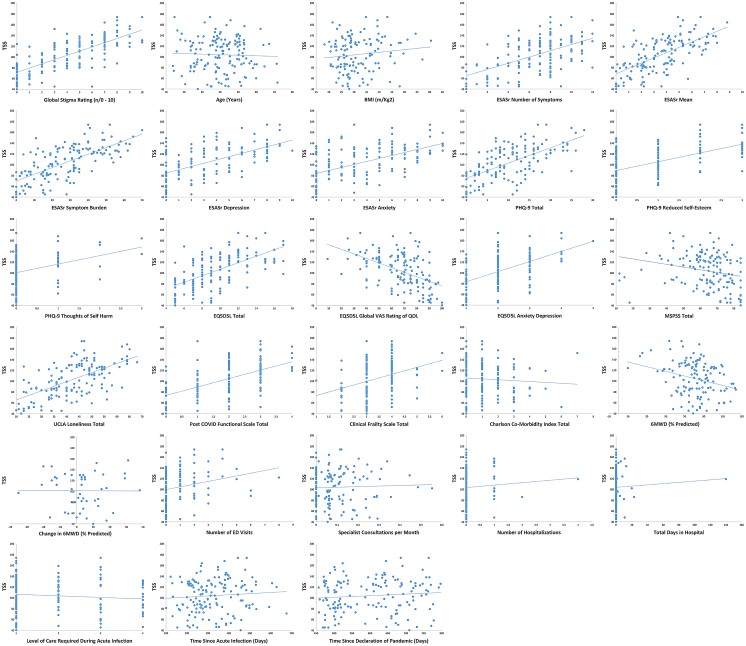
Of the 198 patients invited, 145 (73%) met inclusion criteria and completed usable questionnaires. Total Stigma Score (TSS) on the PCCSQ ranged from 40 to 174/200. The mean (SD) was 103.9 (31.3). Cronbach's alpha was 0.97. Test-retest reliability was 0.92. Factor analysis supported a 6-factor latent construct. Subtest reliabilities were >0.75. Individuals reporting increased TSS occurred across all demographic groups. Increased risk categories included women, white ethnicity, and limited educational opportunities. TSS was positively correlated with symptoms, depression, anxiety, loneliness, reduced self-esteem, thoughts of self-harm, post-COVID functional status, frailty, EQ5D5L score, and number of ED visits. It was negatively correlated with perceived social support, 6-min walk distance, and EQ5D5L global rating. Stigma scores were significantly increased among participants reporting employment status as disabled.
Our findings suggested that the PCCSQ is a valid, reliable tool with which to estimate PCC-related stigma. It allows for the identification of patients reporting increased stigma and offers insights into their experiences.
The Edmonton Post COVID-19 Clinic is supported by the University of Alberta and Alberta Health Services. No additional sources of funding were involved in the execution of this research study.
在10%-20%的新冠病毒病幸存者中,许多人出现了新冠后状况(PCC,即长期新冠),他们描述了一些遭受污名化的经历,而污名化是一个已知的健康社会决定因素。我们的目标是开发一种工具,即新冠后状况污名调查问卷(PCCSQ),用于量化和描述与PCC相关的污名。
我们进行了一项前瞻性队列研究,以评估PCCSQ的信度和效度。2021年5月29日至2022年5月24日期间,转诊至加拿大艾伯塔省埃德蒙顿市我们的新冠后诊所、符合纳入标准(就诊于学术性新冠后诊所;年龄≥18岁;自PCR阳性急性新冠病毒病感染后≥12周仍有持续症状和功能损害;说英语;能上网;同意参与)的患者被邀请完成在线问卷,包括PCCSQ。进行分析以估计该工具的信度、结构效度,以及与相关工具和既定健康结局的关联。
在198名被邀请的患者中,145名(73%)符合纳入标准并完成了可用问卷。PCCSQ的总污名得分(TSS)范围为40至174/200。平均值(标准差)为103.9(31.3)。克朗巴哈系数为0.97。重测信度为0.92。因子分析支持一个六因子潜在结构。子测试信度>0.75。报告TSS增加者出现在所有人口统计学组中。风险增加的类别包括女性、白人种族和教育机会有限者。TSS与症状、抑郁、焦虑、孤独感、自尊降低、自伤想法、新冠后功能状态、虚弱、EQ5D5L评分以及急诊就诊次数呈正相关。它与感知到的社会支持、6分钟步行距离和EQ5D5L总体评分呈负相关。在报告就业状况为残疾的参与者中,污名得分显著增加。
我们的研究结果表明,PCCSQ是一种有效、可靠的工具,可用于估计与PCC相关的污名。它能够识别报告污名增加的患者,并深入了解他们的经历。
埃德蒙顿新冠后诊所由阿尔伯塔大学和阿尔伯塔省卫生服务局提供支持。本研究的实施未涉及其他资金来源。