Division of Nephrology and Transplantation, Department of Internal Medicine, Erasmus MC Transplant Institute, Erasmus University Medical Center, Molewaterplein 40, 3015 GD, Rotterdam, The Netherlands.
Department of Pediatrics, Sophia Children's Hospital, Erasmus University Medical Center, Rotterdam, The Netherlands.
Sci Rep. 2022 Nov 30;12(1):20699. doi: 10.1038/s41598-022-24945-5.
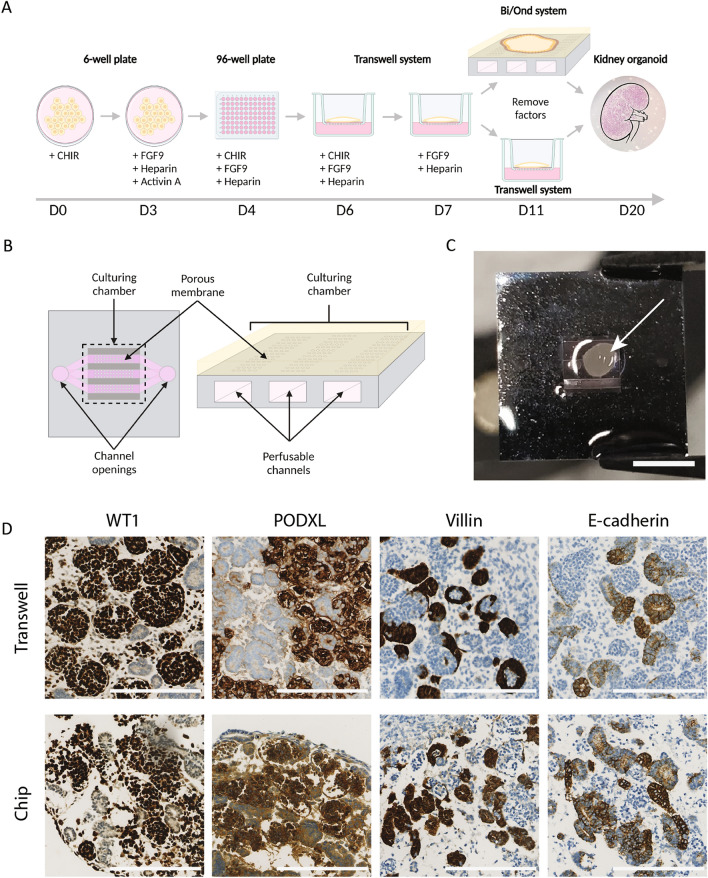
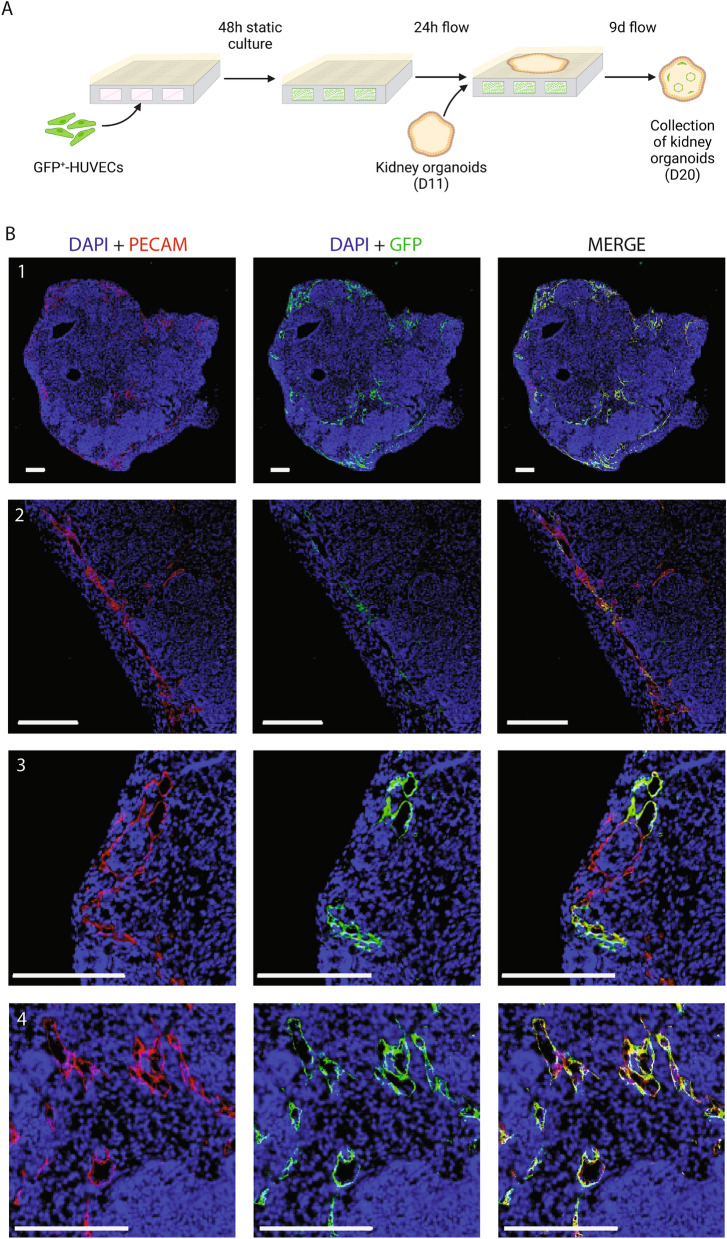
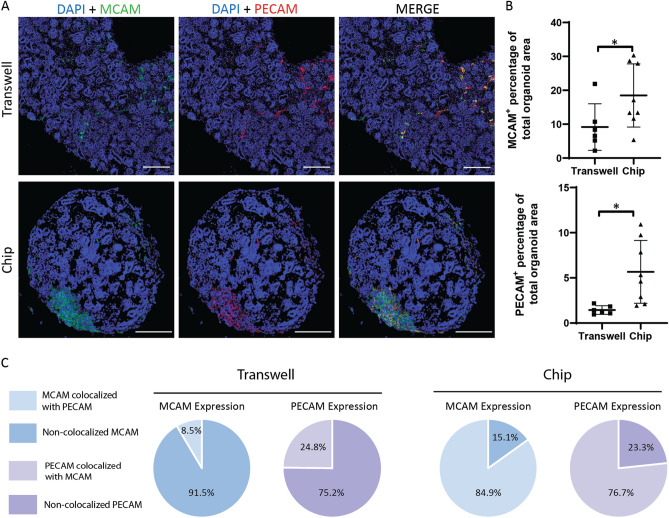
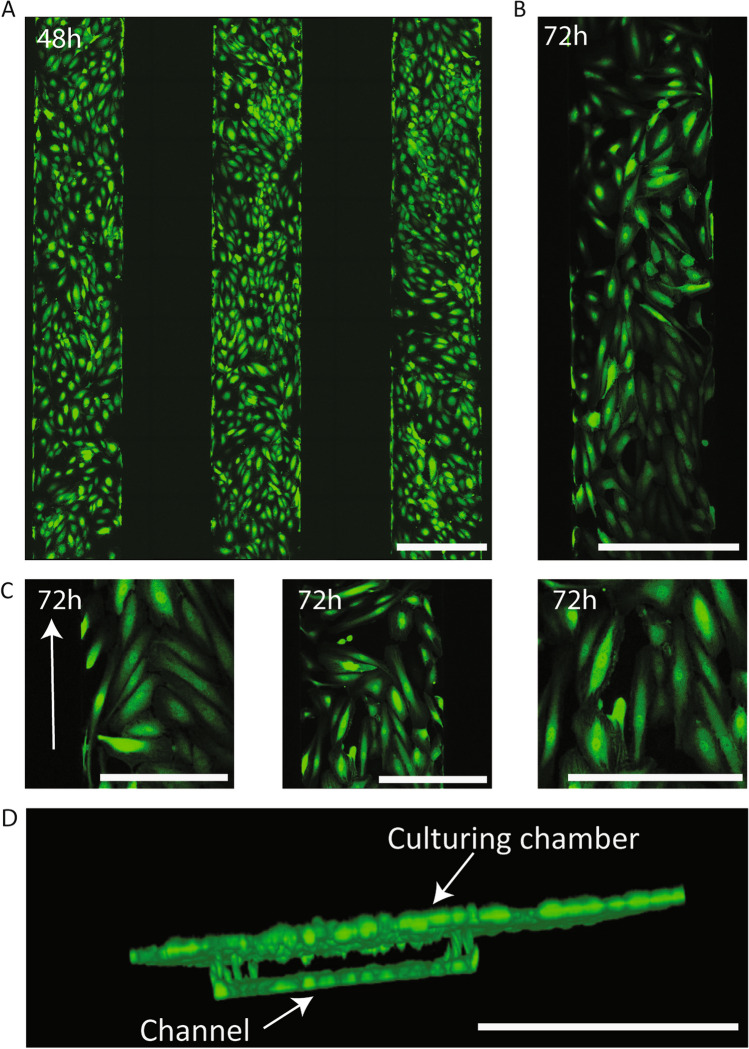
Kidney organoids derived from human induced pluripotent stem cells (iPSCs) have proven to be a valuable tool to study kidney development and disease. However, the lack of vascularization of these organoids often leads to insufficient oxygen and nutrient supply. Vascularization has previously been achieved by implantation into animal models, however, the vasculature arises largely from animal host tissue. Our aim is to transition from an in vivo implantation model towards an in vitro model that fulfils the advantages of vascularization whilst being fully human-cell derived. Our chip system supported culturing of kidney organoids, which presented nephron structures. We also showed that organoids cultured on chip showed increased maturation of endothelial populations based on a colocalization analysis of endothelial markers. Moreover, we observed migration and proliferation of human umbilical vein endothelial cells (HUVECs) cultured in the channels of the chip inside the organoid tissue, where these HUVECs interconnected with endogenous endothelial cells and formed structures presenting an open lumen resembling vessels. Our results establish for the first-time vascularization of kidney organoids in HUVEC co-culture conditions using a microfluidic organ-on-chip. Our model therefore provides a useful insight into kidney organoid vascularization in vitro and presents a tool for further studies of kidney development and drug testing, both for research purposes and pre-clinical applications.
由人诱导多能干细胞 (iPSC) 衍生的肾脏类器官已被证明是研究肾脏发育和疾病的有价值的工具。然而,这些类器官通常缺乏血管化,导致氧气和营养供应不足。先前已经通过植入动物模型来实现血管化,然而,脉管系统主要来自动物宿主组织。我们的目标是从体内植入模型过渡到体外模型,该模型在充分发挥血管化优势的同时完全由人细胞衍生。我们的芯片系统支持肾脏类器官的培养,这些类器官呈现出肾单位结构。我们还表明,基于内皮标记物的共定位分析,在芯片上培养的类器官中内皮群体的成熟度增加。此外,我们观察到在类器官组织内的芯片通道中培养的人脐静脉内皮细胞 (HUVEC) 的迁移和增殖,其中这些 HUVEC 与内源性内皮细胞相互连接并形成呈现出类似于血管的开放腔的结构。我们的结果首次在使用微流控器官芯片的 HUVEC 共培养条件下实现了肾脏类器官的血管化。因此,我们的模型为体外肾脏类器官血管化提供了有用的见解,并为肾脏发育和药物测试的进一步研究提供了工具,既适用于研究目的,也适用于临床前应用。