Khaliq Fariha, Oberhauser Jane, Wakhloo Debia, Mahajani Sameehan
Department of Biomedical Engineering and Sciences (BMES), National University of Science and Technology, Islamabad, Pakistan.
Department of Neuropathology, School of Medicine, Stanford University, Stanford, CA, USA.
Neural Regen Res. 2023 Jun;18(6):1235-1242. doi: 10.4103/1673-5374.355982.
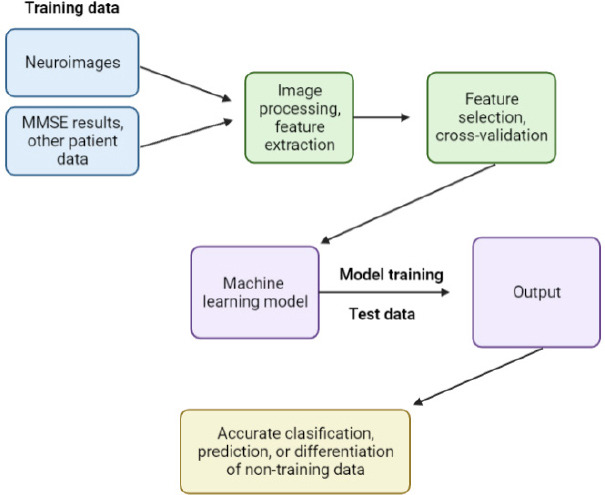
Machine learning represents a growing subfield of artificial intelligence with much promise in the diagnosis, treatment, and tracking of complex conditions, including neurodegenerative disorders such as Alzheimer's and Parkinson's diseases. While no definitive methods of diagnosis or treatment exist for either disease, researchers have implemented machine learning algorithms with neuroimaging and motion-tracking technology to analyze pathologically relevant symptoms and biomarkers. Deep learning algorithms such as neural networks and complex combined architectures have proven capable of tracking disease-linked changes in brain structure and physiology as well as patient motor and cognitive symptoms and responses to treatment. However, such techniques require further development aimed at improving transparency, adaptability, and reproducibility. In this review, we provide an overview of existing neuroimaging technologies and supervised and unsupervised machine learning techniques with their current applications in the context of Alzheimer's and Parkinson's diseases.
机器学习是人工智能中一个不断发展的子领域,在复杂病症(包括阿尔茨海默病和帕金森病等神经退行性疾病)的诊断、治疗和跟踪方面很有前景。虽然这两种疾病都没有明确的诊断或治疗方法,但研究人员已经将机器学习算法与神经成像和运动跟踪技术相结合,以分析病理相关症状和生物标志物。神经网络等深度学习算法以及复杂的组合架构已被证明能够跟踪与疾病相关的脑结构和生理变化,以及患者的运动和认知症状及对治疗的反应。然而,此类技术需要进一步发展,以提高透明度、适应性和可重复性。在本综述中,我们概述了现有的神经成像技术以及有监督和无监督机器学习技术,及其在阿尔茨海默病和帕金森病背景下的当前应用。