Department of Epidemiology of Microbial Diseases, Yale School of Public Health, New Haven, Connecticut, United States of America.
Department of Immunobiology, Yale University School of Medicine, New Haven, Connecticut, United States of America.
PLoS Med. 2022 Dec 1;19(12):e1004136. doi: 10.1371/journal.pmed.1004136. eCollection 2022 Dec.
The benefit of primary and booster vaccination in people who experienced a prior Severe Acute Respiratory Syndrome Coronavirus 2 (SARS-CoV-2) infection remains unclear. The objective of this study was to estimate the effectiveness of primary (two-dose series) and booster (third dose) mRNA vaccination against Omicron (lineage BA.1) infection among people with a prior documented infection.
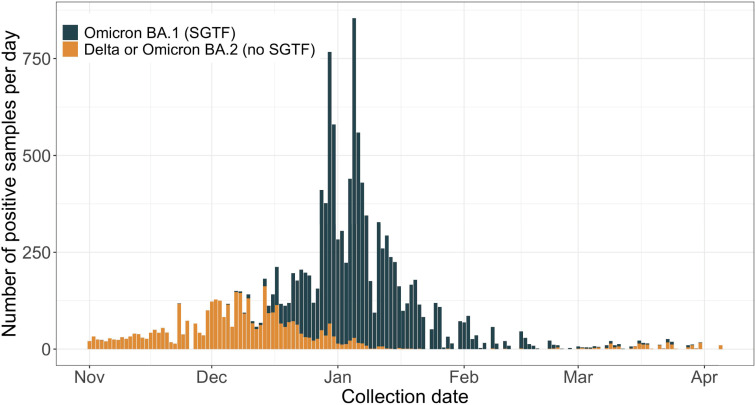
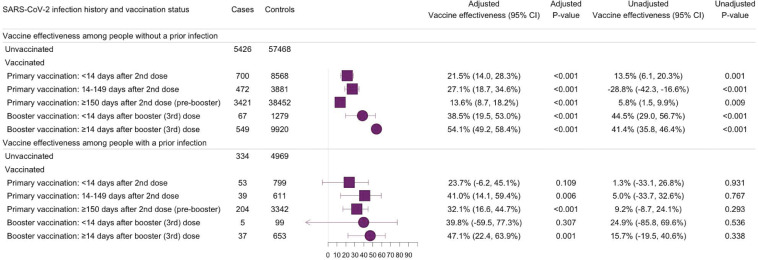
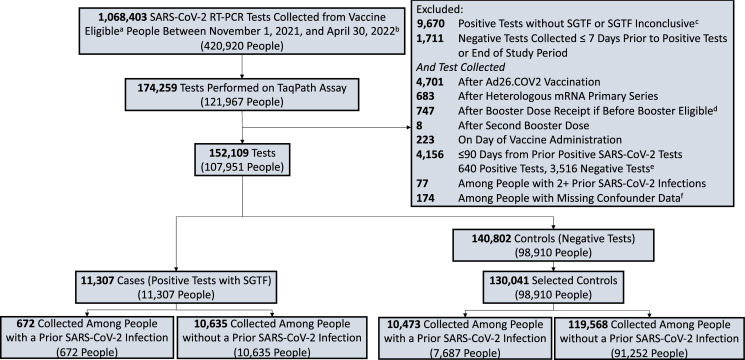
We conducted a test-negative case-control study of reverse transcription PCRs (RT-PCRs) analyzed with the TaqPath (Thermo Fisher Scientific) assay and recorded in the Yale New Haven Health system from November 1, 2021, to April 30, 2022. Overall, 11,307 cases (positive TaqPath analyzed RT-PCRs with S-gene target failure [SGTF]) and 130,041 controls (negative TaqPath analyzed RT-PCRs) were included (median age: cases: 35 years, controls: 39 years). Among cases and controls, 5.9% and 8.1% had a documented prior infection (positive SARS-CoV-2 test record ≥90 days prior to the included test), respectively. We estimated the effectiveness of primary and booster vaccination relative to SGTF-defined Omicron (lineage BA.1) variant infection using a logistic regression adjusted for date of test, age, sex, race/ethnicity, insurance, comorbidities, social venerability index, municipality, and healthcare utilization. The effectiveness of primary vaccination 14 to 149 days after the second dose was 41.0% (95% confidence interval (CI): 14.1% to 59.4%, p 0.006) and 27.1% (95% CI: 18.7% to 34.6%, p < 0.001) for people with and without a documented prior infection, respectively. The effectiveness of booster vaccination (≥14 days after booster dose) was 47.1% (95% CI: 22.4% to 63.9%, p 0.001) and 54.1% (95% CI: 49.2% to 58.4%, p < 0.001) in people with and without a documented prior infection, respectively. To test whether booster vaccination reduced the risk of infection beyond that of the primary series, we compared the odds of infection among boosted (≥14 days after booster dose) and booster-eligible people (≥150 days after second dose). The odds ratio (OR) comparing boosted and booster-eligible people with a documented prior infection was 0.79 (95% CI: 0.54 to 1.16, p 0.222), whereas the OR comparing boosted and booster-eligible people without a documented prior infection was 0.54 (95% CI: 0.49 to 0.59, p < 0.001). This study's limitations include the risk of residual confounding, the use of data from a single system, and the reliance on TaqPath analyzed RT-PCR results.
In this study, we observed that primary vaccination provided significant but limited protection against Omicron (lineage BA.1) infection among people with and without a documented prior infection. While booster vaccination was associated with additional protection against Omicron BA.1 infection in people without a documented prior infection, it was not found to be associated with additional protection among people with a documented prior infection. These findings support primary vaccination in people regardless of documented prior infection status but suggest that infection history may impact the relative benefit of booster doses.
经历过严重急性呼吸系统综合征冠状病毒 2 (SARS-CoV-2)感染的人进行初级和加强免疫接种的益处尚不清楚。本研究的目的是评估在有记录的既往感染人群中,针对 Omicron(谱系 BA.1)感染的初级(两剂系列)和加强(第三剂)mRNA 疫苗接种的有效性。
我们对 2021 年 11 月 1 日至 2022 年 4 月 30 日期间耶鲁纽黑文健康系统记录的逆转录聚合酶链反应(RT-PCR)进行了 TaqPath(赛默飞世尔科技)分析的阴性病例对照研究。总体而言,包括 11307 例病例(阳性 TaqPath 分析 RT-PCR 伴有 S 基因目标失败[SGTF])和 130041 例对照(阴性 TaqPath 分析 RT-PCR)(中位年龄:病例:35 岁,对照:39 岁)。在病例和对照中,分别有 5.9%和 8.1%有记录的既往感染(在包括的检测之前 90 天以上有阳性 SARS-CoV-2 检测记录)。我们使用逻辑回归模型,根据检测日期、年龄、性别、种族/民族、保险、合并症、社会脆弱性指数、市和医疗保健利用情况,调整了初级和加强免疫接种相对 Omicron(谱系 BA.1)变体感染的有效性。在第二剂接种后 14 至 149 天内,初级接种的有效性分别为 41.0%(95%置信区间[CI]:14.1%至 59.4%,p 0.006)和 27.1%(95%CI:18.7%至 34.6%,p<0.001),在有和没有记录的既往感染的人群中。加强接种(加强接种后≥14 天)的有效性分别为 47.1%(95%CI:22.4%至 63.9%,p 0.001)和 54.1%(95%CI:49.2%至 58.4%,p<0.001),在有和没有记录的既往感染的人群中。为了检验加强接种是否降低了原发性系列之外的感染风险,我们比较了加强接种(加强接种后≥14 天)和加强接种合格(第二剂接种后≥150 天)人群的感染几率。有记录的既往感染的加强接种者与加强接种合格者的比值比(OR)为 0.79(95%CI:0.54 至 1.16,p 0.222),而无记录的既往感染的加强接种者与加强接种合格者的 OR 为 0.54(95%CI:0.49 至 0.59,p<0.001)。本研究的局限性包括残余混杂的风险、使用单一系统的数据以及对 TaqPath 分析 RT-PCR 结果的依赖。
在这项研究中,我们观察到初级接种对有和无记录的既往感染的人对 Omicron(谱系 BA.1)感染提供了显著但有限的保护。虽然加强接种与无记录的既往感染人群中 Omicron BA.1 感染的额外保护相关,但在有记录的既往感染人群中,加强接种与额外保护无关。这些发现支持在有和没有记录的既往感染的人群中进行初级接种,但表明感染史可能会影响加强剂量的相对益处。