Yin Jia-Li, Tao Tao, Wen Zhao-Yan, Wang Ran, Sun Ming-Hui, Gao Chang, Chang Yu-Jiao, Yan Shi, Qin Xue, Zhao Yu-Hong, Wang Lan, Gao Song
Department of Clinical Epidemiology, Shengjing Hospital of China Medical University, Shenyang, China.
Clinical Research Center, Shengjing Hospital of China Medical University, Shenyang, China.
Front Nutr. 2022 Nov 15;9:1003675. doi: 10.3389/fnut.2022.1003675. eCollection 2022.
The impact of dietary trace elements intake on ovarian cancer (OC) severity is unknown.
We firstly explore the relationship between dietary copper (Cu), zinc (Zn), and copper-to-zinc (Cu/Zn) ratio and severity of OC.
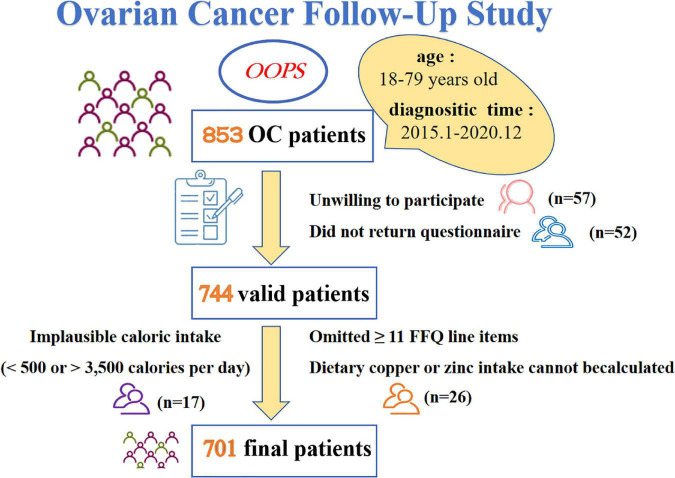
This cross-sectional study included 701 women from the OC follow-up study between 2015 and 2020. Dietary information was collected by a validated food frequency questionnaire (FFQ). The severity information of OC including age at diagnosis, histological type, International Federation of Gynecology and Obstetrics (FIGO) stage, and histopathologic grade was ascertained from medical records. Logistic regression model was used to estimate the odds ratios (ORs) and 95% confidence intervals (CIs) of aforementioned associations.
Among 701 participants, the number of patients age at diagnosis older than 50 were 443 (63.2%). The number of patients diagnosed as serous, III-IV stage, and poorly differentiation OC were 477 (68.05%), 336 (47.93%), and 597 (85.16%), respectively. In addition, compared with the lowest tertile intake, higher possibility of non-serous OC was associated with the pre-diagnosis dietary Cu (OR = 2.39, 95% CI = 1.28-4.47, p trend < 0.05) and Cu/Zn ratio (OR = 2.06, 95% CI = 1.26-3.39, P trend < 0.05) in the highest tertile intake. The risk of poorly differentiation OC at diagnosis was significant inversely related to dietary Cu intake (OR = 0.40, 95% CI = 0.18-0.88, P trend < 0.05). Besides, the results of subgroup analyses were consistent with the main findings but not all of them showed statistical significance.
Pre-diagnostic dietary Cu and Cu/Zn ratio were contributed to reducing the severity of OC at diagnosis, especially for the risk of serous OC and poorly differentiation OC.
饮食中微量元素的摄入量对卵巢癌(OC)严重程度的影响尚不清楚。
我们首先探讨饮食中铜(Cu)、锌(Zn)以及铜锌比(Cu/Zn)与OC严重程度之间的关系。
这项横断面研究纳入了2015年至2020年间OC随访研究中的701名女性。通过经过验证的食物频率问卷(FFQ)收集饮食信息。OC的严重程度信息,包括诊断时的年龄、组织学类型、国际妇产科联合会(FIGO)分期和组织病理学分级,均从医疗记录中确定。采用逻辑回归模型估计上述关联的比值比(OR)和95%置信区间(CI)。
在701名参与者中,诊断时年龄大于50岁的患者有443名(63.2%)。诊断为浆液性、III-IV期和低分化OC的患者分别有477名(68.05%)、336名(47.93%)和597名(85.16%)。此外,与最低三分位数摄入量相比,在最高三分位数摄入量时,非浆液性OC的更高可能性与诊断前饮食中的Cu(OR = 2.39,95% CI = 1.28 - 4.47,p趋势< 0.05)和Cu/Zn比(OR = 2.06,95% CI = 1.26 - 3.39,P趋势< 0.05)相关。诊断时低分化OC的风险与饮食中Cu的摄入量显著负相关(OR = 0.40,95% CI = 0.18 - 0.88,P趋势< 0.05)。此外,亚组分析结果与主要发现一致,但并非所有结果都具有统计学意义。
诊断前饮食中的Cu和Cu/Zn比有助于降低诊断时OC的严重程度,尤其是浆液性OC和低分化OC的风险。