Department of Biotherapy and National Clinical Research Center for Geriatrics, Cancer Center, West China Hospital, Sichuan University, Chengdu, 610041, Sichuan, China.
School of Nursing, Hangzhou Medical College, Hangzhou, Zhejiang, China.
J Transl Med. 2022 Dec 3;20(1):560. doi: 10.1186/s12967-022-03719-7.
The coronavirus disease 2019 (COVID-19) severely hindered the timely receipt of health care for patients with cancer, especially female patients. Depression and anxiety were more pronounced in female patients than their male counterparts with cancer during treatment wait-time intervals. Herein, investigating the impact of treatment delays on the survival outcomes of female patients with early-stage cancers can enhance the rational and precise clinical decisions of physicians.
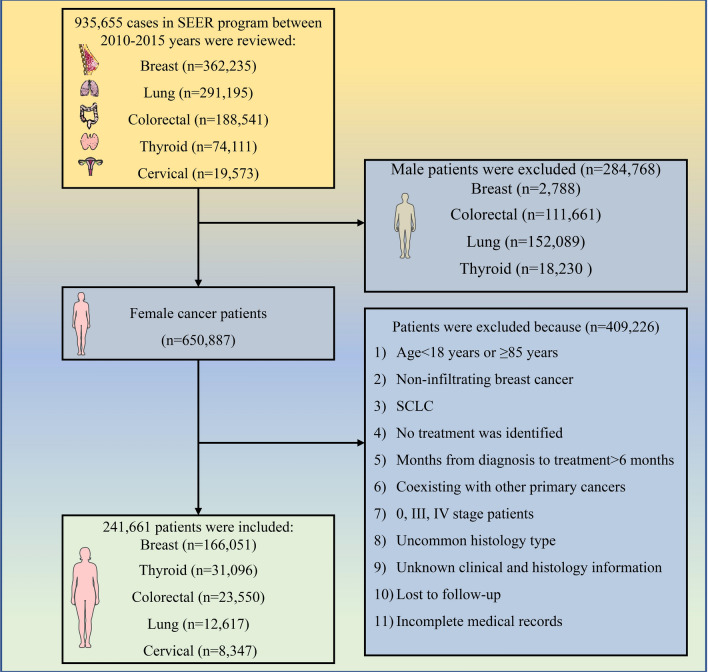
We analyzed five types of cancers in women from the Surveillance, Epidemiology, and End Results (SEER) program between Jan 2010 and Dec 2015. Univariate and multivariate Cox regression analyses were used to determine the impacts of treatment delays on the overall survival (OS) and cancer-specific survival (CSS) of the patients.
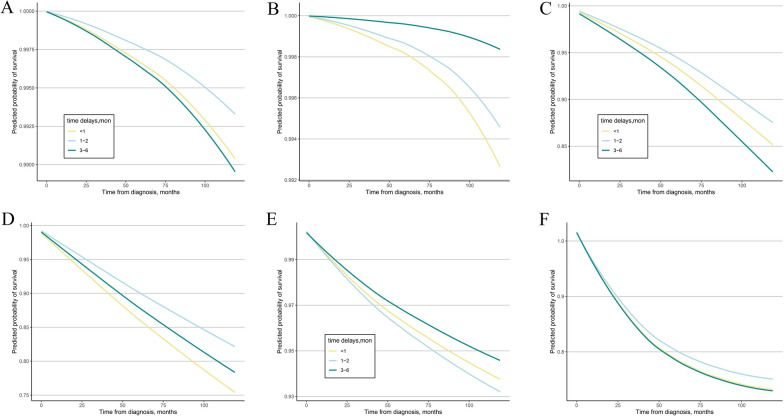
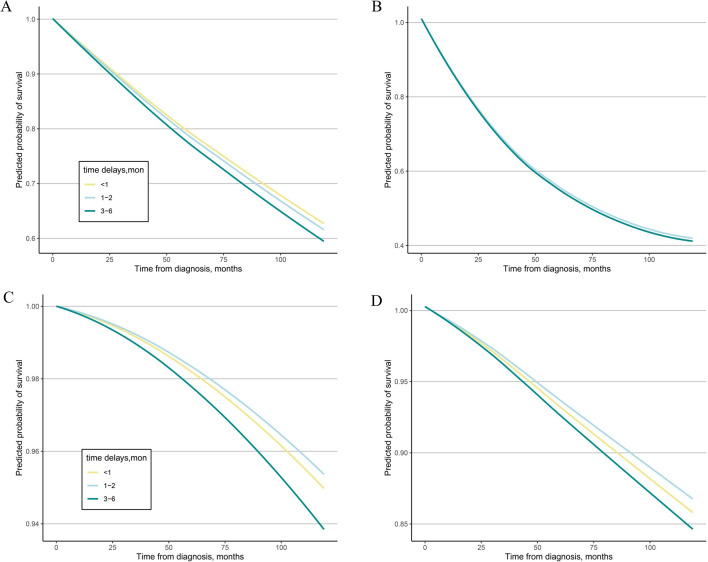
A total of 241,661 females with early-stage cancer were analyzed (12,617 cases of non-small cell lung cancer (NSCLC), 166,051 cases of infiltrating breast cancer, 31,096 cases of differentiated thyroid cancer, 23,550 cases of colorectal cancer, and 8347 cases of cervical cancer). Worse OS rates were observed in patients with treatment delays ≥ 3 months in stage I NSCLC (Hazard ratio (HR) = 1.11, 95% Confidence Interval (CI): 1.01-1.23, p = 0.044) and stage I infiltrating breast cancer (HR = 1.23, 95% CI 1.11-1.37, p < 0.001). When the treatment delay intervals were analyzed as continuous variables, similar results were observed in patients with stage I NSCLC (HR = 1.04, 95% CI 1.01-1.06, p = 0.010) and in those with stage I breast cancer (HR = 1.03, 95% CI 1.00-1.06, p = 0.029). However, treatment delays did not reduce the OS of patients with differentiated thyroid cancer, cervical cancer, or colorectal cancer in the early-stage. Only intermediate treatment delays impaired the CSS of patients with cervical cancer in stage I (HR = 1.31, 95% CI 1.02-1.68, p = 0.032).
After adjusting for confounders, the prolonged time from diagnosis to the initiation of treatment (< 6 months) showed limited negative effects on the survival of most of the patients with early-stage female cancers. Whether our findings serve as evidence supporting the treatment deferral decisions of clinicians for patients with different cancers in resource-limited situations needs further validation.
2019 年冠状病毒病(COVID-19)严重阻碍了癌症患者,尤其是女性患者及时获得医疗保健。在治疗等待期间,与男性癌症患者相比,女性癌症患者的抑郁和焦虑更为明显。因此,研究治疗延迟对早期女性癌症患者生存结果的影响,可以增强医生进行合理和精确临床决策的能力。
我们分析了 2010 年 1 月至 2015 年 12 月期间监测、流行病学和最终结果(SEER)计划中的 5 种女性癌症。采用单因素和多因素 Cox 回归分析来确定治疗延迟对患者总生存期(OS)和癌症特异性生存期(CSS)的影响。
共分析了 241661 例早期癌症女性患者(12617 例非小细胞肺癌(NSCLC),166051 例浸润性乳腺癌,31096 例分化型甲状腺癌,23550 例结直肠癌和 8347 例宫颈癌)。在 I 期 NSCLC(危险比(HR)=1.11,95%置信区间(CI):1.01-1.23,p=0.044)和 I 期浸润性乳腺癌(HR=1.23,95%CI 1.11-1.37,p<0.001)患者中,治疗延迟≥3 个月的患者 OS 率较差。当将治疗延迟间隔作为连续变量进行分析时,在 I 期 NSCLC(HR=1.04,95%CI 1.01-1.06,p=0.010)和 I 期乳腺癌(HR=1.03,95%CI 1.00-1.06,p=0.029)患者中也观察到了类似的结果。然而,治疗延迟并未降低早期分化型甲状腺癌、宫颈癌或结直肠癌患者的 OS。只有中等治疗延迟会影响 I 期宫颈癌患者的 CSS(HR=1.31,95%CI 1.02-1.68,p=0.032)。
在调整混杂因素后,从诊断到开始治疗的时间延长(<6 个月)对大多数早期女性癌症患者的生存结果影响有限。我们的研究结果是否为资源有限情况下不同癌症患者的临床医生治疗延迟决策提供证据,还需要进一步验证。