
药物研发中自然的时机与地位。
The Time and Place for Nature in Drug Discovery.
作者信息
Young Robert J, Flitsch Sabine L, Grigalunas Michael, Leeson Paul D, Quinn Ronald J, Turner Nicholas J, Waldmann Herbert
机构信息
Blue Burgundy Ltd, Ampthill, Bedfordshire MK45 2AD, U.K.
Department of Chemistry, University of Manchester, Manchester Institute of Biotechnology, 131 Princess Street, Manchester M1 7DN, United Kingdom.
出版信息
JACS Au. 2022 Oct 14;2(11):2400-2416. doi: 10.1021/jacsau.2c00415. eCollection 2022 Nov 28.
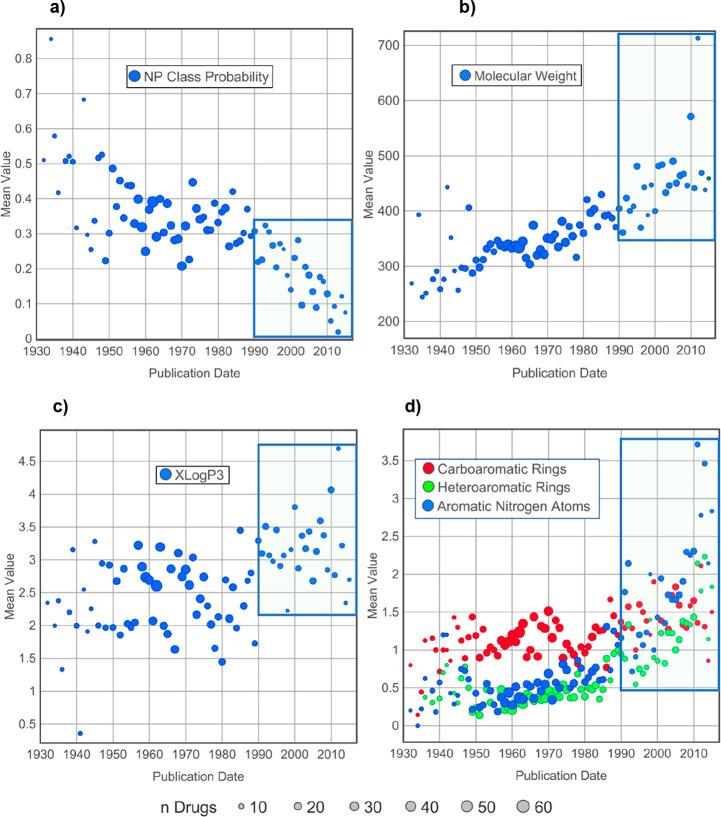
The case for a renewed focus on Nature in drug discovery is reviewed; not in terms of natural product screening, but how and why biomimetic molecules, especially those produced by natural processes, should deliver in the age of artificial intelligence and screening of vast collections both in vitro and in silico. The declining natural product-likeness of licensed drugs and the consequent physicochemical implications of this trend in the context of current practices are noted. To arrest these trends, the logic of seeking new bioactive agents with enhanced natural mimicry is considered; notably that molecules constructed by proteins (enzymes) are more likely to interact with other proteins (e.g., targets and transporters), a notion validated by natural products. Nature's finite number of building blocks and their interactions necessarily reduce potential numbers of structures, yet these enable expansion of chemical space with their inherent diversity of physical characteristics, pertinent to property-based design. The feasible variations on natural motifs are considered and expanded to encompass pseudo-natural products, leading to the further logical step of harnessing bioprocessing routes to access them. Together, these offer opportunities for enhancing natural mimicry, thereby bringing innovation to drug synthesis exploiting the characteristics of natural recognition processes. The potential for computational guidance to help identifying binding commonalities in the route map is a logical opportunity to enable the design of tailored molecules, with a focus on "organic/biological" rather than purely "synthetic" structures. The design and synthesis of prototype structures should pay dividends in the disposition and efficacy of the molecules, while inherently enabling greener and more sustainable manufacturing techniques.
本文回顾了在药物发现中重新关注自然的理由;不是从天然产物筛选的角度,而是从仿生分子,特别是那些由自然过程产生的分子,在人工智能时代以及体外和计算机模拟筛选大量化合物库的背景下如何以及为何能够发挥作用的角度。文中指出了已获批药物中天然产物类似性的下降以及这种趋势在当前实践背景下所带来的物理化学影响。为了遏制这些趋势,探讨了寻求具有更强自然模拟性的新型生物活性剂的逻辑;特别是由蛋白质(酶)构建的分子更有可能与其他蛋白质(如靶点和转运蛋白)相互作用,这一观点已得到天然产物的验证。自然界有限的构建模块及其相互作用必然减少了潜在的结构数量,但这些构建模块凭借其固有的物理特性多样性,能够扩展化学空间,这与基于性质的设计相关。文中考虑并扩展了天然基序的可行变体,以涵盖伪天然产物,进而引出利用生物加工路线获取这些产物的进一步合理步骤。这些共同为增强自然模拟性提供了机会,从而利用自然识别过程的特性为药物合成带来创新。借助计算指导来帮助识别路线图中的结合共性,这是一个合理的机会,能够设计出量身定制的分子,重点关注“有机/生物”而非纯粹的“合成”结构。原型结构的设计和合成应在分子的处置和功效方面有所收获,同时本质上能够实现更绿色、更可持续的制造技术。



 Zotero 插件