Vitello Marie M, Briand Marie-Michèle, Ledoux Didier, Annen Jitka, El Tahry Riëm, Laureys Steven, Martin Didier, Gosseries Olivia, Thibaut Aurore
Coma Science Group, GIGA-Consciousness, University of Liège, Liège, Belgium.
Centre du Cerveau, University Hospital of Liège, Liège, Belgium.
Int J Clin Health Psychol. 2023 Apr-Jun;23(2):100360. doi: 10.1016/j.ijchp.2022.100360. Epub 2022 Nov 29.
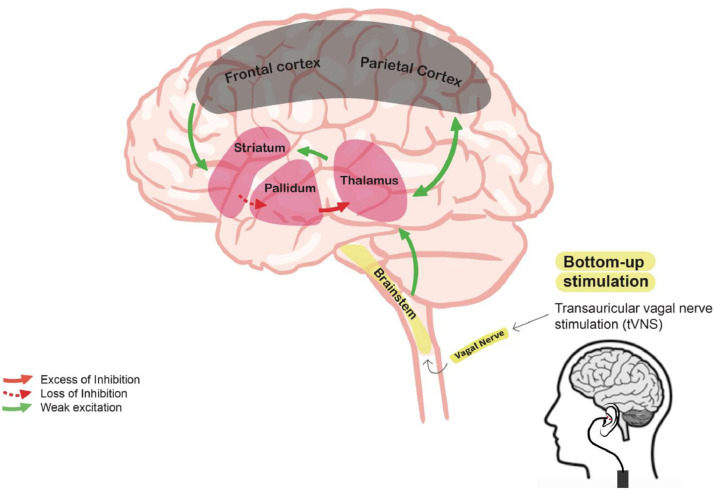
Patients with disorders of consciousness (DoC) are a challenging population prone to misdiagnosis with limited effective treatment options. Among neuromodulation techniques, transcutaneous auricular vagal nerve stimulation (taVNS) may act through a bottom-up manner to modulate thalamo-cortical connectivity and promote patients' recovery. In this clinical trial, we aim to (1) assess the therapeutic clinical effects of taVNS in patients with DoC; (2) investigate the neural mechanisms underlying the effects of its action; (3) assess the feasibility and safety of the procedure in this challenging population; (4) define the phenotype of clinical responders; and (5) assess the long-term efficacy of taVNS in terms of functional outcomes.
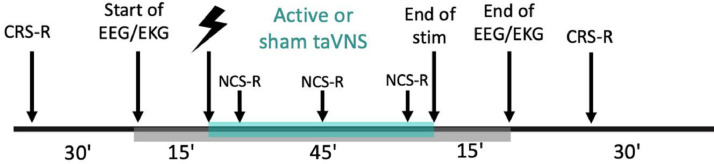
We will conduct a prospective parallel randomized controlled double-blind clinical trial investigating the effects of taVNS as a treatment in DoC patients. Forty-four patients in the early period post-injury (7 to 90 days following the injury) will randomly receive 5 days of either active bilateral vagal stimulation (45 min duration with 30s alternative episodes of active/rest periods; 3mA; 200-300μs current width, 25Hz.) or sham stimulation. Behavioural (i.e., Coma Recovery Scale-Revised, CRS-R) and neurophysiological (i.e., high-density electroencephalography, hd-EEG) measures will be collected at baseline and at the end of the 5-day treatment. Analyses will seek for changes in the CRS-R and the EEG metrics (e.g., alpha band power spectrum, functional connectivity) at the group and individual (i.e., responders) levels.
These results will allow us to investigate the vagal afferent network and will contribute towards a definition of the role of taVNS for the treatment of patients with DoC. We aim to identify the neural correlates of its action and pave the way to novel targeted therapeutic strategies.
Clinicaltrials.gov n° NCT04065386.
意识障碍(DoC)患者是一个具有挑战性的群体,容易被误诊,且有效的治疗选择有限。在神经调节技术中,经皮耳迷走神经刺激(taVNS)可能通过自下而上的方式来调节丘脑-皮质连接并促进患者康复。在这项临床试验中,我们旨在:(1)评估taVNS对DoC患者的治疗临床效果;(2)研究其作用效果的神经机制;(3)评估该操作在这一具有挑战性的群体中的可行性和安全性;(4)定义临床反应者的表型;(5)从功能结局方面评估taVNS的长期疗效。
我们将进行一项前瞻性平行随机对照双盲临床试验,研究taVNS作为一种治疗方法对DoC患者的影响。44名受伤后早期(受伤后7至90天)的患者将被随机分配接受5天的主动双侧迷走神经刺激(持续45分钟,有30秒主动/休息交替时段;3毫安;200 - 300微秒电流宽度,25赫兹)或假刺激。将在基线和5天治疗结束时收集行为学(即昏迷恢复量表修订版,CRS - R)和神经生理学(即高密度脑电图,hd - EEG)测量数据。分析将在组水平和个体(即反应者)水平上寻找CRS - R和脑电图指标(如α波段功率谱、功能连接)的变化。
这些结果将使我们能够研究迷走神经传入网络,并有助于明确taVNS在治疗DoC患者中的作用。我们旨在确定其作用的神经关联,并为新的靶向治疗策略铺平道路。
Clinicaltrials.gov编号NCT04065386。