Zhang Yang, Jin Yanhan, Liu Jinglan, Ren Qiancheng, Chen Zhengyang, Zhao Yi, Zhao Pei
Center for X-Mechanics and Institute of Applied Mechanics, Zhejiang University Hangzhou 310027 P. R. China
College of Information Science and Electronic Engineering, Zhejiang University Hangzhou 310027 P. R. China.
Nanoscale Adv. 2022 Oct 12;4(23):5056-5061. doi: 10.1039/d2na00580h. eCollection 2022 Nov 22.
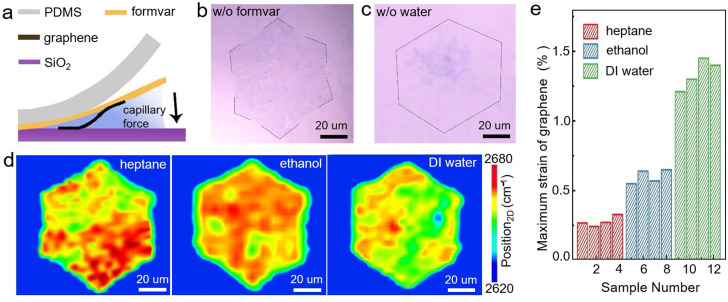
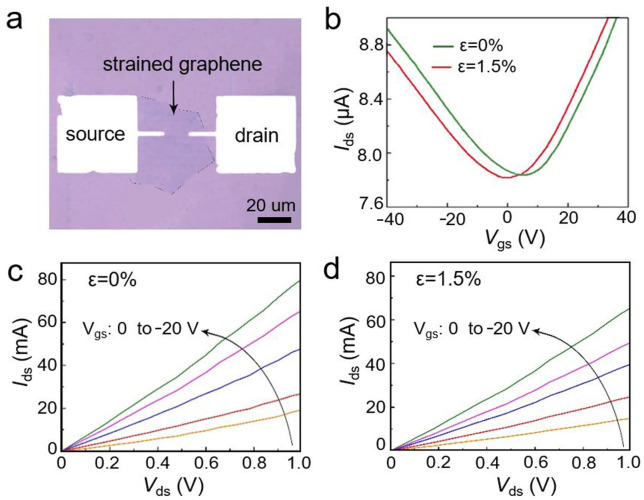
Graphene with a large tensile strain is a promising candidate for the new "straintronics'' applications. The current approaches of strain engineering on graphene are mainly realized by flexible or hollow substrates. In this work, a novel method for strained graphene on a rigid substrate assisted by PDMS stretching and interface adjustments is proposed. The Raman spectra show that the maximum strain of graphene on the SiO/Si substrate is ∼1.5%, and multiple characterizations demonstrate its high cleanness, flatness, integrity, and reliable electrical performance. The successful strain engineering is attributed to the protection of a layer of formvar resin and the interfacial capillary force of the buffering liquid. We believe this technique can advance strain-related fundamental studies and applications of two-dimensional materials.
具有大拉伸应变的石墨烯是新型“应变电子学”应用的有前途的候选材料。目前在石墨烯上进行应变工程的方法主要是通过柔性或中空衬底来实现的。在这项工作中,提出了一种在刚性衬底上通过PDMS拉伸和界面调整辅助制备应变石墨烯的新方法。拉曼光谱表明,SiO/Si衬底上石墨烯的最大应变约为1.5%,多种表征证明了其高洁净度、平整度、完整性和可靠的电学性能。成功的应变工程归因于一层福尔马林中树脂的保护和缓冲液的界面毛细作用力。我们相信这项技术可以推动二维材料与应变相关的基础研究和应用。