Padova Neuroscience Center (PNC), University of Padova, Padova, Italy.
Department of Neuroscience, University of Padova, Padova, Italy.
Commun Biol. 2022 Dec 12;5(1):1361. doi: 10.1038/s42003-022-04294-9.
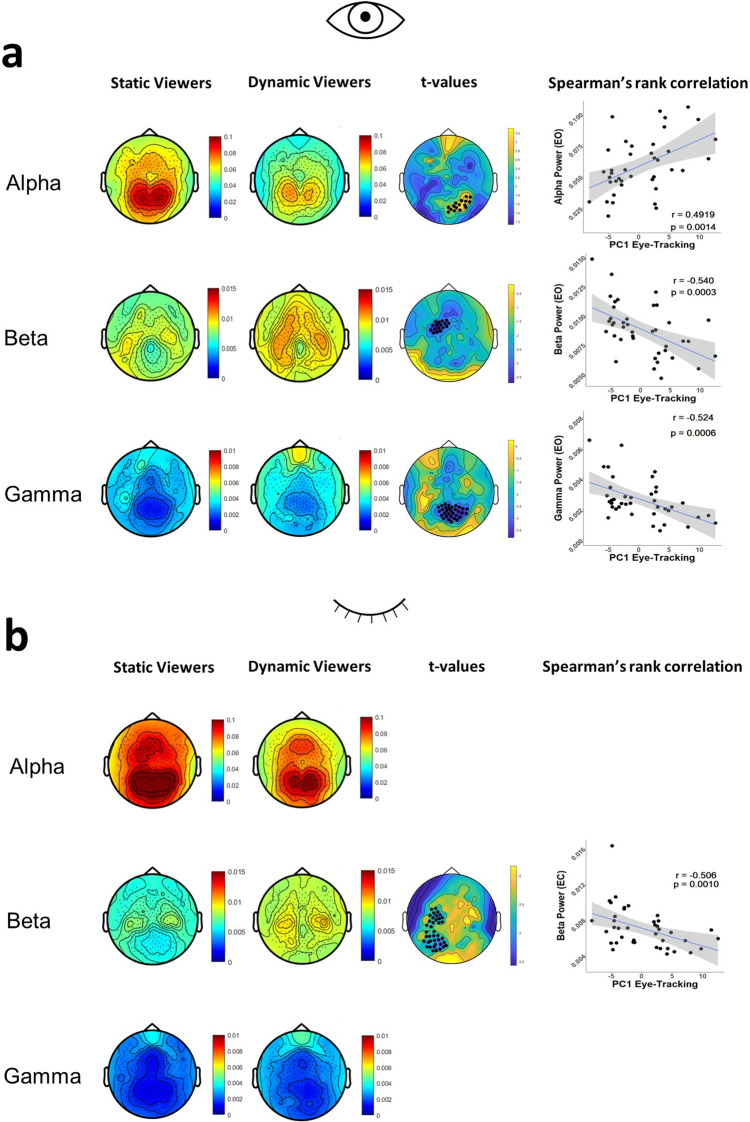
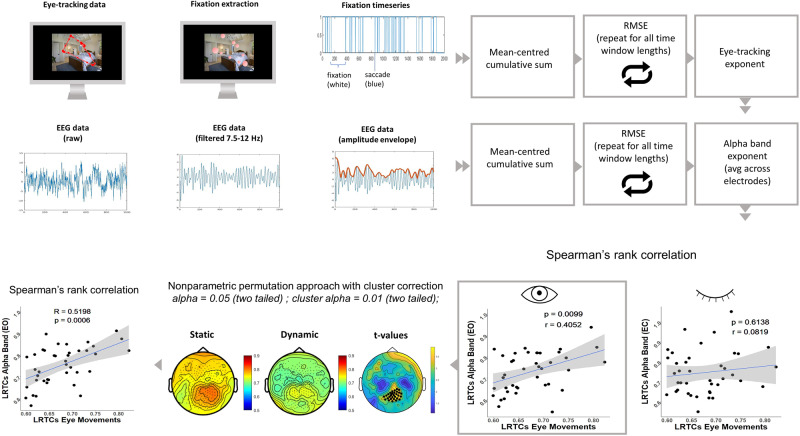
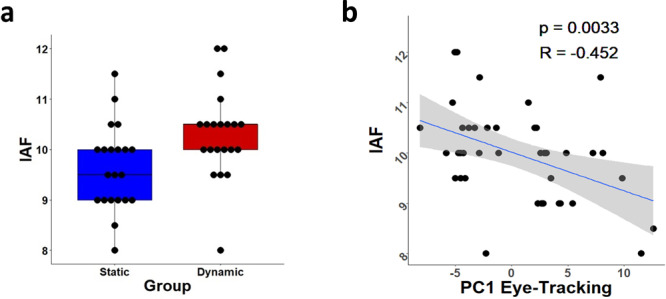
During visual exploration, eye movements are controlled by multiple stimulus- and goal-driven factors. We recently showed that the dynamics of eye movements -how/when the eye move- during natural scenes' free viewing were similar across individuals and identified two viewing styles: static and dynamic, characterized respectively by longer or shorter fixations. Interestingly, these styles could be revealed at rest, in the absence of any visual stimulus. This result supports a role of intrinsic activity in eye movement dynamics. Here we hypothesize that these two viewing styles correspond to different spontaneous patterns of brain activity. One year after the behavioural experiments, static and dynamic viewers were called back to the lab to record high density EEG activity during eyes open and eyes closed. Static viewers show higher cortical inhibition, slower individual alpha frequency peak, and longer memory of alpha oscillations. The opposite holds for dynamic viewers. We conclude that some properties of spontaneous activity predict exploratory eye movement dynamics during free viewing.
在视觉探索过程中,眼球运动受到多种刺激和目标驱动因素的控制。我们最近发现,在自由观看自然场景时,眼球运动的动态——眼睛如何/何时移动——在个体之间是相似的,并确定了两种观看风格:静态和动态,分别以较长或较短的注视时间为特征。有趣的是,这些风格可以在没有任何视觉刺激的情况下在休息时显现出来。这一结果支持了内在活动在眼球运动动态中的作用。在这里,我们假设这两种观看风格对应于不同的大脑活动自发模式。在行为实验一年后,静态和动态观看者被召回实验室,在睁眼和闭眼时记录高密度 EEG 活动。静态观看者表现出更高的皮质抑制、较慢的个体阿尔法频率峰值和更长的阿尔法振荡记忆。动态观看者则相反。我们得出结论,自发活动的某些特性可以预测自由观看时的探索性眼球运动动态。