Lear Annabella, Baker Stuart N, Clarke Hannah F, Roberts Angela C, Schmid Michael C, Jarrett Wendy
Understanding Animal Research, Abbey House, 74-76 St John Street, London, EC1M 4DZ, United Kingdom.
Medical School, Newcastle University, Newcastle upon Tyne, NE2 4HH, United Kingdom.
Curr Res Neurobiol. 2022 Aug 17;3:100049. doi: 10.1016/j.crneur.2022.100049. eCollection 2022.
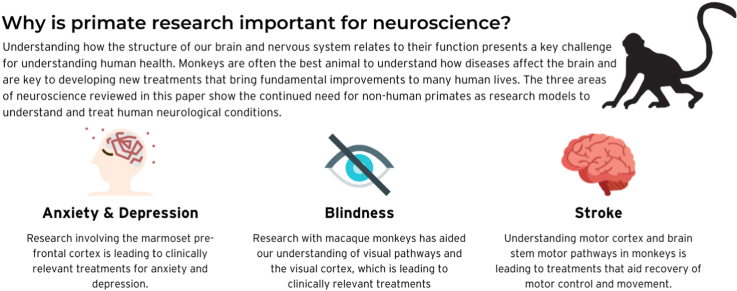
Studying higher brain function presents fundamental scientific challenges but has great potential for impactful translation to the clinic, supporting the needs of many patients suffering from conditions that relate to neuronal dysfunction. For many key questions relevant to human neurological conditions and clinical interventions, non-human primates (NHPs) remain the only suitable model organism and the only effective way to study the relationship between brain structure and function with the knowledge and tools currently available. Here we present three exemplary studies of current research yielding important findings that are directly translational to human clinical patients but which would be impossible without NHP studies. Our first example shows how studies of the NHP prefrontal cortex are leading to clinically relevant advances and potential new treatments for human neuropsychiatric disorders such as depression and anxiety. Our second example looks at the relevance of NHP research to our understanding of visual pathways and the visual cortex, leading to visual prostheses that offer treatments for otherwise blind patients. Finally, we consider recent advances in treatments leading to improved recovery of movement and motor control in stroke patients, resulting from our improved understanding of brain stem parallel pathways involved in movement in NHPs. The case for using NHPs in neuroscience research, and the direct benefits to human patients, is strong but has rarely been set out directly. This paper reviews three very different areas of neuroscience research, expressly highlighting the unique insights offered to each by NHP studies and their direct applicability to human clinical conditions.
研究高等脑功能面临着根本性的科学挑战,但具有对临床产生重大影响的巨大潜力,可满足许多患有与神经元功能障碍相关疾病的患者的需求。对于许多与人类神经疾病和临床干预相关的关键问题,非人类灵长类动物(NHPs)仍然是唯一合适的模式生物,也是利用现有知识和工具研究脑结构与功能之间关系的唯一有效途径。在此,我们展示了三项当前研究的典范,这些研究得出了重要发现,可直接转化应用于人类临床患者,但如果没有对非人类灵长类动物的研究,这些发现将是不可能获得的。我们的第一个例子展示了对非人类灵长类动物前额叶皮层的研究如何在临床上取得相关进展,并为抑郁症和焦虑症等人类神经精神疾病带来潜在的新治疗方法。我们的第二个例子探讨了非人类灵长类动物研究与我们对视觉通路和视觉皮层的理解的相关性,从而带来了可为失明患者提供治疗的视觉假体。最后,我们考虑了治疗方面的最新进展,这些进展因我们对非人类灵长类动物中参与运动的脑干平行通路有了更好的理解,从而使中风患者的运动和运动控制恢复得到改善。在神经科学研究中使用非人类灵长类动物的理由以及对人类患者的直接益处是充分的,但很少被直接阐述。本文回顾了神经科学研究中三个截然不同的领域,特别强调了非人类灵长类动物研究为每个领域提供的独特见解及其对人类临床状况的直接适用性。