Department of Medical Sciences, Clinical Diabetes and Metabolism, Uppsala University, 75185, Uppsala, Sweden.
Cardiovascular, Renal and Metabolism, Medical Department, BioPharmaceuticals, AstraZeneca, Oslo, Norway.
Cardiovasc Diabetol. 2022 Dec 15;21(1):282. doi: 10.1186/s12933-022-01719-x.
The risk of severe coronavirus disease 2019 (COVID-19) is increased in people with diabetes, but effects of diabetes type and other risk factors remain incompletely characterized. We studied this in a Swedish cohort of hospitalized patients with type 1 and type 2 diabetes (T1D and T2D), also including comparisons with influenza epidemics of recent years.
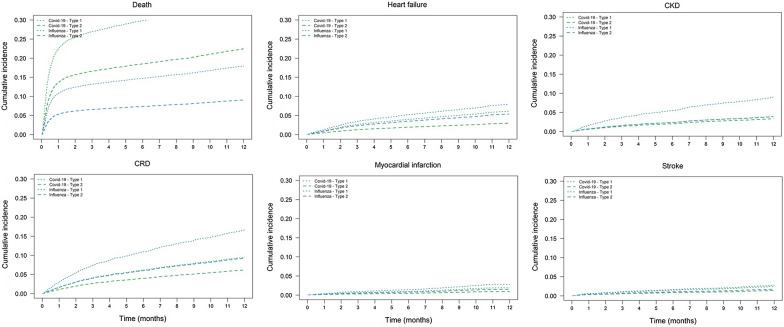
Nationwide healthcare registries were used to identify patients. A total of 11,005 adult patients with diabetes (T1D, n = 373; T2D, n = 10,632) were hospitalized due to COVID-19 from January 1, 2020 to September 1, 2021. Moreover, 5111 patients with diabetes (304 T1D, 4807 T2D) were hospitalized due to influenza from January 1, 2015 to December 31, 2019. Main outcomes were death within 28 days after admission and new hospitalizations for heart failure (HF), chronic kidney disease (CKD), cardiorenal disease (CRD; composite of HF and CKD), myocardial infarction (MI) and stroke during 1 year of follow-up.
Number of deaths and CRD events were 2025 and 442 with COVID-19 and 259 and 525 with influenza, respectively. Age- and sex-adjusted Cox regression models in COVID-19 showed higher risk of death and HF in T1D vs. T2D, hazard ratio (HR) 1.77 (95% confidence interval 1.41-2.22) and 2.57 (1.31-5.05). With influenza, T1D was associated with higher risk of death compared with T2D, HR 1.80 (1.26-2.57). Older age and previous CRD were associated with higher risks of death and hospitalization for CRD. After adjustment for prior comorbidities, mortality differences were still significant, but there were no significant differences in cardiovascular and renal outcomes. COVID-19 relative to influenza was associated with higher risk of death in both T1D and T2D, HR 2.44 (1.60-3.72) and 2.81 (2.59-3.06), respectively.
In Sweden, patients with T1D as compared to T2D had a higher age- and sex-adjusted risk of death within 28 days and HF within one year after COVID-19 hospitalization, whereas the risks of other non-fatal cardiovascular and renal disease events were similar. Patients with T1D as well as T2D have a greater mortality rate when hospitalized due to COVID-19 compared to influenza, underscoring the importance of vaccination and other preventive measures against COVID-19 for diabetes patients.
患有糖尿病的人患严重 2019 年冠状病毒病(COVID-19)的风险增加,但糖尿病类型和其他风险因素的影响仍不完全清楚。我们在瑞典的 1 型和 2 型糖尿病(T1D 和 T2D)住院患者队列中研究了这一点,还包括与近年来的流感流行进行了比较。
利用全国性的医疗保健登记系统来确定患者。从 2020 年 1 月 1 日至 2021 年 9 月 1 日,共有 11005 名成年糖尿病患者(T1D,n=373;T2D,n=10632)因 COVID-19 住院。此外,5111 名糖尿病患者(304 名 T1D,4807 名 T2D)因流感于 2015 年 1 月 1 日至 2019 年 12 月 31 日住院。主要结局为入院后 28 天内死亡以及 1 年内因心力衰竭(HF)、慢性肾脏病(CKD)、心肾疾病(CRD;HF 和 CKD 的组合)、心肌梗死(MI)和中风而再次住院。
COVID-19 死亡和 CRD 事件的数量分别为 2025 例和 442 例,流感为 259 例和 525 例。COVID-19 的年龄和性别调整后的 Cox 回归模型显示,T1D 患者的死亡和 HF 风险高于 T2D,风险比(HR)分别为 1.77(95%置信区间 1.41-2.22)和 2.57(1.31-5.05)。与 T2D 相比,T1D 患者因流感而死亡的风险更高,HR 为 1.80(1.26-2.57)。年龄较大和既往 CRD 与死亡和 CRD 住院风险增加相关。在调整了先前的合并症后,死亡率差异仍然显著,但心血管和肾脏结局无显著差异。与流感相比,COVID-19 在 T1D 和 T2D 中与死亡风险增加相关,HR 分别为 2.44(1.60-3.72)和 2.81(2.59-3.06)。
在瑞典,与 T2D 相比,T1D 患者在 COVID-19 住院后 28 天内和 1 年内的死亡和 HF 风险更高,而其他非致命性心血管和肾脏疾病事件的风险相似。与流感相比,因 COVID-19 住院的 T1D 和 T2D 患者的死亡率更高,这突显了针对 COVID-19 为糖尿病患者接种疫苗和采取其他预防措施的重要性。