School of Child and Adolescent Cognitive Behavior Therapy (AKiP), Faculty of Medicine and University Hospital Cologne, University of Cologne, Pohligstraße 9, 50969, Cologne, Germany.
Department of Special Education, Faculty of Human Sciences, University of Cologne, Cologne, Germany.
BMC Psychiatry. 2022 Dec 22;22(1):820. doi: 10.1186/s12888-022-04440-x.
To examine and validate the self-report Questionnaire on the Regulation of Unpleasant Moods in Children (FRUST), which is a modified and shortened version of the Questionnaire for the Assessment of Emotion Regulation in Children and Adolescents (FEEL-KJ).
The data comprised child and parent ratings of a community-screened sample with differing levels of affective dysregulation (AD) (N = 391, age: M = 10.64, SD = 1.33, 56% male). We conducted latent factor analyses to establish a factor structure. Subsequently, we assessed measurement invariance (MI) regarding age, gender, and AD level and evaluated the internal consistencies of the scales. Finally, we examined the convergent and divergent validity of the instrument by calculating differential correlations between the emotion regulation strategy (ERS) scales and self- and parent-report measures of psychopathology.
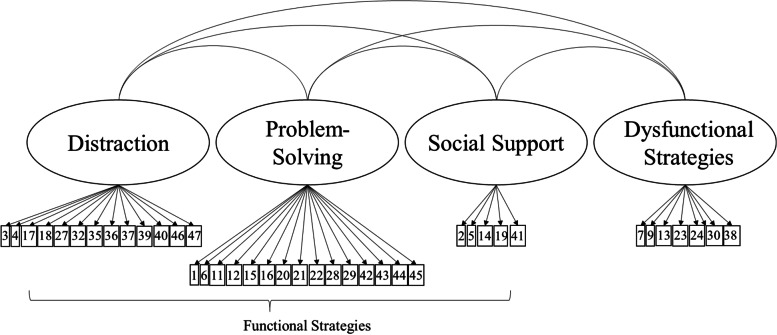
A four-factor model, with one factor representing Dysfunctional Strategies and the three factors Distraction, Problem-Solving and Social Support representing functional strategies provided the best fit to our data and was straightforward to interpret. We found strong MI for age and gender and weak MI for AD level. Differential correlations with child and parent ratings of measures of psychopathology supported the construct validity of the factors.
We established a reliable and valid self-report measure for the assessment of ERS in children. Due to the reduced number of items and the inclusion of highly specific regulatory behaviors, the FRUST might be a valuable contribution to the assessment of ER strategies for diagnostic, therapeutic, and research purposes.
检验和验证儿童不愉快情绪调节自我报告问卷(FRUST),这是儿童和青少年情绪调节评估问卷(FEEL-KJ)的修改和缩短版本。
数据来自具有不同情感失调(AD)水平的社区筛查样本的儿童和家长评定(N=391,年龄:M=10.64,SD=1.33,56%为男性)。我们进行了潜在因素分析以建立因素结构。随后,我们评估了年龄、性别和 AD 水平的测量不变性(MI),并评估了量表的内部一致性。最后,我们通过计算情绪调节策略(ERS)量表与自我和家长报告的精神病理学测量之间的差异相关性来检验该工具的聚合和发散效度。
一个代表功能失调策略的四因素模型和三个代表分心、解决问题和社会支持的功能策略因素提供了最适合我们数据的拟合,并且易于解释。我们发现年龄和性别具有很强的 MI,而 AD 水平的 MI 较弱。与儿童和家长对精神病理学测量的评定的差异相关性支持了因素的结构效度。
我们建立了一种可靠且有效的自我报告测量工具,用于评估儿童的 ERS。由于项目数量减少,并且包括了高度特定的调节行为,FRUST 可能是评估 ER 策略用于诊断、治疗和研究目的的有价值的贡献。