Department of Biochemistry and Molecular Biology, University of Nebraska Medical Center, Omaha, NE, 68198-5870, USA.
Fred and Pamela Buffett Cancer Center, University of Nebraska Medical Center, Omaha, NE, USA.
Mol Cancer. 2022 Dec 22;21(1):225. doi: 10.1186/s12943-022-01682-x.
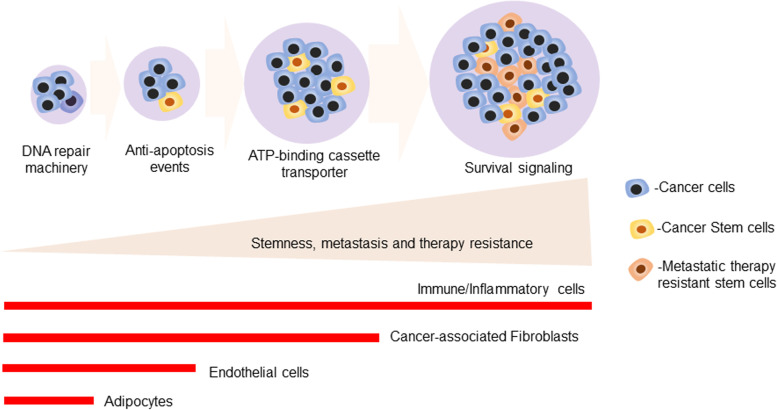
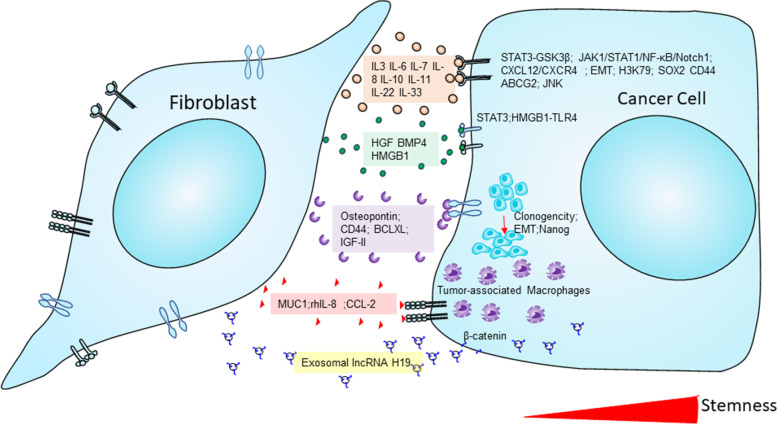
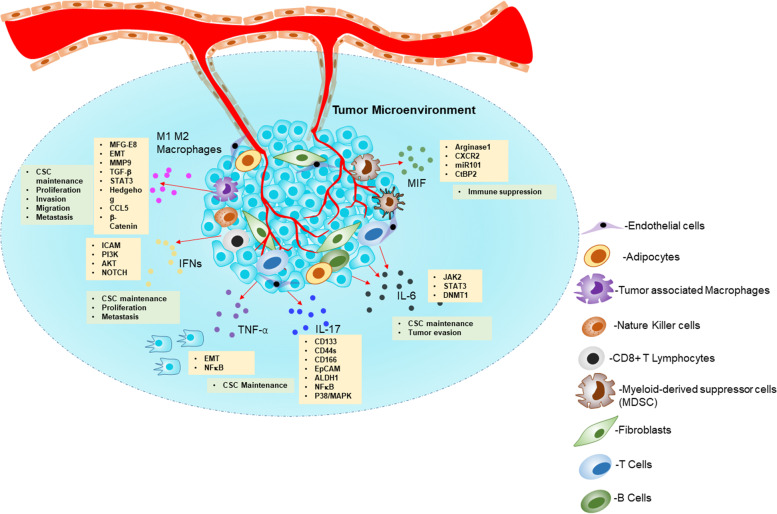
Cancer divergence has many facets other than being considered a genetic term. It is a tremendous challenge to understand the metastasis and therapy response in cancer biology; however, it postulates the opportunity to explore the possible mechanism in the surrounding tumor environment. Most deadly solid malignancies are distinctly characterized by their tumor microenvironment (TME). TME consists of stromal components such as immune, inflammatory, endothelial, adipocytes, and fibroblast cells. Cancer stem cells (CSCs) or cancer stem-like cells are a small sub-set of the population within cancer cells believed to be a responsible player in the self-renewal, metastasis, and therapy response of cancer cells. The correlation between TME and CSCs remains an enigma in understanding the events of metastasis and therapy resistance in cancer biology. Recent evidence suggests that TME dictates the CSCs maintenance to arbitrate cancer progression and metastasis. The immune, inflammatory, endothelial, adipocyte, and fibroblast cells in the TME release growth factors, cytokines, chemokines, microRNAs, and exosomes that provide cues for the gain and maintenance of CSC features. These intricate cross-talks are fueled to evolve into aggressive, invasive, migratory phenotypes for cancer development. In this review, we have abridged the recent developments in the role of the TME factors in CSC maintenance and how these events influence the transition of tumor progression to further translate into metastasis and therapy resistance in cancer.
癌症的异质性不仅被认为是一个遗传术语,还有许多其他方面。理解癌症生物学中的转移和治疗反应是一个巨大的挑战;然而,这也为探索周围肿瘤环境中的可能机制提供了机会。大多数致命的实体恶性肿瘤的特点是其肿瘤微环境(TME)。TME 由间质成分组成,如免疫、炎症、内皮、脂肪细胞和成纤维细胞。癌症干细胞(CSCs)或具有癌症干细胞样特性的细胞是癌细胞中一小部分被认为是负责细胞自我更新、转移和治疗反应的细胞。TME 与 CSCs 之间的相关性仍然是理解癌症生物学中转移和治疗抵抗事件的一个谜。最近的证据表明,TME 决定了 CSCs 的维持,以仲裁癌症的进展和转移。TME 中的免疫、炎症、内皮、脂肪细胞和成纤维细胞释放生长因子、细胞因子、趋化因子、microRNAs 和外泌体,为 CSC 特征的获得和维持提供线索。这些复杂的相互作用被激发,从而演变为侵袭性、迁移性的癌症发展表型。在这篇综述中,我们总结了 TME 因子在 CSC 维持中的作用的最新进展,以及这些事件如何影响肿瘤进展向转移和治疗抵抗的转变。