Zhou De-Xi, Wang Xiao-He, Xu Xuan, Chen Wen-Jie, Wei Jing, Chen Ting-Tao, Wei Hong
School of Life Sciences, Nanchang University, Nanchang 330031, China.
Institute of Translational Medicine, Nanchang University, Nanchang 330031, China.
Pharmaceutics. 2022 Dec 13;14(12):2789. doi: 10.3390/pharmaceutics14122789.
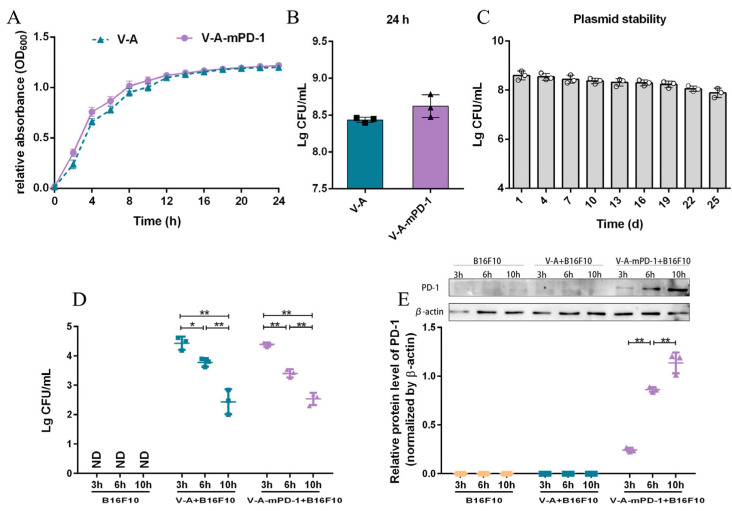
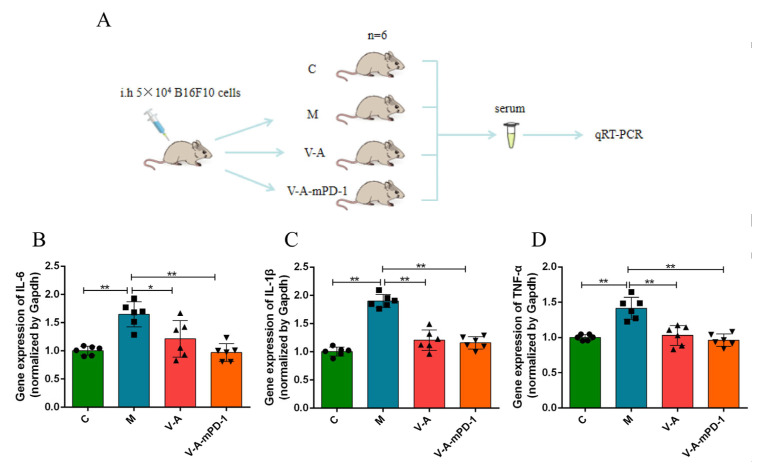
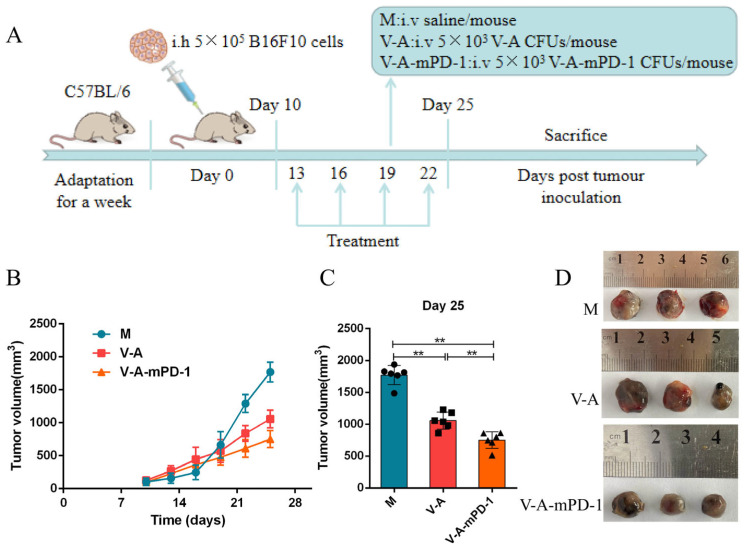
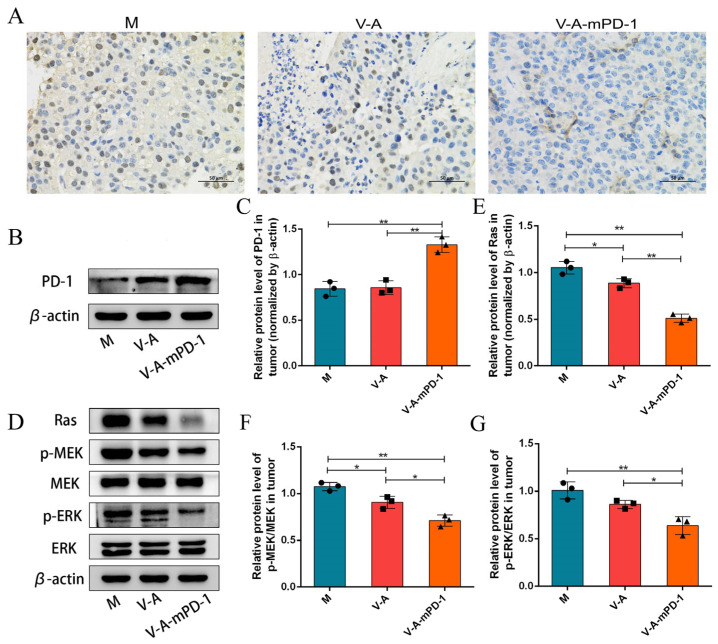
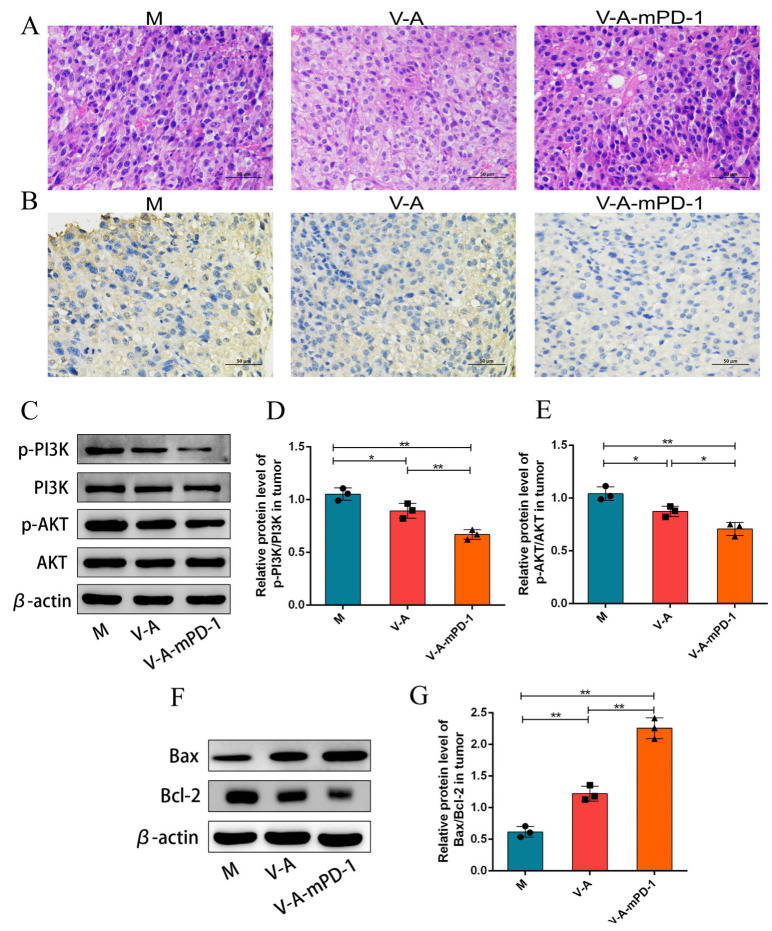
Programmed cell death protein 1/Programmed cell death ligand 1 (PD-1/PD-L1) immune checkpoint inhibitors are the most promising treatments for malignant tumors currently, but the low response rate limits their further clinical utilization. To address this problem, our group constructed an engineered strain of VNP20009-Abvec-Igκ-mPD-1 [V-A-mPD-1 (mPD-1, murine PD-1)] to combine oncolytic bacterial therapy with immunotherapy. Further, we evaluated its growth performance and mPD-1 expression ability in vitro while establishing the melanoma mice model to explore its potential anti-cancer effects in tumor therapy. Our results indicated that the V-A-mPD-1 strain has superior growth performance and can invade B16F10 melanoma cells and express PD-1. In addition, in the melanoma mice model, we observed a marked reduction in tumor volume and the formation of a larger necrotic area. V-A-mPD-1 administration resulted in a high expression of mPD-1 at the tumor site, inhibiting tumor cell proliferation via the down-regulation of the expression of rat sarcoma (Ras), phosphorylated mitogen-activated protein kinase (p-MEK)/MEK, and phosphorylated extracellular signal-regulated kinase (p-ERK)/ERK expression significantly inhibited tumor cell proliferation. Tumor cell apoptosis was promoted by down-regulating phosphoinositide 3 kinase (PI3K) and protein kinase B (AKT) signaling pathways, as evidenced by an increased Bcl-2-associated X protein/B cell lymphoma-2 (Bax/Bcl-2) expression ratio. Meanwhile, the expression levels of systemic inflammatory cytokines, such as interleukin-6 (IL-6), interleukin-1β (IL-1β), and tumor necrosis factor-α (TNF-α), were substantially reduced. In conclusion, our research demonstrated that V-A-mPD-1 has an excellent anti-tumor effect, prompting that the combined application of microbial therapy and immunotherapy is a feasible cancer treatment strategy.
程序性细胞死亡蛋白1/程序性细胞死亡配体1(PD-1/PD-L1)免疫检查点抑制剂是目前治疗恶性肿瘤最有前景的方法,但低应答率限制了它们在临床上的进一步应用。为了解决这个问题,我们团队构建了一种工程菌株VNP20009-Abvec-Igκ-mPD-1 [V-A-mPD-1(mPD-1,小鼠PD-1)],将溶瘤细菌疗法与免疫疗法相结合。此外,我们在体外评估了其生长性能和mPD-1表达能力,同时建立了黑色素瘤小鼠模型,以探索其在肿瘤治疗中的潜在抗癌作用。我们的结果表明,V-A-mPD-1菌株具有优异的生长性能,能够侵袭B16F10黑色素瘤细胞并表达PD-1。此外,在黑色素瘤小鼠模型中,我们观察到肿瘤体积显著减小,坏死区域增大。给予V-A-mPD-1后,肿瘤部位mPD-1高表达,通过下调大鼠肉瘤(Ras)、磷酸化丝裂原活化蛋白激酶(p-MEK)/MEK和磷酸化细胞外信号调节激酶(p-ERK)/ERK的表达显著抑制肿瘤细胞增殖。下调磷酸肌醇3激酶(PI3K)和蛋白激酶B(AKT)信号通路促进了肿瘤细胞凋亡,Bcl-2相关X蛋白/B细胞淋巴瘤-2(Bax/Bcl-2)表达比值增加证明了这一点。同时,全身炎性细胞因子如白细胞介素-6(IL-6)、白细胞介素-1β(IL-1β)和肿瘤坏死因子-α(TNF-α)的表达水平大幅降低。总之,我们的研究表明V-A-mPD-1具有优异的抗肿瘤作用,提示微生物疗法和免疫疗法联合应用是一种可行的癌症治疗策略。