Chronic Disease Research Institute, The Children's Hospital, and National Clinical Research Center for Child Health, School of Public Health, School of Medicine, Zhejiang University, Hangzhou, Zhejiang, China.
Department of Nutrition and Food Hygiene, School of Public Health, School of Medicine, Zhejiang University, Hangzhou, Zhejiang, China.
J Cachexia Sarcopenia Muscle. 2023 Feb;14(1):534-544. doi: 10.1002/jcsm.13157. Epub 2022 Dec 23.
The associations between body flexibility and sarcopenia were not well understood. This study aimed to explore the cross-sectional and longitudinal associations of flexibility with sarcopenia.
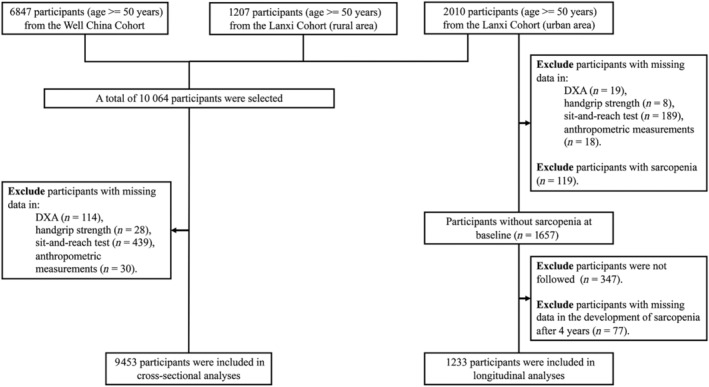
Our study selected participants aged 50-80 from the WELL-China cohort and the Lanxi cohort. Participants from the urban area of the Lanxi cohort were followed up 4 years later. Body flexibility was measured by the sit-and-reach test. Muscle mass was evaluated by dual-energy X-ray absorptiometry. Muscle strength was evaluated using handgrip strength. Sarcopenia was defined as having both low muscle mass and low muscle strength. We used multivariable logistic regressions to assess the cross-sectional associations of body flexibility with low muscle mass, low muscle strength and sarcopenia. We also used multivariable logistic regressions to explore the associations of baseline flexibility and 4-year changes in flexibility with incident low muscle mass, low muscle strength and sarcopenia.
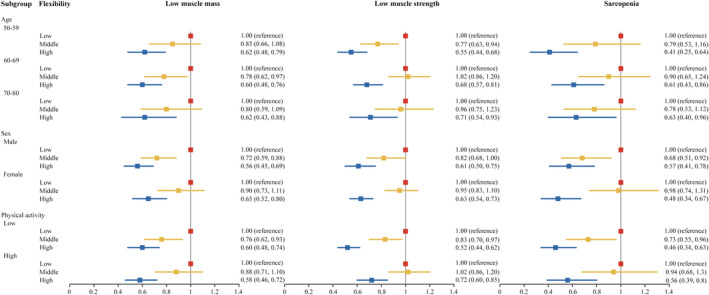
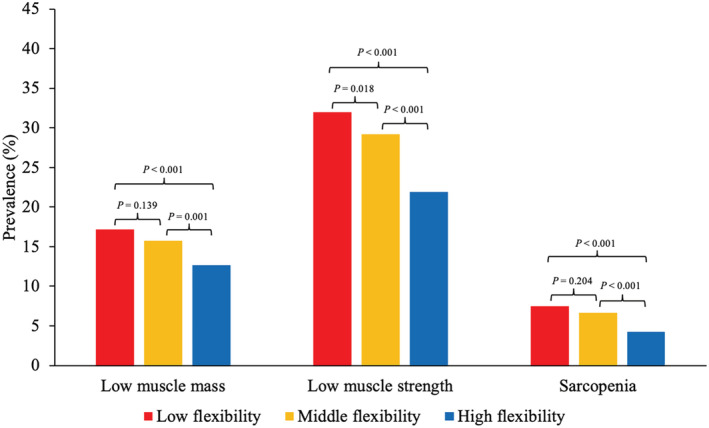
A total of 9453 participants were enrolled in the cross-sectional study, and 1233 participants were included in the longitudinal analyses. In the cross-sectional analyses, compared with low body flexibility, high body flexibility was inversely associated with low muscle mass (odds ratio [OR], 0.58; 95% confidence interval [CI], 0.50-0.68; P < 0.001), low muscle strength (OR, 0.62; 95% CI, 0.55-0.69; P < 0.001) and sarcopenia (OR, 0.52; 95% CI, 0.41-0.65; P < 0.001), and these associations did not differ in different age groups, sex or physical activity levels. In the longitudinal analyses, compared with participants with low body flexibility, participants with high body flexibility had lower risk of the incident low muscle strength (OR, 0.53; 95% CI, 0.38-0.74; P < 0.001) and sarcopenia (OR, 0.36; 95% CI, 0.21-0.61; P < 0.001), but not incident low muscle mass (OR, 0.59; 95% CI, 0.33-1.06; P = 0.076). Every 1-cm increase in flexibility during 4 years was associated with reduced risk of incident low muscle mass (OR, 0.96; 95% CI, 0.93-1.00; P = 0.025), low muscle strength (OR, 0.96; 95% CI, 0.94-0.98; P = 0.002) and sarcopenia (OR, 0.96; 95% CI, 0.93-0.99; P = 0.007).
High flexibility was associated with reduced risk of incident low muscle strength and sarcopenia. Increases in flexibility were associated with reduced risk of incident low muscle mass, low muscle strength and sarcopenia. Flexibility exercises and monitoring the dynamic change of flexibility might be helpful in preventing sarcopenia among adults aged 50 years or over.
身体柔韧性与肌肉减少症之间的关联尚未得到充分理解。本研究旨在探讨柔韧性与肌肉减少症的横断面和纵向关联。
我们的研究从中国 WELL 队列和兰溪市队列中选择了 50-80 岁的参与者。兰溪市队列的城区参与者在 4 年后进行了随访。身体柔韧性通过坐立前伸测试进行测量。肌肉质量通过双能 X 射线吸收法评估。肌肉力量使用握力进行评估。肌肉减少症定义为同时存在低肌肉量和低肌肉力量。我们使用多变量逻辑回归来评估身体柔韧性与低肌肉量、低肌肉力量和肌肉减少症的横断面关联。我们还使用多变量逻辑回归来探讨基线柔韧性和 4 年柔韧性变化与新发低肌肉量、低肌肉力量和肌肉减少症的关联。
共有 9453 名参与者纳入横断面研究,1233 名参与者纳入纵向分析。在横断面分析中,与身体柔韧性低相比,身体柔韧性高与低肌肉量(比值比 [OR],0.58;95%置信区间 [CI],0.50-0.68;P<0.001)、低肌肉力量(OR,0.62;95%CI,0.55-0.69;P<0.001)和肌肉减少症(OR,0.52;95%CI,0.41-0.65;P<0.001)呈负相关,且这些关联在不同年龄组、性别或体力活动水平中无差异。在纵向分析中,与身体柔韧性低的参与者相比,身体柔韧性高的参与者发生低肌肉力量的风险较低(OR,0.53;95%CI,0.38-0.74;P<0.001)和肌肉减少症(OR,0.36;95%CI,0.21-0.61;P<0.001),但新发低肌肉量的风险无差异(OR,0.59;95%CI,0.33-1.06;P=0.076)。4 年内柔韧性每增加 1 厘米,与新发低肌肉量(OR,0.96;95%CI,0.93-1.00;P=0.025)、低肌肉力量(OR,0.96;95%CI,0.94-0.98;P=0.002)和肌肉减少症(OR,0.96;95%CI,0.93-0.99;P=0.007)的风险降低相关。
高柔韧性与新发低肌肉力量和肌肉减少症的风险降低相关。柔韧性的增加与新发低肌肉量、低肌肉力量和肌肉减少症的风险降低相关。柔韧性锻炼和监测柔韧性的动态变化可能有助于预防 50 岁及以上成年人的肌肉减少症。