Iese Viliamu, Wairiu Morgan, Hickey Gordon M, Ugalde David, Hinge Salili Diana, Walenenea John, Tabe Tammy, Keremama Milton, Teva Chris, Navunicagi Otto, Fesaitu Jioje, Tigona Robson, Krishna Deeksha, Sachan Hirdesh, Unwin Nigel, Guell Cornelia, Haynes Emily, Veisa Filipe, Vaike Linda, Bird Zina, Ha'apio Michael, Roko Nasoni, Patolo Soane, Dean Annika Rose, Kiran Sashi, Tikai Pitakia, Tuiloma Jowalesi, Halavatau Siosiua, Francis Judith, Ward Alastair Christopher
Pacific Centre for Environment and Sustainable Development, The University of the South Pacific, Fiji.
McGill University, Canada.
Agric Syst. 2021 May;190:103099. doi: 10.1016/j.agsy.2021.103099. Epub 2021 Feb 25.
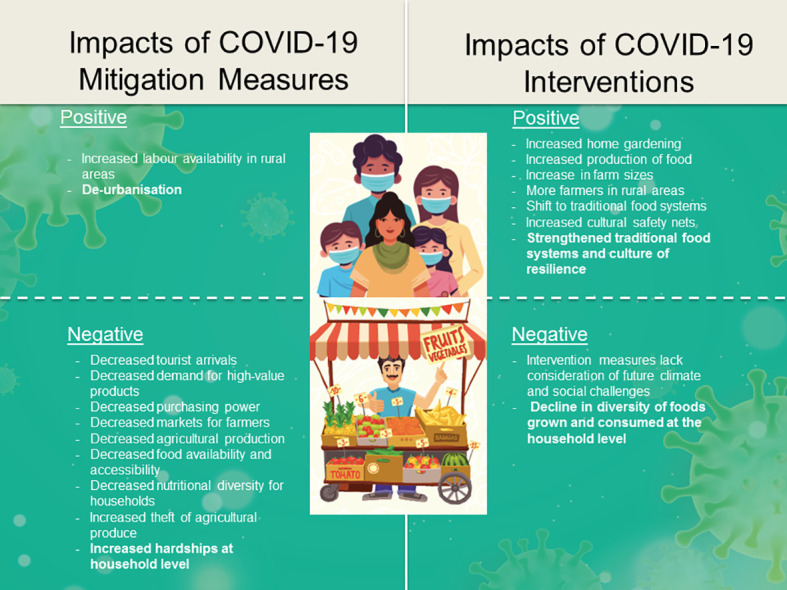
COVID-19 mitigation measures including border lockdowns, social distancing, de-urbanization and restricted movements have been enforced to reduce the risks of COVID-19 arriving and spreading across PICs. To reduce the negative impacts of COVID-19 mitigation measures, governments have put in place a number of interventions to sustain food and income security. Both mitigation measures and interventions have had a number of impacts on agricultural production, food systems and dietary diversity at the national and household levels.
Our paper conducted an exploratory analysis of immediate impacts of both COVID-19 mitigation measures and interventions on households and communities in PICs. Our aim is to better understand the implications of COVID-19 for PICs and identify knowledge gaps requiring further research and policy attention.
To understand the impacts of COVID-19 mitigation measures and interventions on food systems and diets in PICs, 13 communities were studied in Fiji and Solomon Islands in July-August 2020. In these communities, 46 focus group discussions were carried out and 425 households were interviewed. Insights were also derived from a series of online discussion sessions with local experts of Pacific Island food and agricultural systems in August and September 2020. To complement these discussions, an online search was conducted for available literature.
Identified impacts include: 1) Reduced agricultural production, food availability and incomes due to a decline in local markets and loss of access to international markets; 2) Increased social conflict such as land disputes, theft of high-value crops and livestock, and environmental degradation resulting from urban-rural migration; 3) Reduced availability of seedlings, planting materials, equipment and labour in urban areas; 4) Reinvigoration of traditional food systems and local food production; and 5) -emergence of cultural safety networks and values, such as barter systems. Households in rural and urban communities appear to have responded positively to COVID-19 by increasing food production from home gardens, particularly root crops, vegetables and fruits. However, the limited diversity of agricultural production and decreased household incomes are reducing the already low dietary diversity score that existed pre-COVID-19 for households.
These findings have a number of implications for future policy and practice. Future interventions would benefit from being more inclusive of diverse partners, focusing on strengthening cultural and communal values, and taking a systemic and long-term perspective. COVID-19 has provided an opportunity to strengthen traditional food systems and re-evaluate, re-imagine and re-localize agricultural production strategies and approaches in PICs.
为降低新冠病毒传入并在太平洋岛国传播的风险,各国实施了包括边境封锁、社交距离管控、去城市化和行动限制在内的新冠疫情缓解措施。为减少这些措施的负面影响,各国政府采取了一系列干预措施以维持粮食和收入安全。这些缓解措施和干预措施在国家和家庭层面上对农业生产、粮食系统和饮食多样性都产生了诸多影响。
本文对新冠疫情缓解措施和干预措施对太平洋岛国的家庭和社区的直接影响进行了探索性分析。我们的目的是更好地理解新冠疫情对太平洋岛国的影响,并找出需要进一步研究和政策关注的知识空白。
为了解新冠疫情缓解措施和干预措施对太平洋岛国粮食系统和饮食的影响,2020年7月至8月在斐济和所罗门群岛对13个社区进行了研究。在这些社区中,开展了46次焦点小组讨论,并对425户家庭进行了访谈。2020年8月和9月与太平洋岛屿粮食和农业系统的当地专家进行的一系列在线讨论也提供了见解。为补充这些讨论,还对现有文献进行了在线搜索。
已确定的影响包括:1)由于当地市场萎缩和无法进入国际市场,农业生产、粮食供应和收入减少;2)社会冲突增加,如土地纠纷、高价值作物和牲畜被盗,以及城乡迁移导致的环境退化;3)城市地区幼苗、种植材料、设备和劳动力供应减少;4)传统粮食系统和当地粮食生产得到振兴;5)出现了文化安全网络和价值观,如易货系统。农村和城市社区的家庭似乎通过增加自家菜园的粮食生产,特别是根茎类作物、蔬菜和水果,对新冠疫情做出了积极反应。然而,农业生产多样性有限和家庭收入下降正在降低家庭在新冠疫情前就已很低的饮食多样性得分。
这些发现对未来的政策和实践有诸多启示。未来的干预措施若能更广泛地纳入不同伙伴、注重强化文化和社区价值观,并从系统和长期的角度出发,将更有益处。新冠疫情为加强传统粮食系统以及重新评估、重新构想和重新定位太平洋岛国的农业生产战略与方法提供了契机。