Research Center for Small Molecule Immunological Drugs, School of Pharmaceutical Sciences, Shanghai Jiao Tong University, Shanghai, China.
Pharm-X Center, Laboratory of Medicinal Chemical Biology & Frontiers on Drug Discovery (RLMCBFDD), School of Pharmaceutical Sciences, Shanghai Jiao Tong University, Shanghai, China.
Front Immunol. 2022 Dec 8;13:1006395. doi: 10.3389/fimmu.2022.1006395. eCollection 2022.
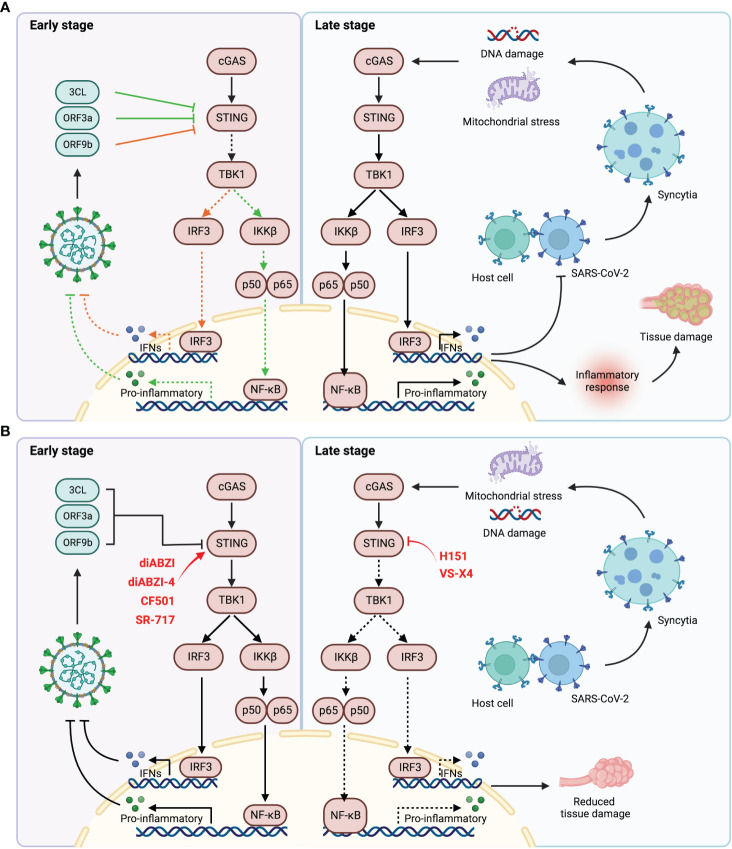
The coronavirus disease 2019 (COVID-19) pandemic caused by the infection of severe acute respiratory syndrome coronavirus 2 (SARS-CoV-2) has cast a notorious damage to the public health and global economy. The Stimulator of Interferon Genes (STING) is a crucial element of the host antiviral pathway and plays a pivotal but complex role in the infection and development of COVID-19. Herein, we discussed the antagonistic mechanism of viral proteins to the STING pathway as well as its activation induced by host cells. Specifically, we highlighted that the persistent activation of STING by SARS-CoV-2 led to abnormal inflammation, and STING inhibitors could reduce the excessive inflammation. In addition, we also emphasized that STING agonists possessed antiviral potency against diverse coronavirus and showed adjuvant efficacy in SARS-CoV-2 vaccines by inducing IFN responses.
新型冠状病毒病 2019(COVID-19)是由严重急性呼吸系统综合征冠状病毒 2(SARS-CoV-2)感染引起的,对公共卫生和全球经济造成了严重破坏。干扰素基因刺激物(STING)是宿主抗病毒途径的关键要素,在 COVID-19 的感染和发展中起着关键但复杂的作用。本文讨论了病毒蛋白对 STING 途径的拮抗机制及其在宿主细胞中的激活。具体而言,我们强调了 SARS-CoV-2 持续激活 STING 导致异常炎症,而 STING 抑制剂可以减少过度炎症。此外,我们还强调 STING 激动剂具有针对多种冠状病毒的抗病毒效力,并通过诱导 IFN 反应在 SARS-CoV-2 疫苗中显示出佐剂功效。