• 文献检索
  • 文档翻译
  • 深度研究
  • 学术资讯
  • Suppr Zotero 插件Zotero 插件
  • 邀请有礼
  • 套餐&价格
  • 历史记录
应用&插件
Suppr Zotero 插件Zotero 插件浏览器插件Mac 客户端Windows 客户端微信小程序
定价
高级版会员购买积分包购买API积分包
服务
文献检索文档翻译深度研究API 文档MCP 服务
关于我们
关于 Suppr公司介绍联系我们用户协议隐私条款
关注我们

Suppr 超能文献

核心技术专利:CN118964589B侵权必究
粤ICP备2023148730 号-1Suppr @ 2026

文献检索

告别复杂PubMed语法,用中文像聊天一样搜索,搜遍4000万医学文献。AI智能推荐,让科研检索更轻松。

立即免费搜索

文件翻译

保留排版,准确专业,支持PDF/Word/PPT等文件格式,支持 12+语言互译。

免费翻译文档

深度研究

AI帮你快速写综述,25分钟生成高质量综述,智能提取关键信息,辅助科研写作。

立即免费体验

分子分类能否助力转移性肾细胞癌一线治疗的个性化?对现有模型的系统评价

Can Molecular Classifications Help Tailor First-line Treatment of Metastatic Renal Cell Carcinoma? A Systematic Review of Available Models.

作者信息

Ouzaid Idir, Rioux-Leclercq Nathalie, Khene Zine-Eddine, Bensalah Karim, Kammerer-Jacquet Solène-Florence

机构信息

Department of Pathology, University of Rennes, CHU Rennes, Inserm, EHESP, Irset (Institut de recherche en santé, environnement et travail)-UMR_S1085, Rennes, France.

Department of Urology, Bichat Claude Bernard Hospital, University of Paris, Paris, France.

出版信息

Eur Urol Open Sci. 2022 Dec 15;47:12-19. doi: 10.1016/j.euros.2022.11.006. eCollection 2023 Jan.

DOI:10.1016/j.euros.2022.11.006
PMID:36573246
原文链接:https://pmc.ncbi.nlm.nih.gov/articles/PMC9789383/
Abstract

CONTEXT

The advent of immune check inhibitors (ICIs) has tremendously changed the prognosis of metastatic renal cell carcinoma (mRCC), adding an unseen substantial overall survival benefit. These agents could be administered alone or in combination with anti-vascular endothelial growth factor (anti-VEGF) therapies. So far, treatment allocation is based only on clinical stratification risk models.

OBJECTIVE

Herein, we aimed to report the different molecular classifications reported in the first-line treatment of mRCC and discuss the awaited clinical implications in terms of treatment selection.

EVIDENCE ACQUISITION

Medline database as well as European Society for Medical Oncology (ESMO)/American Society of Clinical Oncology (ASCO) conference proceedings were searched to identify biomarker studies. Inclusion criteria comprised randomized and nonrandomized clinical trials that included patients treated in the first line of mRCC setting, patients treated with anti-VEGF therapies or ICIs, biological modeling, and available survival outcomes.

EVIDENCE SYNTHESIS

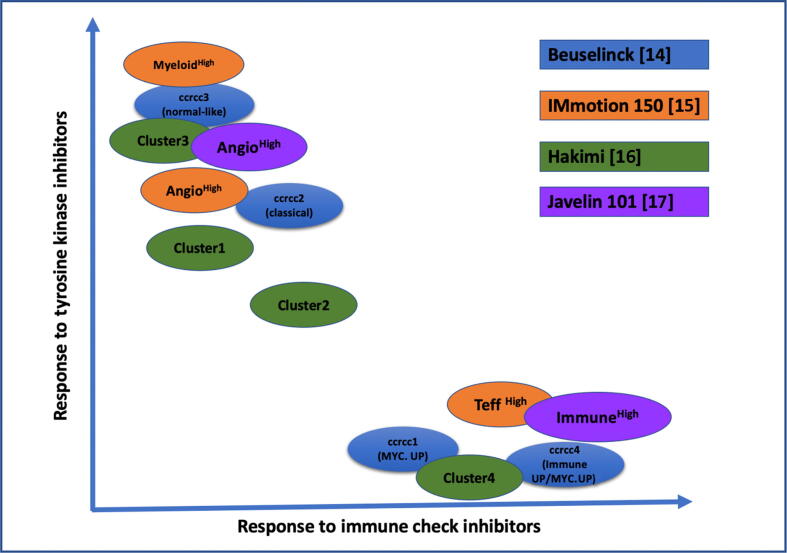
Four classification models were identified with subsequent clinical implications: Beuselinck model (34 gene signatures), IMmotion150, Hakimi, and JAVELIN 101 model. Tumor profiling shows distinct outcomes when treated with one or other combination. Patients are clustered into two gene signatures: angiogenic and proinflammatory (as per JAVELIN). The first is more likely to respond to therapy that includes anti-VEGF agents, while the best outcomes are obtained with an ICI combination with the second.

CONCLUSIONS

The findings presented here were mostly derived from ancillary registered studies of new drugs in the setting of mRCC. Further validation is needed, which sets new paradigms for investigation in clinical research based on tumor biology for treatment allocation and not only on clinical stratification tools.

PATIENT SUMMARY

First-line treatment of metastatic kidney includes immunotherapy alone or in combination with antiangiogenic therapy. However, clinical practice demonstrated that the "one treatment fits all" strategy might not be the best approach. In fact, recent studies showed that the addition of immunotherapy agents will not benefit all patients equally, and some still respond either equally to or better than anti-vascular endothelial growth factor alone. This review revealed biomarker modeling that impacts treatment selection. Recent tumor profiling into "angiogenic signature" more sensitive to angiogenic agents versus "immune signature" more likely to achieve the best response with immunotherapy should be validated. Tumor biology features might be more powerful than clinical classification for a tailored treatment approach.

摘要

背景

免疫检查点抑制剂(ICI)的出现极大地改变了转移性肾细胞癌(mRCC)的预后,带来了显著的总体生存获益。这些药物可以单独使用,也可以与抗血管内皮生长因子(抗VEGF)疗法联合使用。到目前为止,治疗方案的选择仅基于临床分层风险模型。

目的

在此,我们旨在报告mRCC一线治疗中报道的不同分子分类,并讨论在治疗选择方面有待实现的临床意义。

证据获取

检索了Medline数据库以及欧洲医学肿瘤学会(ESMO)/美国临床肿瘤学会(ASCO)会议论文集,以确定生物标志物研究。纳入标准包括随机和非随机临床试验,这些试验纳入了mRCC一线治疗的患者、接受抗VEGF疗法或ICI治疗的患者、生物学建模以及可用的生存结果。

证据综合

确定了四种分类模型及其后续临床意义:Beuselinck模型(34个基因特征)、IMmotion150、Hakimi和JAVELIN 101模型。肿瘤分析显示,在接受一种或另一种联合治疗时会有不同的结果。患者被分为两种基因特征:血管生成性和促炎性(根据JAVELIN)。第一种更可能对包括抗VEGF药物的治疗产生反应,而第二种与ICI联合使用可获得最佳结果。

结论

此处呈现的研究结果大多来自mRCC背景下新药的辅助注册研究。需要进一步验证,这为基于肿瘤生物学而非仅基于临床分层工具进行治疗分配的临床研究调查设定了新的范式。

患者总结

转移性肾癌的一线治疗包括单独免疫治疗或与抗血管生成治疗联合使用。然而,临床实践表明,“一刀切”的策略可能不是最佳方法。事实上,最近的研究表明,添加免疫治疗药物并不会使所有患者同等受益,而且一些患者对单独抗血管内皮生长因子的反应仍然相同或更好。本综述揭示了影响治疗选择的生物标志物建模。最近将肿瘤分析为对血管生成药物更敏感的“血管生成特征”与更可能通过免疫治疗获得最佳反应的“免疫特征”应得到验证。肿瘤生物学特征对于量身定制的治疗方法可能比临床分类更具影响力。

https://cdn.ncbi.nlm.nih.gov/pmc/blobs/b79f/9789383/93f34246cf1d/gr2.jpg
https://cdn.ncbi.nlm.nih.gov/pmc/blobs/b79f/9789383/596183ff8b85/gr1.jpg
https://cdn.ncbi.nlm.nih.gov/pmc/blobs/b79f/9789383/93f34246cf1d/gr2.jpg
https://cdn.ncbi.nlm.nih.gov/pmc/blobs/b79f/9789383/596183ff8b85/gr1.jpg
https://cdn.ncbi.nlm.nih.gov/pmc/blobs/b79f/9789383/93f34246cf1d/gr2.jpg

相似文献

1
Can Molecular Classifications Help Tailor First-line Treatment of Metastatic Renal Cell Carcinoma? A Systematic Review of Available Models.分子分类能否助力转移性肾细胞癌一线治疗的个性化?对现有模型的系统评价
Eur Urol Open Sci. 2022 Dec 15;47:12-19. doi: 10.1016/j.euros.2022.11.006. eCollection 2023 Jan.
2
First-line Immunotherapy-based Combinations for Metastatic Renal Cell Carcinoma: A Systematic Review and Network Meta-analysis.一线免疫治疗联合方案治疗转移性肾细胞癌的系统评价和网络荟萃分析。
Eur Urol Oncol. 2021 Oct;4(5):755-765. doi: 10.1016/j.euo.2021.03.001. Epub 2021 Mar 20.
3
Impact of Clinicopathological Features on Survival in Patients Treated with First-line Immune Checkpoint Inhibitors Plus Tyrosine Kinase Inhibitors for Renal Cell Carcinoma: A Meta-analysis of Randomized Clinical Trials.一线免疫检查点抑制剂联合酪氨酸激酶抑制剂治疗肾细胞癌患者的生存与临床病理特征的关系:一项随机临床试验的荟萃分析。
Eur Urol Focus. 2022 Mar;8(2):514-521. doi: 10.1016/j.euf.2021.03.001. Epub 2021 Mar 11.
4
Sequencing and Combination of Systemic Therapy in Metastatic Renal Cell Carcinoma.转移性肾细胞癌的系统治疗的测序和联合应用。
Eur Urol Oncol. 2019 Sep;2(5):505-514. doi: 10.1016/j.euo.2019.06.022. Epub 2019 Aug 1.
5
Predictive Biomarkers of Response to Immunotherapy in Metastatic Renal Cell Cancer.转移性肾细胞癌免疫治疗反应的预测生物标志物
Front Oncol. 2020 Aug 12;10:1644. doi: 10.3389/fonc.2020.01644. eCollection 2020.
6
The Predictive Value of Programmed Death Ligand 1 in Patients with Metastatic Renal Cell Carcinoma Treated with Immune-checkpoint Inhibitors: A Systematic Review and Meta-analysis.程序性死亡配体 1 预测转移性肾细胞癌患者接受免疫检查点抑制剂治疗的价值:系统评价和荟萃分析。
Eur Urol. 2021 Jun;79(6):783-792. doi: 10.1016/j.eururo.2020.10.006. Epub 2020 Nov 7.
7
Immunotherapy Is Changing First-Line Treatment of Metastatic Renal-Cell Carcinoma.免疫疗法正在改变转移性肾细胞癌的一线治疗方法。
Clin Genitourin Cancer. 2019 Jun;17(3):e513-e521. doi: 10.1016/j.clgc.2019.01.017. Epub 2019 Feb 5.
8
Systemic Treatment of Metastatic Clear Cell Renal Cell Carcinoma in 2018: Current Paradigms, Use of Immunotherapy, and Future Directions.2018 年转移性透明细胞肾细胞癌的系统治疗:当前范例、免疫治疗的应用及未来方向。
Eur Urol. 2019 Jan;75(1):100-110. doi: 10.1016/j.eururo.2018.10.010. Epub 2018 Oct 13.
9
Combination of immune checkpoint inhibitors and tyrosine kinase inhibitors for the treatment of renal cell carcinoma.免疫检查点抑制剂与酪氨酸激酶抑制剂联合用于治疗肾细胞癌。
Expert Opin Biol Ther. 2021 Sep;21(9):1215-1226. doi: 10.1080/14712598.2021.1890713. Epub 2021 Feb 27.
10
Synergies of Antiangiogenic Therapy and Immune Checkpoint Blockade in Renal Cell Carcinoma: From Theoretical Background to Clinical Reality.肾细胞癌中抗血管生成疗法与免疫检查点阻断的协同作用:从理论背景到临床实践
Front Oncol. 2020 Jul 29;10:1321. doi: 10.3389/fonc.2020.01321. eCollection 2020.

本文引用的文献

1
Biomarkers for Renal Cell Carcinoma Recurrence: State of the Art.肾细胞癌复发的生物标志物:现状。
Curr Urol Rep. 2021 Apr 22;22(6):31. doi: 10.1007/s11934-021-01050-0.
2
The PRISMA 2020 statement: An updated guideline for reporting systematic reviews.《PRISMA 2020声明:报告系统评价的更新指南》
J Clin Epidemiol. 2021 Jun;134:178-189. doi: 10.1016/j.jclinepi.2021.03.001. Epub 2021 Mar 29.
3
Updated European Association of Urology Guidelines on Renal Cell Carcinoma: Nivolumab plus Cabozantinib Joins Immune Checkpoint Inhibition Combination Therapies for Treatment-naïve Metastatic Clear-Cell Renal Cell Carcinoma.
更新的欧洲泌尿外科学会肾癌指南:纳武利尤单抗联合卡博替尼加入免疫检查点抑制联合治疗用于治疗初治转移性透明细胞肾细胞癌。
Eur Urol. 2021 Mar;79(3):339-342. doi: 10.1016/j.eururo.2020.12.005. Epub 2020 Dec 24.
4
Predicting Response to Immunotherapy in Metastatic Renal Cell Carcinoma.预测转移性肾细胞癌对免疫疗法的反应
Cancers (Basel). 2020 Sep 18;12(9):2662. doi: 10.3390/cancers12092662.
5
Avelumab plus axitinib versus sunitinib in advanced renal cell carcinoma: biomarker analysis of the phase 3 JAVELIN Renal 101 trial.avelumab 联合阿昔替尼对比舒尼替尼用于晚期肾细胞癌:III 期 JAVELIN Renal 101 试验的生物标志物分析。
Nat Med. 2020 Nov;26(11):1733-1741. doi: 10.1038/s41591-020-1044-8. Epub 2020 Sep 7.
6
Efficacy and Safety of Nivolumab Plus Ipilimumab versus Sunitinib in First-line Treatment of Patients with Advanced Sarcomatoid Renal Cell Carcinoma.纳武利尤单抗联合伊匹单抗对比舒尼替尼用于晚期肉瘤样肾细胞癌患者一线治疗的疗效和安全性。
Clin Cancer Res. 2021 Jan 1;27(1):78-86. doi: 10.1158/1078-0432.CCR-20-2063. Epub 2020 Sep 1.
7
BIONIKK: A phase 2 biomarker driven trial with nivolumab and ipilimumab or VEGFR tyrosine kinase inhibitor (TKI) in naïve metastatic kidney cancer.BIONIKK:一项2期生物标志物驱动试验,在初治转移性肾癌中使用纳武单抗和伊匹单抗或VEGFR酪氨酸激酶抑制剂(TKI)。
Bull Cancer. 2020 Jun;107(5S):eS22-eS27. doi: 10.1016/S0007-4551(20)30283-6.
8
Updated efficacy results from the JAVELIN Renal 101 trial: first-line avelumab plus axitinib versus sunitinib in patients with advanced renal cell carcinoma.JAVELIN肾101试验的最新疗效结果:一线阿维鲁单抗联合阿昔替尼与舒尼替尼治疗晚期肾细胞癌患者的对比
Ann Oncol. 2020 Aug;31(8):1030-1039. doi: 10.1016/j.annonc.2020.04.010. Epub 2020 Apr 25.
9
NCCN Guidelines Insights: Kidney Cancer, Version 2.2020.NCCN 指南解读:肾癌,第 2.2020 版。
J Natl Compr Canc Netw. 2019 Nov 1;17(11):1278-1285. doi: 10.6004/jnccn.2019.0054.
10
Updated European Association of Urology Guidelines on Renal Cell Carcinoma: Immune Checkpoint Inhibition Is the New Backbone in First-line Treatment of Metastatic Clear-cell Renal Cell Carcinoma.更新的欧洲泌尿外科学会肾癌指南:免疫检查点抑制是转移性透明细胞肾细胞癌一线治疗的新支柱。
Eur Urol. 2019 Aug;76(2):151-156. doi: 10.1016/j.eururo.2019.05.022.