
儿童近视性屈光参差的准分子激光原位角膜磨镶术十年疗效
Ten-Year Outcomes of LASIK for Pediatric Myopic Anisometropia.
作者信息
Hashem Omar, Sheha Hosam
机构信息
Cornea and Refractive Department, Research Institute of Ophthalmology, Giza, Cairo, Egypt.
Department of Ophthalmology, Florida International University, Herbert Wertheim College of Medicine & Glaucoma Research Organization, Miami, FL, USA.
出版信息
Clin Ophthalmol. 2022 Dec 22;16:4293-4301. doi: 10.2147/OPTH.S387302. eCollection 2022.
PURPOSE
To evaluate long-term safety, effectiveness, and stability of unilateral LASIK in pediatric myopic anisometropic amblyopia.
METHODS
This retrospective study included children who received unilateral LASIK for myopic anisometropia of >6 D, after mandatory 6-month occlusion/penalization therapy. They were evaluated at 6 months, 1 year, 2 years and biannually until 10 years. Outcome measures included visual acuity, refraction, ocular alignment, stereopsis, corneal clarity, and corneal topography.
RESULTS
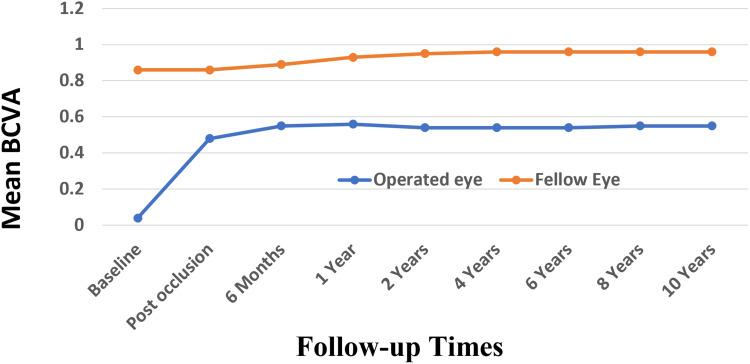
32 patients (16 girls) with mean age of 8.6 ± 2.3 years completed 10 years of follow up after unilateral LASIK. Mean preoperative spherical equivalent refraction (SER) was -10.3D ±2.0D in the affected eye, with anisometropic difference of -9.5D ±1.7D. Mean post-LASIK SER was -1.3D±0.8D (p<0.001). Anisometropia significantly decreased to 0.3D±0.8D, 0.4D±1.0D, and 1.0±2.5D at 6 months, 1 year and 10 years respectively (p<0.001). 11 patients (34%) who had preoperative intermittent exotropia (< 15°) regained orthophoria in all gazes, while 5 of 10 who had constant exotropia with large angle (>30°) required strabismus surgery for ocular alignment. BCVA improved from 0.04±0.6 Decimal at baseline to 0.6 ±0.2 after LASIK and occlusion therapy (p< 0.001). Despite insignificant refractive regression in both eyes, patients have maintained orthophoria, improved stereopsis, clear cornea, and the topography showed no evidence of post-LASIK ectasia.
CONCLUSION
LASIK appears safe, effective, and stable for correcting refractory pediatric myopic anisometropia, in which conventional measures fail or endanger normal visual development. Eliminating anisometropic aniseikonia consequently restores binocular vision and stereopsis which, along with amblyopia therapy, would reverse amblyopia and prevent recurrence.
目的
评估单侧准分子激光原位角膜磨镶术(LASIK)治疗儿童近视性屈光参差性弱视的长期安全性、有效性和稳定性。
方法
这项回顾性研究纳入了在接受6个月强制性遮盖/压抑疗法后因近视性屈光参差超过6D而接受单侧LASIK手术的儿童。在术后6个月、1年、2年进行评估,之后每半年评估一次,直至10年。观察指标包括视力、屈光、眼位、立体视、角膜清晰度和角膜地形图。
结果
32例患者(16名女孩)平均年龄8.6±2.3岁,在单侧LASIK术后完成了10年的随访。患眼术前平均等效球镜度(SER)为-10.3D±2.0D,屈光参差差值为-9.5D±1.7D。LASIK术后平均SER为-1.3D±0.8D(p<0.001)。屈光参差在术后6个月、1年和10年时分别显著降低至0.3D±0.8D、0.4D±1.0D和1.0±2.5D(p<0.001)。11例(34%)术前有间歇性外斜视(<15°)的患者在所有注视方向均恢复了正位,而10例恒定性外斜视且角度较大(>30°)的患者中有5例需要斜视手术来矫正眼位。最佳矫正视力(BCVA)从基线时的0.04±0.6小数视力提高到LASIK和遮盖疗法后的0.6±0.2(p<0.001)。尽管双眼屈光有不显著的回退,但患者保持了正位、改善了立体视、角膜清晰,角膜地形图显示无LASIK术后角膜扩张的迹象。
结论
对于矫正难治性儿童近视性屈光参差,当传统方法无效或危及正常视觉发育时,LASIK似乎是安全、有效和稳定的。消除屈光参差性不等像从而恢复双眼视觉和立体视,这与弱视治疗一起,将逆转弱视并防止复发。


 Zotero 插件