Theoretical and Computational Biophysics Group, NIH Center for Macromolecular Modeling and Bioinformatics, Beckman Institute for Advanced Science and Technology, Department of Biochemistry, University of Illinois, Urbana, IL 61801.
Center for Biophysics and Quantitative Biology University of Illinois, Urbana, IL 61801.
Proc Natl Acad Sci U S A. 2023 Jan 3;120(1):e2213437120. doi: 10.1073/pnas.2213437120. Epub 2022 Dec 29.
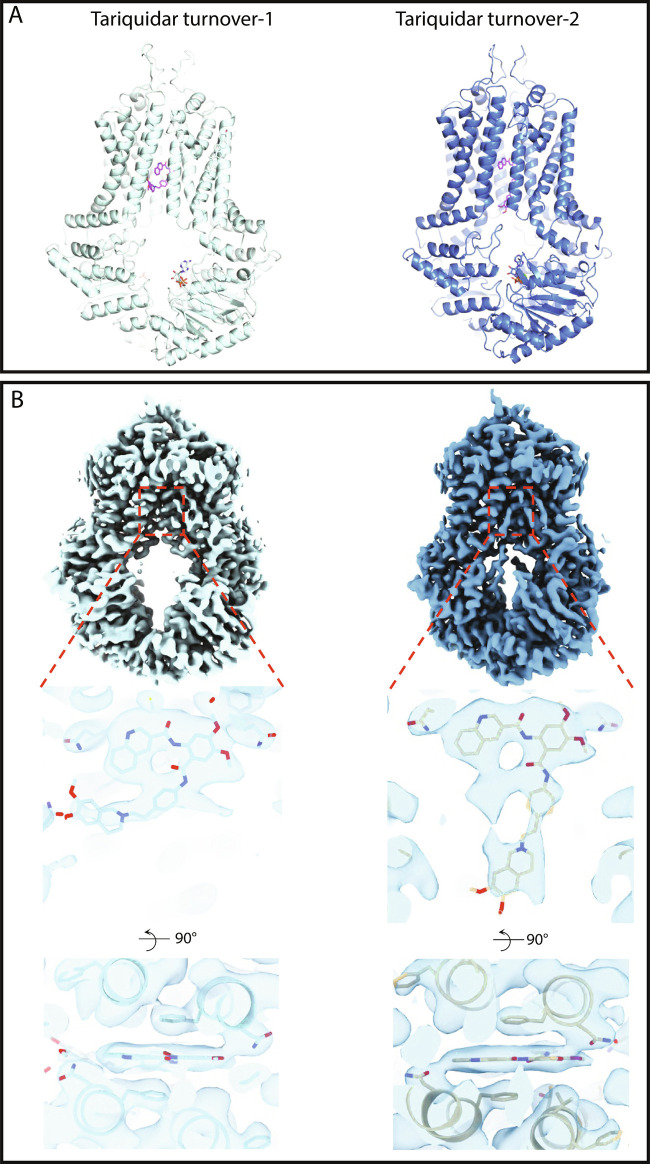
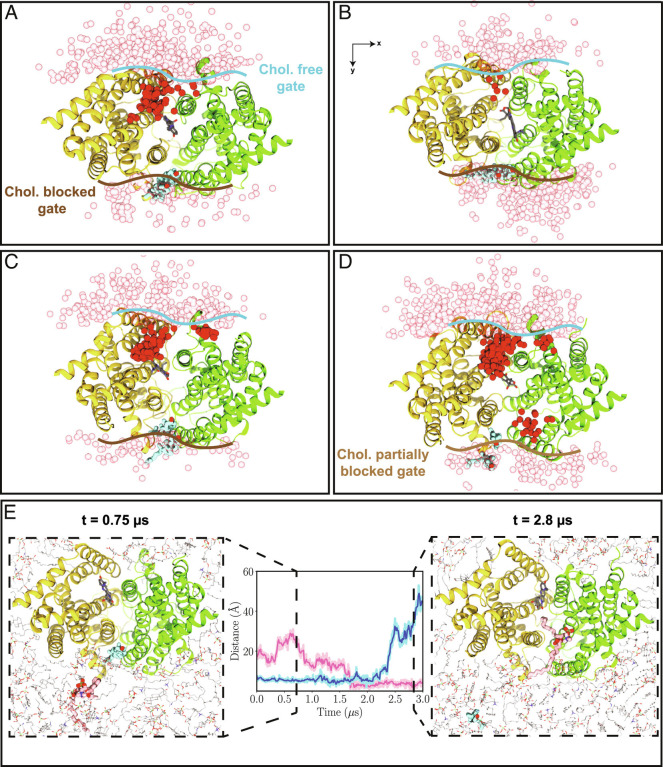
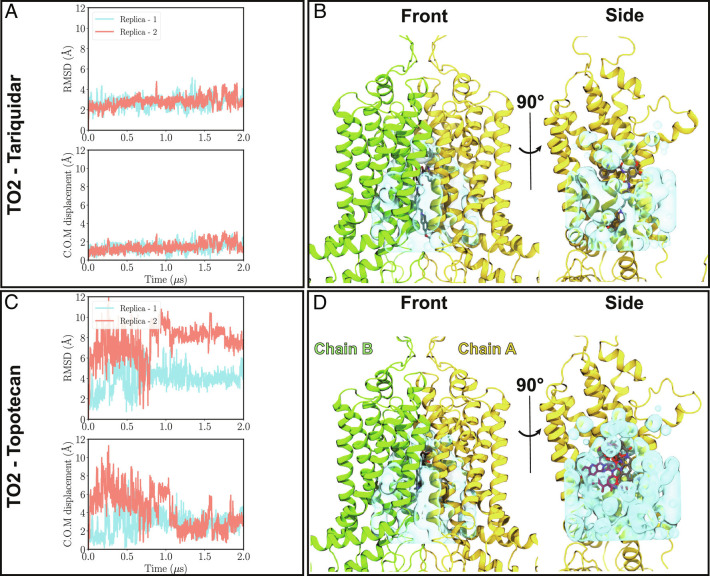
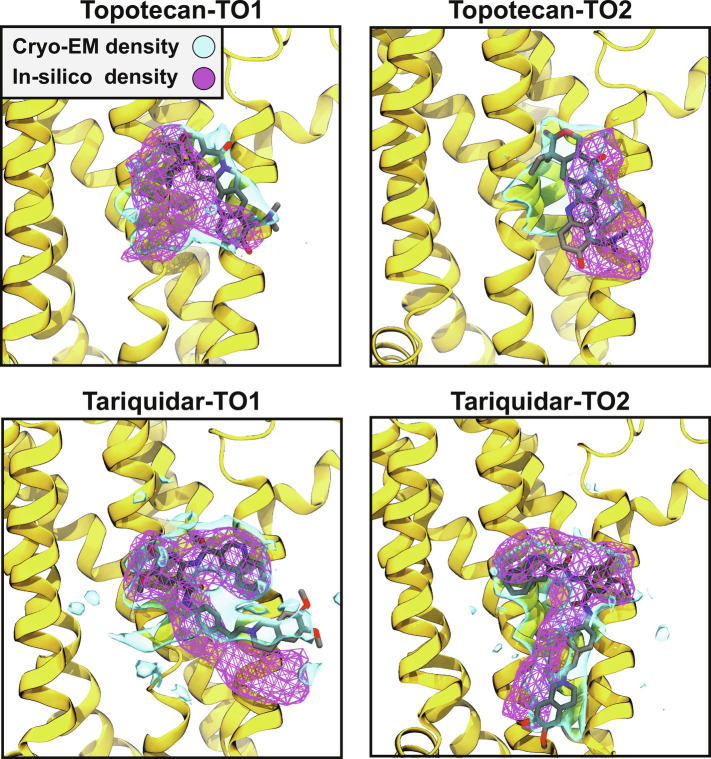
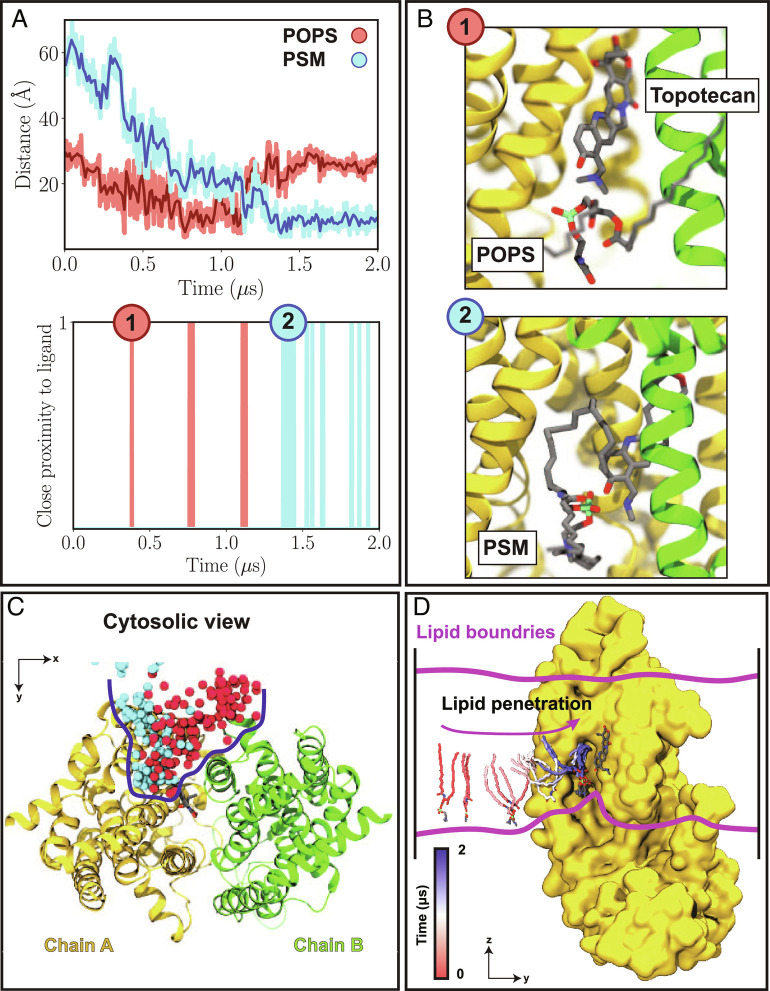
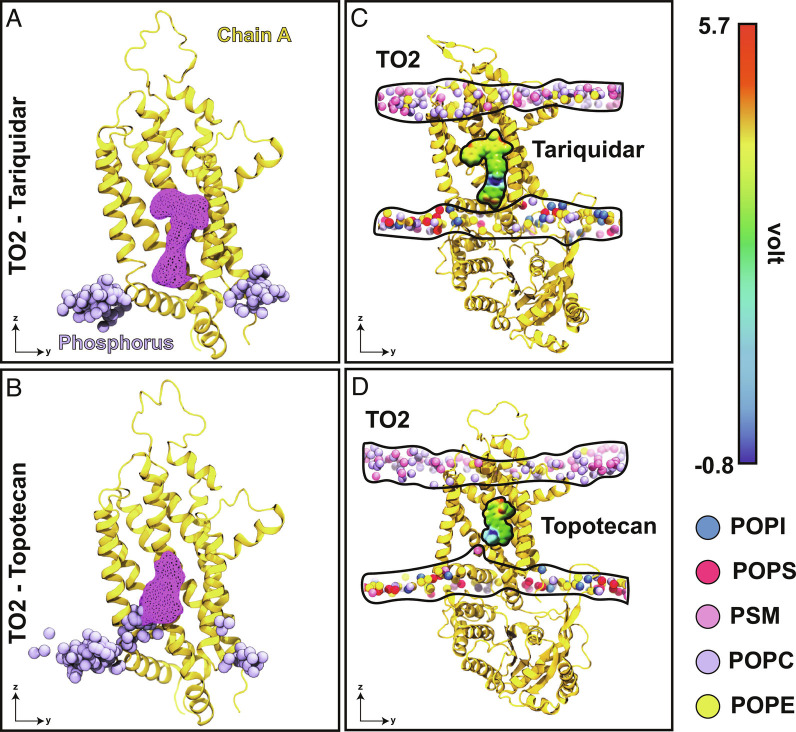
ABCG2 is an ATP-binding cassette (ABC) transporter that extrudes a wide range of xenobiotics and drugs from the cell and contributes to multidrug resistance in cancer cells. Following our recent structural characterization of topotecan-bound ABCG2, here, we present cryo-EM structures of ABCG2 under turnover conditions in complex with a special modulator and slow substrate, tariquidar, in nanodiscs. The structures reveal that similar to topotecan, tariquidar induces two distinct ABCG2 conformations under turnover conditions (turnover-1 and turnover-2). μs-scale molecular dynamics simulations of drug-bound and apo ABCG2 in native-like lipid bilayers, in both topotecan- and tariquidar-bound states, characterize the ligand size as a major determinant of its binding stability. The simulations highlight direct lipid-drug interactions for the smaller topotecan, which exhibits a highly dynamic binding mode. In contrast, the larger tariquidar occupies most of the available volume in the binding pocket, thus leaving little space for lipids to enter the cavity and interact with it. Similarly, when simulating ABCG2 in the apo inward-open state, we also observe spontaneous penetration of phospholipids into the binding cavity. The captured phospholipid diffusion pathway into ABCG2 offers a putative general path to recruit any hydrophobic/amphiphilic substrates directly from the membrane. Our simulations also reveal that ABCG2 rejects cholesterol as a substrate, which is omnipresent in plasma membranes that contain ABCG2. At the same time, cholesterol is found to prohibit the penetration of phospholipids into ABCG2. These molecular findings have direct functional ramifications on ABCG2's function as a transporter.
ABCG2 是一种 ATP 结合盒(ABC)转运蛋白,可将多种外源性物质和药物从细胞内排出,导致癌细胞的多药耐药性。在我们最近对拓扑替康结合的 ABCG2 进行结构表征之后,在这里,我们呈现了在纳米盘复合物中处于周转状态下与特殊调节剂和缓慢底物塔里奎达(tariquidar)结合的 ABCG2 的冷冻电镜结构。这些结构表明,与拓扑替康类似,塔里奎达在周转条件下诱导两种不同的 ABCG2 构象(周转-1 和周转-2)。在天然脂质双层中,对药物结合和apo ABCG2 进行微秒尺度的分子动力学模拟,在拓扑替康和塔里奎达结合状态下,将配体大小作为其结合稳定性的主要决定因素。这些模拟突出了较小的拓扑替康的直接脂质-药物相互作用,其表现出高度动态的结合模式。相比之下,较大的塔里奎达占据了结合口袋中大部分可用体积,因此几乎没有空间让脂质进入腔并与之相互作用。同样,当在 apo 内向开放状态下模拟 ABCG2 时,我们也观察到磷脂自发渗透到结合腔中。捕获到的磷脂进入 ABCG2 的扩散途径提供了一种从膜中直接招募任何疏水性/两亲性底物的可能一般途径。我们的模拟还表明,ABCG2 拒绝胆固醇作为底物,而胆固醇在含有 ABCG2 的质膜中普遍存在。同时,发现胆固醇会阻止磷脂渗透到 ABCG2 中。这些分子发现对 ABCG2 作为转运蛋白的功能具有直接的功能影响。