Mehta Aashna, Cheng Ng Jyi, Andrew Awuah Wireko, Huang Helen, Kalmanovich Jacob, Agrawal Aniket, Abdul-Rahman Toufik, Hasan Mohammad Mehedi, Sikora Vladyslav, Isik Arda
University of Debrecen-Faculty of Medicine, Debrecen, 4032, Hungary.
Faculty of Medicine and Health Sciences, University of Putra Malaysia, Serdang, Malaysia.
Ann Med Surg (Lond). 2022 Nov 1;84:104803. doi: 10.1016/j.amsu.2022.104803. eCollection 2022 Dec.
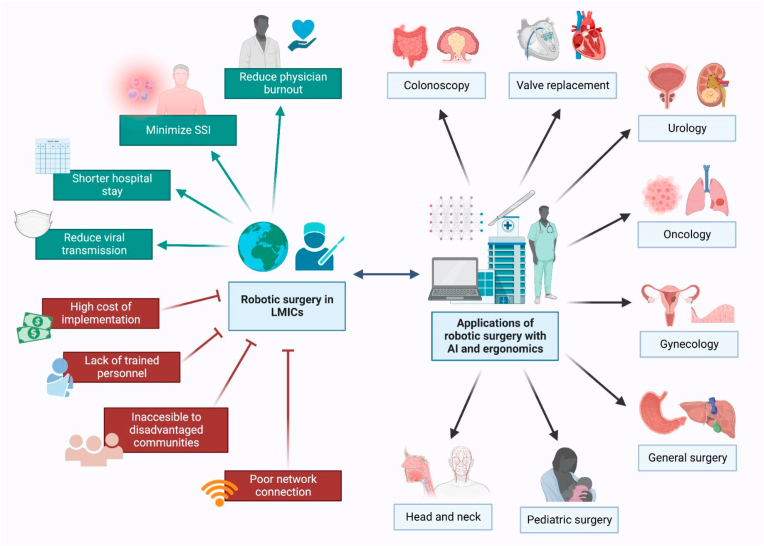
Robotic surgery has applications in many medical specialties, including urology, general surgery, and surgical oncology. In the context of a widespread resource and personnel shortage in Low- and Middle-Income Countries (LMICs), the use of robotics in surgery may help to reduce physician burnout, surgical site infections, and hospital stays. However, a lack of haptic feedback and potential socioeconomic factors such as high implementation costs and a lack of trained personnel may limit its accessibility and application. Specific improvements focused on improved financial and technical support to LMICs can help improve access and have the potential to transform the surgical experience for both surgeons and patients in LMICs. This review focuses on the evolution of robotic surgery, with an emphasis on challenges and recommendations to facilitate wider implementation and improved patient outcomes.
机器人手术在许多医学专科中都有应用,包括泌尿外科、普通外科和外科肿瘤学。在低收入和中等收入国家(LMICs)普遍存在资源和人员短缺的情况下,手术中使用机器人可能有助于减少医生倦怠、手术部位感染和住院时间。然而,缺乏触觉反馈以及诸如高昂的实施成本和缺乏训练有素的人员等潜在社会经济因素可能会限制其可及性和应用。专注于为低收入和中等收入国家提供更好的财政和技术支持的具体改进措施,有助于改善可及性,并有可能改变低收入和中等收入国家外科医生和患者的手术体验。本综述聚焦于机器人手术的发展历程,重点关注促进更广泛应用和改善患者预后的挑战与建议。